Paired Donation Options: Guest Blogger, Martha Gershun

I am very pleased to share this space with a fellow living donor/donation advocate (BTW, her excellent book, Kidney to Share, belongs on your bookshelf right next to The Insider’s Guide to Living Kidney Donation).

Beyond direct donation: what if your friends and family don’t match?

September 28, 2023

By Martha Gershun, Guest Blogger 

As a living kidney donor, I often hear from people who have recently been diagnosed with End Stage Renal Disease (ESRD) or have a relative who is a kidney patient.  These patients have usually been given little information about the advantages of living kidney donation and almost no guidance on how to maximize their chances of finding a donor.  Many providers, who are highly experienced in the medical and surgical aspects of the procedure, have limited resources to help patients implement a successful donor search.  Not surprisingly, they do not tell patients that other transplant centers may have a model that offers a better chance of finding them a kidney.

Family and friends often want to help, but finding a match can be hard. Even close biological relatives, such as siblings, may not match.  The odds of a potential donor matching with a non-biological relative or friend can range from 1 in 100 to 1 in 100,000, depending on the patient’s blood type and other immunological markers. Upwards of one-third of willing donors are not compatible matches for their intended recipients.

There are several ways these generous people can still donate to benefit their designated kidney patient.

Many transplant clinics manage their own databases to form kidney pairs or chains, putting together a prospective donor/recipient pair with another donor/recipient pair (or multiple pairs in the case of kidney chains) to form matches.  These heroic efforts can result in several transplants over a very short period of time.  However,  they rely on the hospital to find these matches within their own patient population.

There are also national nonprofits that work to find matches across hospital systems for pair or chain exchanges, significantly expanding the set of possible donors.  The largest of these organizations, the National Kidney Registry (NKR) lists thousands of potential donors. If a kidney patient has a willing donor who is not a match, that person can donate through the National Kidney Registry to generate a voucher, which allows the patient they intend to benefit to receive a matching kidney from someone else on the Registry.  Often these vouchers are “redeemable” within weeks or months, allowing the intended kidney patient to receive a new kidney very quickly.

The National Kidney Registry also has a program called Donor Shield, which provides a multitude of benefits to the donor, including reimbursement for travel, lodging, and dependent care; reimbursement for lost wages; the possible opportunity to donate at a hospital closer to home; home blood draws; and significant support beginning with the medical and psychological evaluation for all prospective donors and extending past the surgery.

Participating in the National Kidney Registry requires the patient to be listed at one of the 102 Transplant Clinics that are paying members of the National Kidney Registry.

The Alliance for Paired Kidney Donation (APKD) does similar work, facilitating paired or chain exchanges through its network of transplant clinics in 24 states. Donors who donate as part of an APKD kidney exchange are eligible for a robust package of support and protections that include wage reimbursement; travel expense reimbursement; and donor and companion life, disability, and complication insurance.  Non-directed donors also receive APKD’s KidneyPledge, which comes in several forms, including an Advanced Donor Pledge, which will provide the opportunity to participate in an APKD kidney exchange for one named individual with known kidney disease, for the life of the named individual.

The benefits to this process are so significant – for the patient, who will likely find a living donor much faster, and for their donor, who will have the benefits of NKR’s Donor Shield or APKD’s KidneyPledge, that I encourage kidney patients to seek out a transplant clinic that is affiliated with one of these nonprofits, even if they are already listed elsewhere or have to travel to do so.

Finding a living donor can be difficult, but staying creative, flexible, and persistent can make it easier.


Martha Gershun is a nonprofit consultant and writer living in Fairway, KS with her husband Don Goldman. Her most recent book, Kidney to Share (Cornell University Press, 2021), with co-author John Lantos, MD, details her experience donating a kidney at the Mayo Clinic to a woman she read about in the newspaper. Gershun serves on the Expert Advisory Panel for the Kidney Transplant Collaborative and serves on the Board of the National Kidney Foundation Serving Kansas, Oklahoma, and Western Missouri.
A Week to Celebrate!

Last week was quite a memorable one, jam-packed with kidney-donation milestones and special events.

First, on  June 27, my husband, son/recipient Paul, and I marked kidneyversary no. 17 with our traditional celebratory dinner out (no, no special cakes–we save those for biggies like nos. 10 and 15).

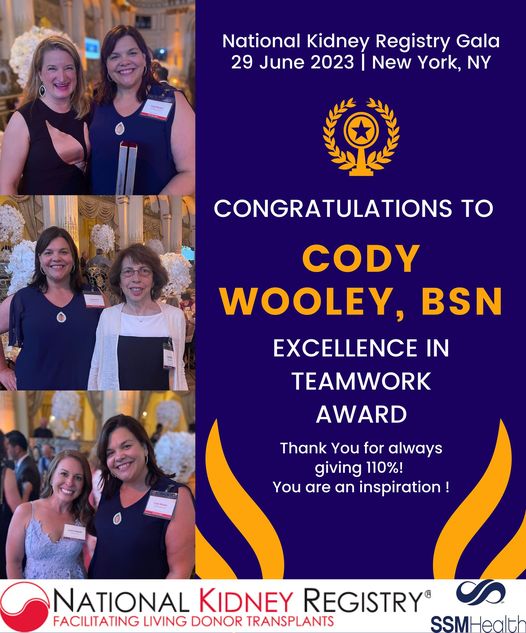
Next, two days later found me in New York City at—of all places!—the Plaza. The occasion was the lavish National Kidney Registry Awards Gala honoring living donors, with a champagne reception followed by a delicious sit-down dinner in a gorgeous hotel ballroom.

I was one of more than a hundred living donors, plus donation professionals, attending from all over the country. One of the dedicated professionals I got to chat with was Cody Wooley, a very engaging donor coordinator from St. Louis University Nephrology Division. Cody was actually one of the professionals honored, and I was delighted to have my photo taken with her before she received the award.

NKR is the world’s largest paired-exchange (aka “kidney swap”) program. Founder/CEO Garet Hil (a living donor himself) started the nonprofit following his family’s desperate search for a matching kidney for his young daughter in 2007.

Since then NKR has facilitated more than 7,000 living donations.Its goal is to increase and improve living donation while removing all the disincentives to being a donor. Here are just a few of the “what ifs” that NKR has successfully addressed, largely through its Donor Shield protections:

… a family member later needs a kidney at some unknown date? Living donors can receive a voucher for their intended recipient to get a kidney months or even many years later.

… I can’t afford the lost wages and extra childcare costs while I’m recovering? Donor Shield reimburses donors up to $17,000 (up to $12,000 for lost wages and up to $5,000 for travel/lodging and dependent care costs).

—I need a kidney transplant myself one day? Living donors through NKR have priority for a living kidney should they ever need one. (Note: Of the 7,000-plus living donations it’s facilitated, NKR has never had a donor need one.)

In addition to the dinner and the impressive stats, the evening included dramatic video presentations on (and talks by) super-athlete living donors who have done multiple marathons, ultramarathons, and summit climbs. The memorable takeaway, of course, is that donating a kidney does not mean a change in an active lifestyle. Full disclosure: most living donors are more like you or me (a healthy daily walker/zumba fan) than an ultramarathoner–but the point is that those who were runners or swimmers or whatever before donation can certainly continue to exercise their passion (other than contact sports) with just one kidney.

Then, on June 30, I attended the National Kidney Donation Organization‘s living donation symposium. There I learned so much exciting new information about kidney transplants that I’ll cover it in a separate post. Stay tuned!

For related posts, resources, and information on The Insider’s Guide to Living Kidney Donation, be sure to explore the rest of my website.

Active Athletes, Artists, Academics All Illustrate After-Transplant Benefits

Riddle: What has three transplanted organs and works full time in a demanding, important career into her seventies?

Answer: Elizabeth (Betsy) Crais, my co-author and friend–the academic energizer bunny–whose retirement party I just attended at the University of North Carolina at Chapel Hill.

Betsy Crais (right, looking the picture of heath) had a kidney transplant in 2004 and a kidney-liver transplant in 2021.

In addition to her regular responsibilities as a professor and researcher, Betsy has taken on numerous roles such as leading a professional association, mentoring students, writing for publication, and more.

Impressive with or without a transplant! It occurred to me that you’ve probably seen stories about athletes who are transplant recipients and have gone back onto the court (Alonzo Mourning went on to win an NBA championship) or singers who’ve gone back on tour or into the studio (think Stevie Wonder), or actors who’ve gone back onto the stage or film set (think Selena Gomez).

But there are many more professors, researchers, contractors, plumbers, lawyers, gardeners–people you pass unknowingly throughout your day–who have been able to lead a full, productive, and rewarding life thanks to an organ donor. It may have even been a living donor (Betsy’s first kidney transplant was from a university colleague friend) or a deceased one (Betsy’s second was a dual kidney and liver transplant from a deceased donor).

Organ transplants give recipients like my son, Paul, a second–sometime a third or more–chance at a full life. If you’re not already registered as an organ donor, please take a couple of minutes to sign up (at organdonor.gov or many other sites).

For related posts, resources, and information on The Insider’s Guide to Living Kidney Donation, be sure to explore the rest of my website.

Alonzo Mourning had a kidney transplant in 2003, returned to the court in 2004, and helped win an NBA championship with the Miami Heat in 2006.
Paul Offen (my son/recipient) had his kidney transplant in 2006.
Actress/singer Selena Gomez had a kidney transplant in 2017.

Stevie Wonder had his kidney transplant at the end of 2019.

Why NOT Donate Life?

As you surely know by now, April is National Donate Life Month. The vast majority of my posts, naturally, are about living donation and transplant and kidneys. I haven’t written much about the more well known topic of organ donation—that is, after death. It’s one of those subjects that make some people uncomfortable (I was one of them, when I was young).

That said, I’m going to give it a try anyway and hope that you’ll keep reading. No matter what I’m writing about, you may have noticed by now, I prefer a light touch and maybe go for a smile or two. So I’m not going to berate anyone who’s not already signed up to be a donor. And I’m not going to drone on about how important it is and how it’s our duty to our community yada yada. You already know that, right? (If not, I might note that more than 100,000 people are waiting for a lifesaving organ in this country—most of them for a kidney—and about 17 people die each day because they didn’t get one in time.)

So what am I going to do here? I’m just going to ask a few simple questions:

1-What percentage of people in this country do you suppose die in a way that even makes it possible for their organs to be donated?

2-If a registered organ donor is dying in a hospital, do you imagine that the doctors and nurses will throw in the towel that much sooner?

3-Are you afraid you might not be “completely dead” when they get ready to recover your organs?

Answers:

  1. Less than 1% (If you’re stunned by that news, you’re not alone. Years ago my guess would have been less than half, but maybe 20% or 30%, but I honestly had no idea.) In other words, the pool is very small.
  2. First of all, they don’t even know—or care—whether you’re a donor or not. Their only concern is saving you, their patient (remember “first, do no harm”?). Secondly, transplant teams don’t get involved until after death is pronounced. In fact, most deceased donors actually come from hospitals that don’t even have transplant centers.
  3. Lots of tests are done—even more than usual–to make absolutely sure that someone is in fact dead.

So, if you’ve read this far, thank you! If you weren’t already signed up, I hope this post has given you something to think about and maybe you’ll go to organdonor.gov–or any of a dozen or more sites (don’t wait to renew your driver’s license!)–to register. If you’re already registered, please share this post with others who may not be or who might know someone who would like to share it.

For related posts, resources, and information on The Insider’s Guide to Living Kidney Donation, be sure to explore the rest of my website.

Kidney Patient Summit on Capitol Hill

Yes, I finally made it! I made it all the way to the Capitol earlier this month for in-person meetings.

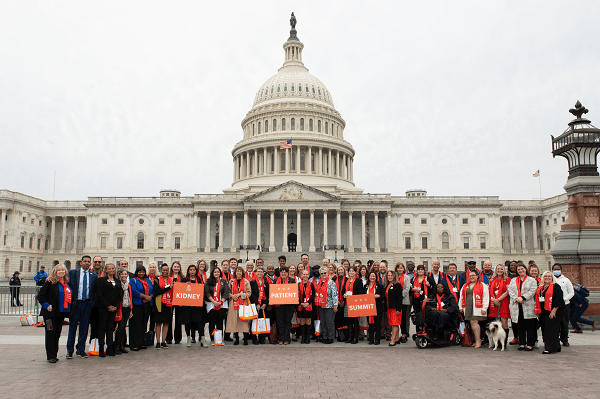
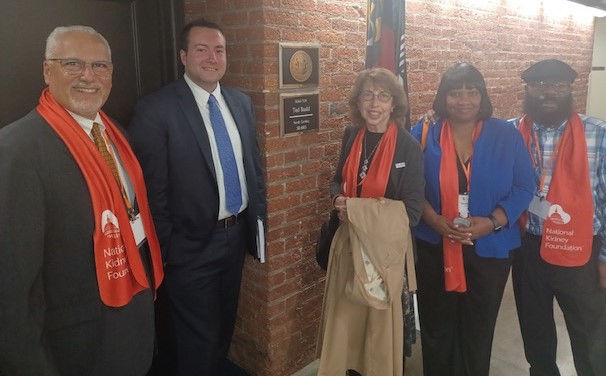
Taken during a brief break between legislative meetings. That’s me in the front row (in the beige raincoat)!
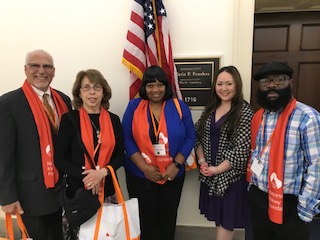
With teammates Necole and Dre Roundtree, left, and Alan Levy.
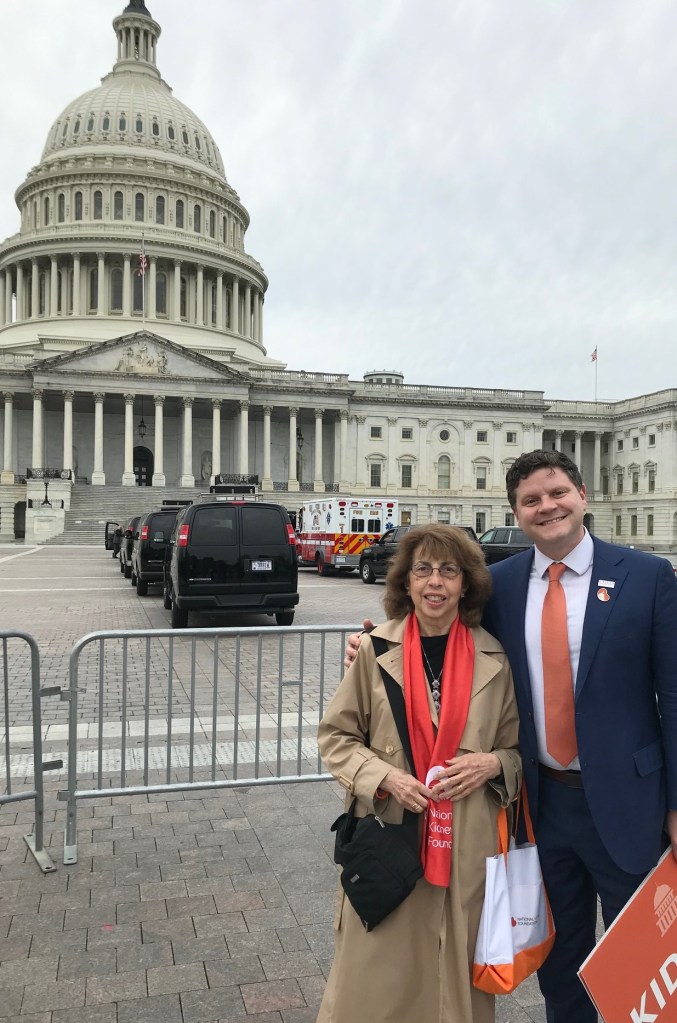
With Matthew Fitting, NKF’s Grassroots Advocacy Director.

During a hectic but fun afternoon of training and getting to know my delightful team members (pictured at right), we got tips not only on the legislative “asks,” but also on the fine points of meeting with congressional staffers. In fact, we even heard from two congressional staffers who knew the topics firsthand: one of them had been a National Kidney Foundation advocate himself, another was a recent living donor!

So what were our asks this time? Alas, if they look familiar that’s simply because we’ve been there before with the same critical requests:

1-Co-sponsor the Living Donor Protection Act (you’ve read a lot about this one both here and elsewhere through the years): To end discrimination by insurance companies against living donors just because of having donated a kidney.

2-Co-sponsor the Improving Access to Home Dialysis Act: A much newer piece of legislation, this would make it easier for those who want to do dialysis in their own home (right now only about 15% of people have dialysis at home because it’s not a simple matter–it requires training and support). The act would provide lots of in-home support for the first 90 days, among other benefits. This legislation would obviously be a boon for people in rural areas who may live well over an hour’s drive from the nearest dialysis center.

3-Support increases in funding for kidney research, innovation, and early detection. We asked for a substantial increase in funding for the CDC’s Chronic Kidney Disease Initiative plus increases on a par with other important diseases in the National Institutes of Diabetes, Digestive and Kidney Disease (NIDDK). While other major diseases have seen dramatic improvements in recent years, kidney disease outcomes, on the contrary, have gotten worse.

The team with Elizabeth Adkins, Rep. Foushee’s legislative. staffer.
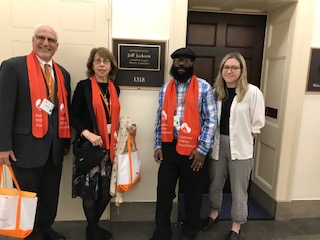
Our team with Laney O’Shea, Rep. Jeff Jackson’s staffer.
With Gray Rixey, Sen. Thom Tillis’s legislative staffer.
With Jacob Dunklin, Sen. Ted Budd’s legislative staffer.

National Foundation for Transplants, Trees, and Me

When I launched this website in early 2019, my goal was simple: to raise awareness of living donation by sharing my story of donating to my son, along with timely posts and practical resources to help donors and would-be donors–and anyone interested in supporting people with chronic kidney disease. I threw in a dose of self-deprecating humor because I’ve seen how well it helps information go down.

Photo by Syed Qaarif Andrabi on Pexels.com

I had no sense of how many people I could reach. The website’s following has certainly grown but continues to be a modest audience. And if I don’t spread the word on social media about each new post, far fewer people see it (after all, if a tree falls in the forest and there’s no one there to tweet about it, how in the world does anyone know it fell?).

So, I’m excited, honored (and downright tickled) to announce that the National Foundation for Transplants discovered my blog and wants to amplify the sound of the falling trees–I mean, blog posts!

NFT has asked me to be a guest contributor and run one of my posts once a month on its site. Partnering with such a large, respected organization to spread the word about the importance of living donation–all kinds–is a fantastic opportunity.

An individual donor advocate–particularly a nontech-savvy one like me–can’t hope to make much of an impact alone. Certainly, for government-related aims, having a major, moneyed organization behind you is essential. Being an active kidney advocate for the National Kidney Foundation, and to a lesser extent, a UNOS Ambassador, has been extremely gratifying.

But I’ve also wanted to reach out personally to potential donors because I believe that my story is more relatable than most: I donated to my son, not a stranger; our family had no history of kidney disease; and, maybe this most of all, I’m not an adventurous person, I’m a wimp (I faint at flu shots). And, for goodness sake, I’m no saint or heroine. Most anyone in my situation would have done the same if they could.

I hope that NFT can help me share my perspective and my insights with a wider audience. When you join forces with dedicated, like-minded people and organizations, anything’s possible. Thank you, NFT, for helping this donor advocate amplify her passionate but quiet voice.

For related posts and information on my new book, The Insider’s Guide to Living Kidney Donation, be sure to explore the rest of my website.

How’s Your State Doing on Donor Protection Measures?

In my last post I promised information about living donation-related protections and benefits, by state. As I mentioned, while awaiting passage of a federal Living Donor Protection Act, more than half of states now have their own version (28 at last count). In fact, like the one we’re supporting in North Carolina, some actually are more generous than the federal version (by including paid leave for state employees who donate).

United States Map With State Names Pdf Valid Printable Map Of | Printable Map Of The United States Pdf – Printable US Maps

But the LDPA is just one way that states can encourage living donation. Financial supports and job protections are other critical ones. Are you considering being a living donor, or have you donated recently? Do you know what the relevant tax provisions and protections are in your state–or in a state you may be looking at? It’s worth doing your homework.

The National Kidney Foundation has a terrific resource in a map you can click on to find out what donation-related laws and protections a particular state offers. Does it have a Living Donor Protection Act, or similar insurance-discrimination protections? Does it also have job-protected living donor leave for private employees? How about for state employees? What about paid leave? What about tax deductions? Even better, what about tax credits?

The American Kidney Fund website also features an invaluable resource: a state report card. It rates each state based on important donation-related measures and provides an overall rating on how well that state encourages living donation and removes barriers. Not surprisingly, only a few states merit an A: Arkansas, Connecticut, and Louisiana. Glad to see that more than a dozen at least get Bs, but nearly as many have Cs, a few get Ds (including, alas, North Carolina).

Unfortunately, nine states rate an F–that is, these states failed miserably because they have no donation-related measures in place: Alabama, Michigan, Montana, Nevada, New Hampshire, South Dakota, Tennessee, Vermont, and Wyoming.

The tragedy is that none of these donation measures is really controversial–they shouldn’t be so damn hard to pull off. They are simple, reasonable, common sense ways that a state can demonstrate its support for people who help save a life in this way. In fact, not only does encouraging living donation save lives, for kidney patients it reduces costs by reducing the number of people on dialysis (Medicare pays about $90,000 a year per dialysis patient).

With 106,000 people in this country on the national transplant waiting list (most of them needing a kidney), it seems that the very least we can do is remove the barriers to living donation.

For related posts and information on my new book, The Insider’s Guide to Living Kidney Donation, be sure to explore the rest of my website.

Contributor Spotlight: Doing All They Can to Help Donors Donate

Some of the most dedicated, ardent advocates of living donation I know are neither living donors nor transplant recipients themselves. That’s surely the case for these two contributors–Tammy Wright and Jenine Lewis–to our book, The Insider’s Guide to Living Kidney Donation.

For Tammy, who has helped donor and recipient pairs as a transplant coordinator for nearly 30 years at Sharp Memorial Hospital in San Diego, it’s a profession she deeply loves. For Jenine, who came ever so close to donating one of her own kidneys, it’s a passion and an avocation.

Tammy Wright, a veteran donor nurse coordinator.

You may think that once someone is approved as a donor, it means smooth sailing ahead and just depends on everyone’s schedule. Alas, that’s not the case for many donors and recipients. Even before COVID came along, life always had a way of throwing complications in people’s paths even when the stakes are frighteningly high.

Example? Recipient gets so sick before the scheduled transplant that it has to be postponed indefinitely. Or donor gets the flu and needs to reschedule. Or an overweight donor learns that he’s prediabetic and has to start an extended period of dieting and nutrition counseling. I could go on.

In Tammy’s book chapter, “Helping Overcome Transplant Obstacles,” she relates several daunting situations she has helped her patients navigate. Many of the creative solutions she draws on were not available when she started out in this profession (or even when I donated in 2006). Paired donation (kidney exchange), notably, often holds the answer to a donation problem, and Tammy’s chapter describes some pioneering efforts.

Tammy movingly relates how she’s worked–and cried–with patients at each new disappointment. Named “Nurse of the Year” at Sharp in 2020, Tammy is as modest as she is private. “I am pretty boring but love what I do and enjoy helping people get transplanted,” she says simply.

When she’s not working, Tammy enjoys being active in Transplant Trekkers, a nonprofit San Diego group dedicated to raising awareness of living organ donation. (She proudly admits also to being a dog lover.)

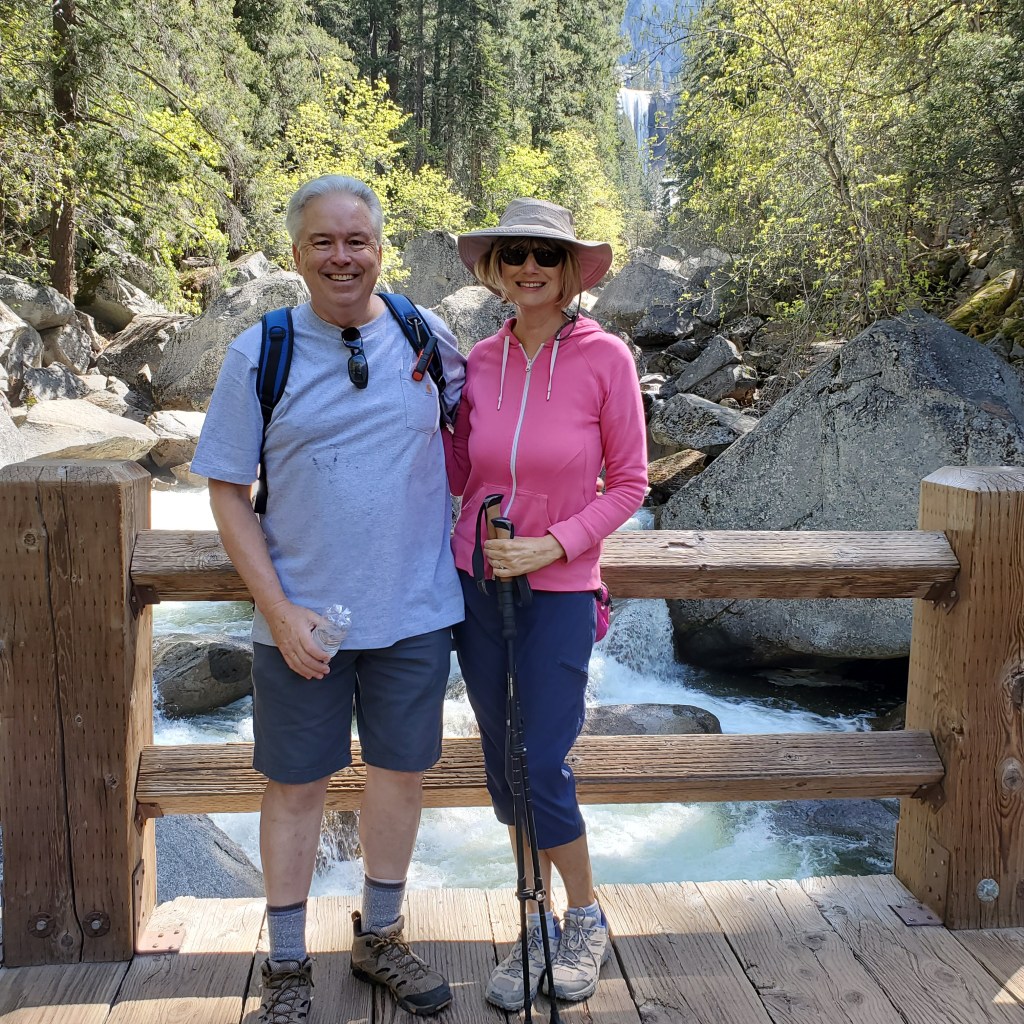
Jenine Lewis, a donation advocate, seen here at Yosemite National Park with her husband, Alan.

Like Tammy, Jenine is a San Diegan who does all she can to support living donation, through Transplant Trekkers. Jenine’s book chapter, “How a Would-be Donor Became an Advocate,” relates how she set out determined to donate her kidney to her good friend. After a very long, circuitous route, she finally got the green light for donor surgery in 2016 until…

We’ll let Jenine’s chapter tell what happened and why. Though she was initially heartbroken about not being able to gift her own kidney, Jenine says she soon learned that she could provide valuable help to other potential donors. She’s been an active volunteer in raising awareness of living organ donation in the San Diego area. She often counsels others who have been similarly disappointed and shows them how they can still help their intended recipient.

A youthful grandmother of three, Jenine enjoys hiking, as you can see from the photo. Obviously, Transplant Trekkers, which interestingly raises awareness of living organ donation through virtual, customized hikes, is a perfect fit.

Fun Fact: Transplant Trekkers is the (independent) re-creation of the original WELD (Women Encouraging Living Donation) San Diego group. WELD later teamed up with Donate Life America and added chapters around the country. It now accepts men, so the acronym officially stands for We Encourage Living Donation.)

Diane Brockington, herself a living donor and a tireless champion for living donation, founded WELD in 2015. She now leads the original San Diego group, which renamed itself the Transplant Trekkers. It was Diane who introduced me to WELD and all these impressive women.

Zooming into DC for a Unique Virtual Kidney Patient Summit

Instead of flying to Washington, DC, in March with other advocates for the National Kidney Foundation Kidney Patient Summit as planned pre-COVID, we Zoomed and Hopped in last week for virtual meetings on Capitol Hill. Admittedly, virtual was less of a kick than the real thing, but it was surprisingly effective in garnering cosponsors for important pieces of legislation.

I was excited to meet with members of Congress and/or their legislative staffers to share my personal story of donating to my son and to explain the importance of a few key pieces of long-overdue legislation: the federal Living Donor Protection Act (S511/HR1224), which prevents insurance companies from discriminating against donors (I’d earlier met with my state legislators about a state version); the Immunosuppressive Drug Coverage bill (S3353/HR5534), to safeguard a kidney recipient’s precious transplant by continuing coverage of antirejection meds for the life of the transplant, instead of cutting it off at 36 months for recipients not otherwise Medicare eligible.

Given that chronic kidney disease is so widespread–about 37 million Americans have it–and underdetected–the vast majority of them don’t know it yet–we’re also asking for funds for a new Kidney Risk Campaign.

“Are You the 33%?” is a simple quiz to help raise public awareness that one in three people in this country is at risk for kidney disease. Actor/advocate Wilmer Valderrama is helping to spread the word in both English and Spanish. The risk is particularly high among African Americans and Hispanics.

Perhaps the highlight of our eight meetings was the one with my long-time congressman, Rep. David Price, who has been very supportive of the kidney community. He’s been a cosponsor of the Living Donor Protection Act for a long time and just agreed to do the same for the Immuno Drug bill! If there’s an appropriations bill before year’s end, he was also receptive to supporting the Kidney Risk Campaign funds.

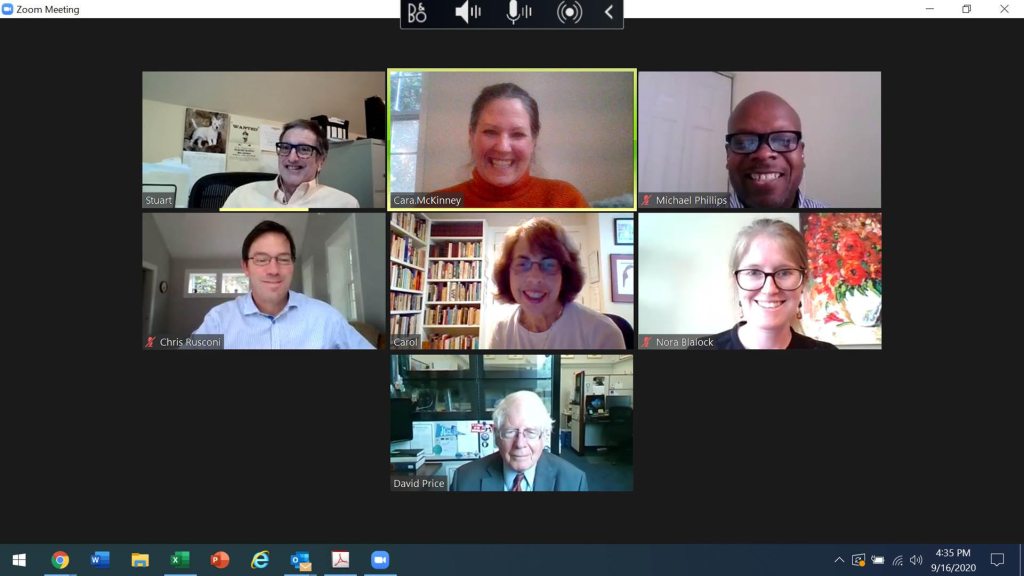
Here I am meeting with Rep. David Price, his legislative director, Nora Blalock–thank you both!–and my fellow NKF advocates.

I learned a lot and “met” a lot of interesting, extremely dedicated people, like my joint North Carolina-Georgia teammates pictured here: Stuart Miller (a transplant recipient who led our group) and Cara McKinney (NKF’s exec director for Georgia, Alabama, and Mississippi) from Georgia; and, from NC, Michael Phillips, a transplant recipient who survived COVID (sadly, 20 of his relatives also contracted it); and Chris Rusconi, chief research officer for the Polycystic Kidney Foundation, a fellow Triangle resident.

We raced from meeting to meeting by catching a Zoom. It was hectic but very gratifying (and my feet didn’t hurt one bit!). Afterward we compared the day’s highs and lows with other advocates. It all definitely whet my appetite for repeating this experience in person someday.