Help Is on the Way: HOLD Act Advances!

If you’ve never heard of the HOLD (Honor Our Living Donors) Act, I can assure you this is good news! Great news, in fact, for potential living donors, so, by extension, for potential kidney recipients. If this bill becomes federal law, the National Living Donor Assistance Center, or NLDAC, would consider only the donor’s income–not the recipient’s, too–when deciding whether to provide critical financial assistance and reimbursement to donors. Seems logical, don’t you think? And yet, for years, NLDAC has perversely considered both.

Photo by Nataliya Vaitkevich on Pexels.com

As a living donor to my son, I can tell you that the very idea of putting both potential donor and recipient in such an untenable position makes me want to scream. I explained more when I wrote about it here last fall when the bill was introduced.

Okay, but that was in November. What’s the great news?

Remember, now, this is federal legislation so everything moves very slowly (need I remind you about the Living Donor Protection Act?). That said, this particular bill has had bipartisan support, has already been referred to a committee (Energy and Commerce) and, last month, passed unanimously!

The HOLD Act now awaits consideration by the House as a whole. Please contact your member of Congress and urge him or her to lend support to the HOLD Act, HR 6020. If they are already sponsors or cosponsors, be sure to thank them!

For related posts and information on my book, The Insider’s Guide to Living Kidney Donation, be sure to explore the rest of my website.

HOLD Act = Aid for More Would-be Donors

If you’ve read any of my blog posts about financial assistance for living donors, you know that one of my pet peeves (boy, is that a euphemism!) is the practice of making aid for donors dependent on their recipient‘s income, as has been the policy through the federal National Living Donor Assistance Center (NLDAC).

So I was delighted to see a bipartisan piece of legislation introduced in Congress last month that would shift the emphasis and could directly lead to more people becoming living organ donors. The Honor Our Living Donors (HOLD) Act (H.R. 6020) would help more donors qualify for reimbursement from NLDAC for lost wages and travel and caregiving expenses–based on the donor’s own financial status. (Fortunately, there are currently other options–see my Resources section–but a federal assistance program needs to be available to everyone.)

Photo by rawpixel.com on Pexels.com

As the mother of my recipient, I know both sides of this very special relationship. We were fortunate that I was able to donate to my son. If that had not been possible, I can’t imagine the extra emotional and financial strain that trying to help a donor would have put on our family. The obvious potential for tension and discomfort (for both parties) inherent in this perverse system is not only unfair but also counterproductive. Thousands of lives are lost each year because so many patients’ potential donors decline to donate because of these obstacles.

If you want to help living donors–and thereby kidney patients–please contact your member of Congress now to help build support for this urgently needed bill (HR 6020). And if your representative happens to be either Rep. Jay Obernolte (R-Calif), who introduced the bill, or Rep. Suzan DelBene (D-WA), who cosponsored it–be sure to thank them.

For related posts and information on my book, The Insider’s Guide to Living Kidney Donation, be sure to explore the rest of my website.

Thanksgiving Dinners and Donors

Every Thanksgiving at my house, we go around the table after dinner and talk about what we’re each thankful for–a fairly typical American tradition that for us started when my adult kids were little kids.The usual topics come up, of course: being together, good health, good news, good food. Naturally, one not-so-typical topic also has come up every year for nearly two decades: kidneys. So I decided to devote this Thanksgiving blog post to kidneys and living donation.

Photo by Element5 Digital on Pexels.com

I’ll start. I am thankful for

  • my right kidney (aka Righty). My son, Paul, is thankful for my left (both are doing well, thanks). Righty has managed to give me what would be a solidly normal kidney function for someone my age with two kidneys–and she’s done it all alone!
  • the transplant team at the University of North Carolina Kidney Center that supported both of us skillfully and caringly throughout the donation and transplant process 16 and a half years ago.

So much has happened in the field of living donation since then, and prospective donors can now take advantage of options that didn’t practically exist in the early 2000s. So, even though my family didn’t benefit, I’m thankful that the recent donors I know and the would-be donors who have written to me in recent years can. Here are just a few of those options:

  • Paired donation—not around when I donated—enables someone who isn’t a match for their intended recipient to donate a kidney to someone else to enable their recipient to get another, better-matched one, when he or she needs it. Often they donate to someone they don’t know–a “nondirected donation.”
  • Expanded financial assistance for living donors–including nondirected ones–to cover lost wages and donation-related expenses like travel, childcare, and eldercare. In addition to organizations such as the National Kidney Registry and the Alliance for Paired Kidney Donation (see Resources), a big federal program that for many years covered only travel expenses–the National Living Donor Assistance Center (NLDAC)–has substantially expanded its financial assistance in the past couple of years. Thankfully, we managed without all that back then, but our situation was a best-case scenario in many ways.
  • State-level living donor protections in 28 states, offering benefits that range from basic job protections to paid leave for state employees to tax credits. The list is growing while the federal version gets tantalizingly close to passage.

Now it’s your turn. If kidneys and/or living donation is a big topic in your house too, you might want to reflect on these worthy items for thanks giving after you finish your pie. Happy Thanksgiving to you and yours!

For related posts, resources, and information on The Insider’s Guide to Living Kidney Donation, be sure to explore the rest of my website.

Another Donate Life Month Quiz

At the end of this special month, I came across a brief Donate Life Month Quiz I posted a few years back. Happy to see that it’s still accurate. I thought I’d add a few updates:

Photo by Olya Kobruseva on Pexels.com

1–To be a living kidney donor, you have to be (a) young, (b) a family member of the recipient, (c) brave, (d) all of the above, or (e) none of the above?

(a) Wrong. I was 58. In fact, more than a third of living donors are over 50.

(b) Wrong. Though the largest group of donors are indeed family members, unrelated donors are an increasingly large portion of living donors.

(c) Wrong. “Brave” is certainly not a word ever used to describe me! As a self-described wimp, I relied heavily on my supportive and caring transplant team, who did all they could to accommodate my needs and concerns. The experience proved to be much easier than I expected (certainly easier than childbirth!).

(d) Wrong.

(e) Bingo! Happily, none of the above.

2–To qualify for financial assistance from the National Living Donor Assistance Center, (a) a donor has to be related to the recipient, (b) you can’t be a nondirected (aka altruistic) donor, and (c) you and your recipient must be U.S. citizens.
All false. If you’re not U.S. citizens, however, both recipient and donor must be “lawfully present residents.” As I explained in my last post, NLDAC has greatly expanded its assistance for living donors, and more people qualify than ever before. Be sure to check out the guidelines.

For related posts and information on my new book, The Insider’s Guide to Living Kidney Donation, be sure to explore the rest of my website.

More Living Donors Could Get Financial Help!

High on the list of ways to encourage living donation (after educating people about living donation, of course) is to make the experience financially neutral. That is, not that live donors earn money for their organs (though some experts have made a case that that actually might be done efficiently and fairly)–only that no one lose money in trying to save someone’s life (I think we can all agree on that part).

Well, guess what? A major source of aid, the federally funded National Living Donor Assistance Center, says that about 70% of U.S. households meet its income requirements to apply for living-donor financial aid.

If you already know that the recipient’s insurance (including Medicare) covers the donor’s evaluation and surgery (and some major insurers now cover travel expenses), you might wonder why a donor would need additional financial assistance. Let’s consider all the things that often need to be in place for someone to donate–apart from a clean bill of health and matching-related issues.

1–What if a donor lives hundreds or even thousands of miles from the recipient’s transplant center? Transportation and lodging expenses for a few days of evaluation plus surgery and post-op time can add up pretty quickly. They can easily be a deal breaker.

2–What if a potential donor doesn’t have paid sick leave? Two to four weeks lost pay for recovery plus time off work for evaluation tests and appointments can be prohibitive. So, covering lost wages is crucial.

3–And what if the donor needs to pay for childcare or eldercare for those weeks? That could clearly tip the balance, so reimbursement of dependent care expenses is right up there too.

Fortunately, not all donors require all three of those essentials. Back when I donated to my son in 2006, we were lucky that the transplant center was right in our town, I had sufficient paid leave between my own plus my colleagues’ kind shares, and we had no dependent care expenses.

Photo by Pixabay on Pexels.com

But for people who do, any one of those factors could nix the idea for donors who are otherwise eligible. Such expenses can run into several thousand dollars. Happily, NLDAC grants, usually in the form of a prepaid credit card, are sizeable: up to a total of $6,000 per donor.

You can download guidelines and application forms from the NLDAC website. Funds are available only for those donors who have no other reimbursement options, be it insurance, state or federal funding, or (for me, this is the part that still rankles) the recipient’s funds. Both donor and recipient must provide income and asset information, but the recipient’s matters most. I guess the assumption is that recipients “should” reimburse their donor if need be.

True, if a recipient doesn’t meet the guidelines but says he or she can’t afford to reimburse the donor, there’s a hardship exception, requiring more paperwork. In other words, at a time of ill health, lost wages, and great family stress, the recipient is expected to prove that he or she can’t help the donor. Shouldn’t the donor’s income be the major factor if we want “to reduce the financial disincentives to living organ donation” (per NLDAC’s mission statement)?

NLDAC has been a major source of financial assistance for nonmedical aspects of donation for many years. Until late 2020, that assistance was mostly limited to travel and lodging, so as a donation advocate, I certainly applaud the major expansion.

NLDAC needs to get the word out so more potential donors can take advantage of this much-needed additional assistance. I’m happy to help. Please do pass it on!

For related posts and information on my new book, The Insider’s Guide to Living Kidney Donation, be sure to explore the rest of my website.

Happy World Kidney Day–with a shout-out to women!

March 12 is World Kidney Day, and it seems fitting to continue our theme of women and kidneys (two of my favorite subjects). In a recent post, I pointed out that neither gets the respect and attention they/we deserve. It’s mostly because most people just don’t know a whole lot about what they do: in the case of women, we hold up half the sky, as the African proverb says. And kidneys do much the same for the body, quietly keeping it functioning as it should, balancing nutrients, eliminating dangerous toxins, regulating fluids and salt content, promoting bone health. I could go on.

Now how do I tie this back to women, you ask? Let’s consider living kidney donors. Not surprisingly, most are women. When I participated in setting the Guinness World Record for largest gathering of living donors in April 2018, it was clear that the vast majority of us donors there were women. Now, it’s tempting to say that’s all due to our natural empathy and nurturing instincts. I do believe that’s partly responsible, but I know it’s more complicated than that.

For one thing, donating a kidney, like any major surgery, usually entails taking off work for at least a couple of weeks, if you have a sedentary job as I did (editor/writer). If you’re a laborer, however, because of a restriction on lifting anything over 10 pounds for about the first 6 weeks after surgery, that obviously could mean a lot longer interruption.

Donors who are lucky enough to have sufficient paid sick leave (or any at all) don’t have to worry about lost pay. But for anyone who doesn’t, that’s a major road block to being a live donor. The reality is that, in a lot of families, it’s still harder to get by without the man’s earnings. The National Living Donor Assistance Center has been offering much-needed financial help with travel and lodging costs for some donors who need to travel to their recipient’s transplant center. It’s a wonderful program, but it hasn’t covered lost pay and other uncovered expenses. Now there’s a plan to significantly expand that assistance to cover a donor’s lost pay and major “incidental” expenses like child care and elder care. But it needs a major boost in funding from the House Appropriations Committee. Please contact your representative and tell him or her to get behind this important effort. Helping living donors helps to save lives.

International Women’s Day…and Kidneys, of course

March 8 is International Women’s Day, so it seems fitting to continue our theme of women and kidneys (two of my favorite subjects). In my last post, I pointed out that neither gets the respect and attention they/we deserve. It’s mostly because most people just don’t know a whole lot about what they do: in the case of women, we hold up half the sky, as the African proverb says. And kidneys do much the same for the body, quietly keeping it functioning as it should, balancing nutrients, eliminating dangerous toxins, regulating fluids and salt content, promoting bone health. I could go on.

Now how do I tie this back to women, you ask? Let’s consider living kidney donors. Not surprisingly, most are women. When I participated in setting the Guinness World Record for largest gathering of living donors last April, it was clear that the vast majority of us donors there were women. Now, it’s tempting to say that’s all due to our natural empathy and nurturing instincts. I do believe that’s partly responsible, but I know it’s more complicated than that. (For one thing, in the case of the Guinness event in Chicago, many of us needed to be able to afford a trip halfway across the country.) More important, donating a kidney, like any major surgery, usually entails taking off work for at least a couple of weeks, if you have a sedentary job as I did (editor/writer). If you’re a laborer, however, because of a restriction on lifting anything over 10 pounds for about the first 6 weeks after surgery, that obviously could mean a lot longer interruption.

Donors who are lucky enough to have sufficient paid sick leave (or any at all) don’t have to worry about lost pay. But for anyone who doesn’t, that’s a major disincentive to be a live donor. The reality is that, in a lot of families, it’s still harder to get by without the man’s earnings. The National Living Donor Assistance Center has been offering much-needed financial help with travel and lodging costs for donors who need to travel to their recipient’s transplant center. It’s a wonderful program, but it doesn’t cover lost pay. Now there’s a growing movement in Congress, spearheaded by Reps. Jaime Herrera-Beutler and Matthew Cartwright, to expand that assistance to cover lost pay. Contact your representative and tell him or her to get behind this important effort!

                                       *                                                     *                                          

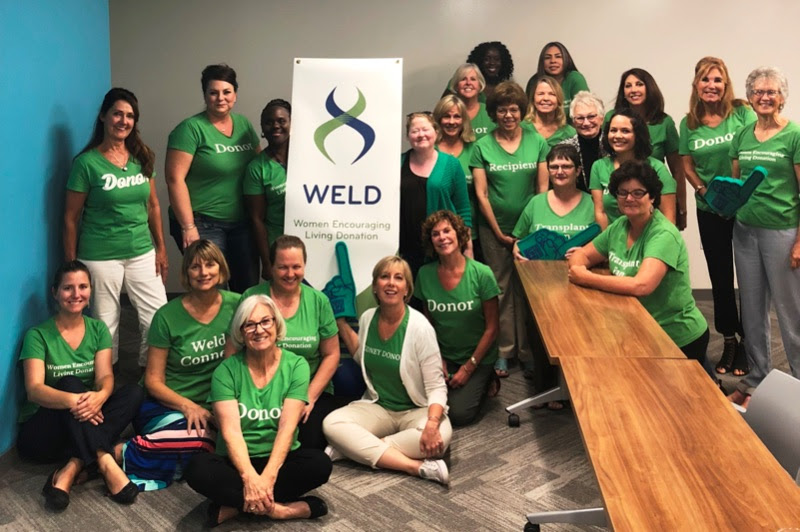
Have you ever heard of WELD (spoiler: it has nothing to do with welding)? It stands for Women Encouraging Living Donation.  I’m guessing you’re going to start hearing more about it as this terrific organization grows. I recently went to my first meeting of its fledgling NC site. It was a kick, as always, to meet other women who’ve donated, are in the process of donating, or touched by donation and transplant in some way, whether personally or professionally.

The main WELD group started in 2015 in San Diego. It’s composed of dedicated living kidney donors, transplant recipients, transplant surgeons, nephrologists, nurse coordinators, transplant social workers, volunteer advocates—all women. WELD started as an offshoot of the John Brockington Foundation, founded by John and Diane Brockington. Diane donated her kidney to John, an ex-football star, in 2001, and they later married. Today the Foundation provides financial assistance and education resources to donors and recipients in the San Diego area. Meanwhile, WELD, led by Diane, actively encourages living donation through in-home presentations, one-on-one mentoring, billboards, and support of public events.

I heard about the San Diego organization more than a year ago and was excited to learn that they were exploring branching out. They’ve teamed up with Donate Life, which promotes organ donation (after death). Deceased donation alone can’t meet the need for organs—nearly 100,000 Americans are on waiting lists for a kidney, for example, and only about 20,000 transplants are performed each year. So, WELD—and other groups promoting living donation—hope to bridge that gap. I’m so happy to be a part of their efforts.