Paired Donation Options: Guest Blogger, Martha Gershun

I am very pleased to share this space with a fellow living donor/donation advocate (BTW, her excellent book, Kidney to Share, belongs on your bookshelf right next to The Insider’s Guide to Living Kidney Donation).

Beyond direct donation: what if your friends and family don’t match?

September 28, 2023

By Martha Gershun, Guest Blogger 

As a living kidney donor, I often hear from people who have recently been diagnosed with End Stage Renal Disease (ESRD) or have a relative who is a kidney patient.  These patients have usually been given little information about the advantages of living kidney donation and almost no guidance on how to maximize their chances of finding a donor.  Many providers, who are highly experienced in the medical and surgical aspects of the procedure, have limited resources to help patients implement a successful donor search.  Not surprisingly, they do not tell patients that other transplant centers may have a model that offers a better chance of finding them a kidney.

Family and friends often want to help, but finding a match can be hard. Even close biological relatives, such as siblings, may not match.  The odds of a potential donor matching with a non-biological relative or friend can range from 1 in 100 to 1 in 100,000, depending on the patient’s blood type and other immunological markers. Upwards of one-third of willing donors are not compatible matches for their intended recipients.

There are several ways these generous people can still donate to benefit their designated kidney patient.

Many transplant clinics manage their own databases to form kidney pairs or chains, putting together a prospective donor/recipient pair with another donor/recipient pair (or multiple pairs in the case of kidney chains) to form matches.  These heroic efforts can result in several transplants over a very short period of time.  However,  they rely on the hospital to find these matches within their own patient population.

There are also national nonprofits that work to find matches across hospital systems for pair or chain exchanges, significantly expanding the set of possible donors.  The largest of these organizations, the National Kidney Registry (NKR) lists thousands of potential donors. If a kidney patient has a willing donor who is not a match, that person can donate through the National Kidney Registry to generate a voucher, which allows the patient they intend to benefit to receive a matching kidney from someone else on the Registry.  Often these vouchers are “redeemable” within weeks or months, allowing the intended kidney patient to receive a new kidney very quickly.

The National Kidney Registry also has a program called Donor Shield, which provides a multitude of benefits to the donor, including reimbursement for travel, lodging, and dependent care; reimbursement for lost wages; the possible opportunity to donate at a hospital closer to home; home blood draws; and significant support beginning with the medical and psychological evaluation for all prospective donors and extending past the surgery.

Participating in the National Kidney Registry requires the patient to be listed at one of the 102 Transplant Clinics that are paying members of the National Kidney Registry.

The Alliance for Paired Kidney Donation (APKD) does similar work, facilitating paired or chain exchanges through its network of transplant clinics in 24 states. Donors who donate as part of an APKD kidney exchange are eligible for a robust package of support and protections that include wage reimbursement; travel expense reimbursement; and donor and companion life, disability, and complication insurance.  Non-directed donors also receive APKD’s KidneyPledge, which comes in several forms, including an Advanced Donor Pledge, which will provide the opportunity to participate in an APKD kidney exchange for one named individual with known kidney disease, for the life of the named individual.

The benefits to this process are so significant – for the patient, who will likely find a living donor much faster, and for their donor, who will have the benefits of NKR’s Donor Shield or APKD’s KidneyPledge, that I encourage kidney patients to seek out a transplant clinic that is affiliated with one of these nonprofits, even if they are already listed elsewhere or have to travel to do so.

Finding a living donor can be difficult, but staying creative, flexible, and persistent can make it easier.


Martha Gershun is a nonprofit consultant and writer living in Fairway, KS with her husband Don Goldman. Her most recent book, Kidney to Share (Cornell University Press, 2021), with co-author John Lantos, MD, details her experience donating a kidney at the Mayo Clinic to a woman she read about in the newspaper. Gershun serves on the Expert Advisory Panel for the Kidney Transplant Collaborative and serves on the Board of the National Kidney Foundation Serving Kansas, Oklahoma, and Western Missouri.

Word of the Day: “Eplets”

As I wrote last week, I recently was very fortunate to attend two memorable donation-related events in New York City. Between the National Kidney Registry Awards Gala and the National Kidney Donation Organization‘s living kidney donation symposium, I heard fascinating research updates, applauded impressive awards and presentations by dedicated donation advocates, and learned so much.

I met and talked with people I admire and felt an immediate bond with. That held true from the first person I met when I sat down to breakfast at the NKDO symposium, held at the New York City Bar Association–a woman in a Kidney Donor Athletes tee shirt, who said she knew me from this website(!)–to the last person I met, after they’d closed the building and people were lingering outside: a donor/writer who started a nonprofit, Rock1Kidney, and was clearly moved when I talked about being at the Guinness Records gathering of living donors at the Bean.

It always takes time to digest all the new information and remarks, and invariably one or two strong takeaways emerge. This time it was a single word and dramatic new concept for me: eplets. They’re the key to what NKR calls the “Kidney for Life Initiative.”

It turns out that compatibility is way more nuanced than I ever imagined. You may have heard about HLA antigens (you know, the 6-out-of-6 match being the so-called “perfect match”?) . Well, apparently, “matching” antigens may look the same, but they differ by their eplet pattern (think of them as “immunologic hot spots”).

Photo by Pixabay on Pexels.com

Fair warning: I am not a transplant surgeon, a scientist, or a medical writer, so please do not quote me on this. Rather, use the occasion to go ask someone who is–or, better yet, google Kidney for Life.

Dr. Dorry Segev, NYU Langone transplant surgeon (photo by Carol Offen)

I’d seen the word eplet on charts and even heard it referenced at the NKR Gala presentations. I got the basic gist from the context, but it wasn’t until Dorry Segev, transplant surgeon at NYU Langone, explained it so well at the symposium that I “got it.” From what I understand, it’s time that potential donors and transplant recipients started using the term, as in “Do you test for eplets?”

Yup, Dr. Segev says “everyone should ask” that before a donation/transplant, so be sure to add it to your list of questions. Not all transplant centers do the necessary “high-resolution typing” that can see how many eplets are in the antigens. The number of eplet mismatches can make the difference between a kidney transplant that starts to deteriorate months later, and leads to rejection, and one that can conceivably last “for life,” requiring a lower level of immunosuppressants.

Wow–what a potential game changer! Though “eplets” are new to me, and probably to you, they’re hardly new to transplant professionals, who have been studying this “latest generation in DNA sequencing technology” (per the NKR website) for years. Dr. Segev thinks that within about five years, we’ll all be talking about eplets. I know I will and I hope you will too.

For related posts, resources, and information on The Insider’s Guide to Living Kidney Donation, be sure to explore the rest of my website.

A Week to Celebrate!

Last week was quite a memorable one, jam-packed with kidney-donation milestones and special events.

First, on  June 27, my husband, son/recipient Paul, and I marked kidneyversary no. 17 with our traditional celebratory dinner out (no, no special cakes–we save those for biggies like nos. 10 and 15).

Next, two days later found me in New York City at—of all places!—the Plaza. The occasion was the lavish National Kidney Registry Awards Gala honoring living donors, with a champagne reception followed by a delicious sit-down dinner in a gorgeous hotel ballroom.

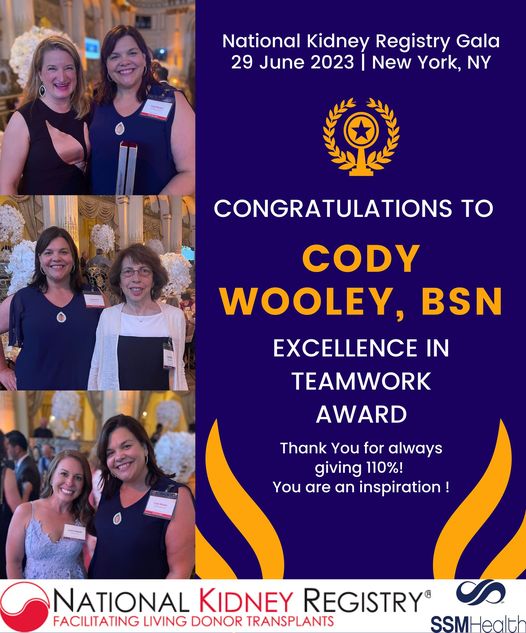
I was one of more than a hundred living donors, plus donation professionals, attending from all over the country. One of the dedicated professionals I got to chat with was Cody Wooley, a very engaging donor coordinator from St. Louis University Nephrology Division. Cody was actually one of the professionals honored, and I was delighted to have my photo taken with her before she received the award.

NKR is the world’s largest paired-exchange (aka “kidney swap”) program. Founder/CEO Garet Hil (a living donor himself) started the nonprofit following his family’s desperate search for a matching kidney for his young daughter in 2007.

Since then NKR has facilitated more than 7,000 living donations.Its goal is to increase and improve living donation while removing all the disincentives to being a donor. Here are just a few of the “what ifs” that NKR has successfully addressed, largely through its Donor Shield protections:

… a family member later needs a kidney at some unknown date? Living donors can receive a voucher for their intended recipient to get a kidney months or even many years later.

… I can’t afford the lost wages and extra childcare costs while I’m recovering? Donor Shield reimburses donors up to $17,000 (up to $12,000 for lost wages and up to $5,000 for travel/lodging and dependent care costs).

—I need a kidney transplant myself one day? Living donors through NKR have priority for a living kidney should they ever need one. (Note: Of the 7,000-plus living donations it’s facilitated, NKR has never had a donor need one.)

In addition to the dinner and the impressive stats, the evening included dramatic video presentations on (and talks by) super-athlete living donors who have done multiple marathons, ultramarathons, and summit climbs. The memorable takeaway, of course, is that donating a kidney does not mean a change in an active lifestyle. Full disclosure: most living donors are more like you or me (a healthy daily walker/zumba fan) than an ultramarathoner–but the point is that those who were runners or swimmers or whatever before donation can certainly continue to exercise their passion (other than contact sports) with just one kidney.

Then, on June 30, I attended the National Kidney Donation Organization‘s living donation symposium. There I learned so much exciting new information about kidney transplants that I’ll cover it in a separate post. Stay tuned!

For related posts, resources, and information on The Insider’s Guide to Living Kidney Donation, be sure to explore the rest of my website.

Don’t All Donors Deserve Donor Shield?

I’ve been emailing, calling, and visiting state legislators and members of Congress for a long time about supporting and protecting living donors. I don’t mean the feel-good kind of support that calls us “heroes” and “awesome folks” but takes no action. I’m talking about finding meaningful ways to remove hurdles that can be deal breakers for so many people who might otherwise consider donating their kidney. While Congress and legislators have been dragging their feet, a terrific model plan has been hiding in plain sight: the National Kidney Registry’s Donor Shield.

First, a little background that may be familiar to some of you: nearly 100,000 people in this country wait years for a kidney, but only about 23,000 kidney transplants were performed last year. Meanwhile, thousands die every year because they didn’t get a kidney (or other organ) in time. For the foreseeable future, our best hope of dramatically changing those appalling odds is through living donation. So, simply put, we need to make it easier for people to manage being live donors.

Photo by rawpixel.com on Pexels.com

How? For starters, by providing paid leave for all living donors for donation-related time off work–not just for federal and some state employees (not everyone has paid sick leave, and those who do shouldn’t have to use up their leave time); reimbursing for travel and lodging costs if donating far from home; and covering “incidental” expenses (which can feel anything but incidental: think childcare or eldercare).

You may already know that NKR facilitates paired donation (aka kidney swaps) through the world’s largest database of potential recipients and live donors. If you’ve never heard of Donor Shield, remember that name even if you don’t plan to be part of a paired donation. NKR automatically provides Donor Shield, which encompasses those common-sense protections and so much more, to all its living donors. But if you donate at any of the 90 U.S. transplant centers that’s affiliated with NKR– even if you’re not part of a paired donation!–you would get Donor Shield, too. I’m happy to see that the University of North Carolina Hospitals, where I donated to my son in 2006, is now affiliated with NKR.

The transplant center pays the Donor Shield premium, so there’s no charge for the donor. And there’s no cost to the recipient either. I hasten to add that, because I was shocked–and infuriated–to learn that the National Living Donor Assistance Center bases its eligibility for donor assistance on the recipient’s household income. NLDAC apparently figures that the recipient, who’s already contending with surgery and lost work time, should simply reimburse the donor for any such expenses.

In addition to the benefits and protections for living donors mentioned above, which legislators and federal agencies have been studying for years, Donor Shield also includes additional attractive features, such as providing legal support in the unlikely event that a donor is fired for taking time off to donate or encounters insurance discrimination; and in the rare event that a donor later needs surgery for a donation-related complication that isn’t covered for any reason, Donor Shield will cover it along with lost wages, and travel and lodging expenses for the donor and a companion. That’s at any point, no matter how many years after the donation. And there’s no income-based eligibility for donor or recipient.

Not only are these measures the right thing to do, they obviously save lives by making more transplants possible and taking people off the waitlists. If the moral argument doesn’t sway the powers that be, the economic argument should. Shortening the wait for a kidney, and reducing or even avoiding time on dialysis, saves hospitals and the federal government millions of dollars.

Even if the transplant center you’re donating at isn’t affiliated with NKR, it’s worth asking if they would agree to provide Donor Shield (they can obtain it). The more donors who request it, the more likely centers are to get on board. If only paired donation, NKR, and Donor Shield had been available back when I donated!

Just How Unlikely Is It for a Donor to Need a Transplant?

I just read a stunning statistic that was extremely reassuring for living donors, so I just had to pass it on. You may already know that living donors have less than a 1% chance of someday developing kidney failure themselves. Did you know that in the “unlikely event” that a living kidney donor ever needs a transplant themselves, they are given priority on the national transplant waiting lists? That would mean they could receive a kidney from a deceased donor in a matter of weeks or months, not years—thus, probably avoiding dialysis. That’s certainly comforting.

But “unlikely event” takes on a whole new meaning when you see this statistic: Of the 60,000 people who donated between 1998 and 2007, only 11 were added to the transplant list! Do the math, that’s about 0.02%–two-hundredths of 1%. And if you were part of a kidney swap or donor chain through the National Kidney Registry, you would receive priority to receive a living donor kidney. I’d say those are damn good odds.

Kidney Vouchers Are Even Cooler Than You Thought

My last post, “Kidney Swaps and Vouchers and Chains, Oh My!” got a very positive reaction. It was a real feel-good story about a living donor I know who made a new kidney possible for her son even though she couldn’t donate to him directly, thanks to a voucher system. Several people outside the kidney community were blown away by the idea of vouchers, which is part of the National Kidney Registry’s advanced donation program. Not surprising—it is pretty cool. I realized though that I hadn’t explained some of the amazing ramifications of a voucher system.

I’ve heard many living donors who’ve given to a friend or acquaintance–or even someone they didn’t know–report that their families were very upset with them. Can you imagine how shaken these donors were to encounter not just concern but sometimes outright anger as they contemplated the most selfless act of their lives? What if your mother or I need one? What if one of your kids ever needs a kidney (often asked of childless couples and unattached individuals)?

The donor’s answer usually was that they felt compelled to respond to someone’s very real need now and couldn’t refuse to help that person because of a what-if that might never occur. Many of these donors say they felt confident that an equally generous person would step up at such a time of need. One African American woman I was on a panel with recently said because live donation is still uncommon in the black community, her mother was particularly uncomfortable with the idea of her donating to someone she didn’t know. She stopped her mother’s protests once and for all, though, by asking simply, “If I were the one who needed a kidney and had no family donor, wouldn’t you want someone to come to my aid?”

The young man I wrote about in my last post was fortunate to get his live-donor kidney soon after he needed it, just a few months after his mother’s donation. Vouchers can be redeemed years, or even decades, after the donation if they’re not needed right then.

I remember reading about a healthy man in his 60s whose granddaughter had kidney disease and would probably need a kidney transplant in a few years. He feared that he might not be healthy enough to donate by then. With a voucher system, he was able to donate soon to improve the child’s chances of getting a live kidney if and when she needs it. There are no guarantees that a good match will be available at that point, of course, but having the voucher would definitely make her wait much shorter.

Photo by u041fu0430u0432u0435u043b u0421u043eu0440u043eu043au0438u043d on Pexels.com

So potential living donors who encounter their families’–or their own–troubling “what if” questions, actually have a practical response. NKR vouchers are increasing the number of people willing to donate a kidney—and saving more lives.

Kidney Swaps and Vouchers and Chains, Oh My!

I was delighted to hear from fellow WELD (Women Encouraging Living Donation) member, Michele Hughes, that her son Dan had just had a successful kidney transplant, at New York-Presbyterian/Weill Cornell Medical Center. Like me, Michele had wanted to donate her kidney to her 20-something son with kidney disease. In their case, though, it wasn’t possible. But this is 2019. So, a few months ago, Michele donated her kidney at Vidant Medical Center in Greenville, North Carolina, to a stranger on Dan’s behalf. In return, they received a prized voucher through the National Kidney Registry for a compatible kidney for her son.

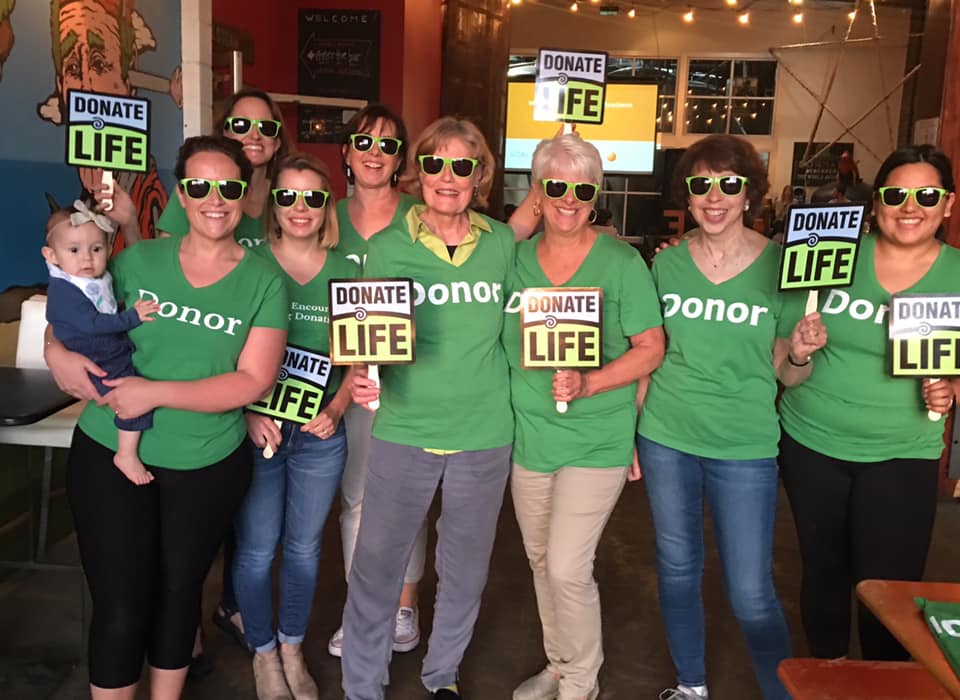
A picture of WELD members wearing DONOR tee shirts and holding signs that say "Donate Life." The caption tells where Michele is standing.
Michele is in the front row, third from the left (not counting our littlest WELD member). That’s me, second from the right.

NKR has a huge living-donor pool in the United States; it tries to find the best match for a potential recipient so that if the intended donor isn’t a match for them, they can do a “swap” or even form a kidney chain.

Yes, these amazing options make everything so much easier than it used to be. But anyone whose loved one has had a life-threatening condition knows how stressful and overwhelming navigating the system can be. Fortunately, Michele’s family was closely supported by a knowledgeable friend who’s a living donor himself, Ned Brooks.  I recently heard Brooks’s fascinating TED talk, “What Makes a Person Decide to Donate His Kidney to a Stranger?

In 2015 Brooks, a retired businessman, decided to donate his “spare” kidney to a stranger to set off a chain of three transplants. Like many of us, he found the living-donation experience so uplifting and life changing that he was determined to spread the word. He went so far as to found a nonprofit, Donor to Donor, to publicize the kidney crisis and to encourage and facilitate living kidney donation. In addition to sharing valuable information and donation stories, the organization matches potential kidney recipients with previous kidney donors/advocates who volunteer to help them find a donor.

Congratulations to Michele and her son. Wishing Dan a smooth recovery.

Donor to Donor will sponsor a (free) one-day Volunteer Kidney Donor Advocates Conference April 24, 2020, in New York City. Details to come.