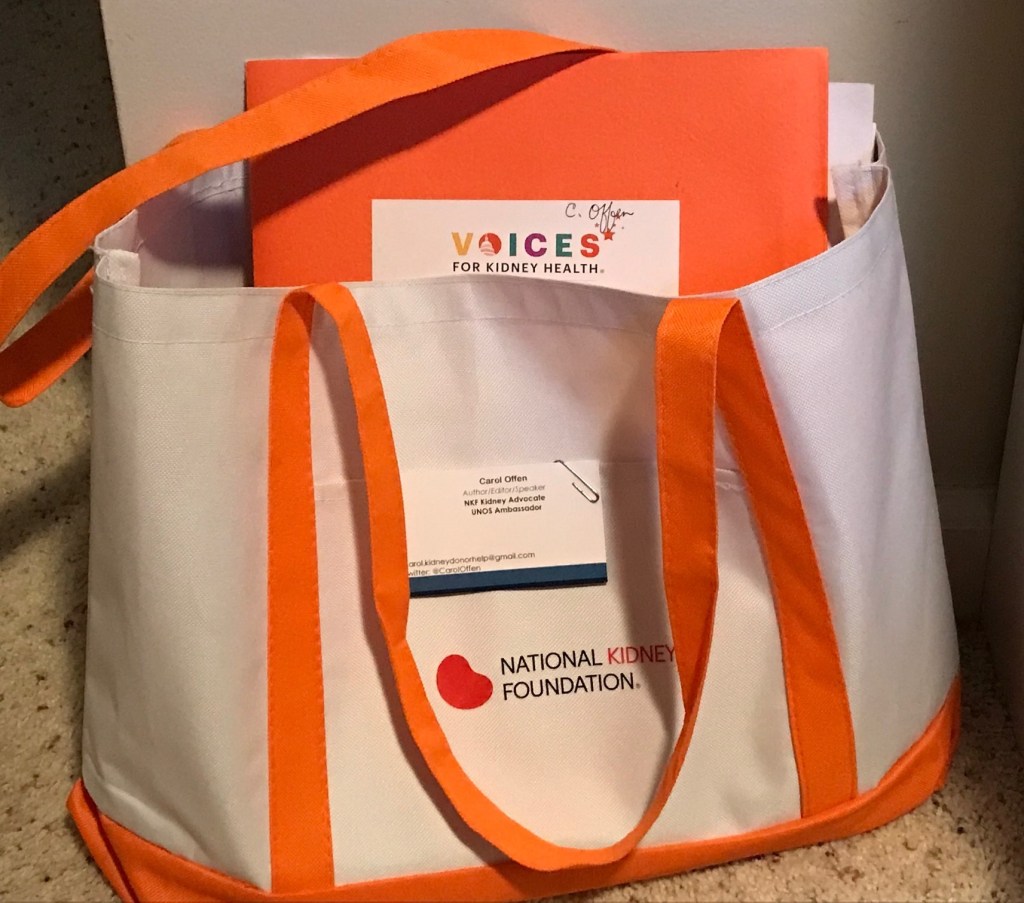
Kidney Advocacy 101

I just came back from Washington, DC, where I participated in in-person meetings on Capitol Hill–for the fourth time–to discuss ways that Congress can and must support the kidney community. As I type these words, I realize that the kidney community may sound like a small portion of Americans, a discrete segment of the population.

Unfortunately, that’s hardly the case.

Numbers typically don’t leave a lasting impression on most of us. Reading the oft-repeated statistic that 37 million people in this country, one in seven, are estimated to have chronic kidney disease starts to lose its shock value. Dramatic as that is, however, it’s usually followed by the shocking statement that 90% of them don’t know it.

It’s likely that you know someone who’s among the people in that estimate–maybe even a loved one.

Before my son was diagnosed with chronic kidney disease about 20 years ago, my family thought, like many, that kidney disease was something that just happened to other people. Not true, of course. And when people hear that my son’s condition was caused by a strep infection, they quickly realize that what happened to our family could happen to any family.

So our “asks” for Congress this time were threefold:

–Support the sweeping and way-overdue modernization of the antiquated and inefficient organ allocation system with funding: $67 million (the bill authorizing the modernization was passed in 2023).

–Co-sponsor the bill to expand and improve access to home dialysis (introduced in the last session of Congress but needs to be reintroduced in the new session).

–Support a brand-new and much-needed initiative to expand education and screening for kidney disease. Right now kidney patients don’t get thorough counseling until Stage 4 of chronic kidney disease–that is, just before their kidneys fail in stage 5. Early screening and detection for everyone is vital in catching declining kidney function in the early stages, when it’s still treatable.

So whatever the particular legislative “asks” at a given time–and whether I go to Capitol Hill as part of a delegation from the National Kidney Foundation, as I did last week, or the American Kidney Fund, as I did last May–my advocacy has a very simple goal.

To keep this vital topic on Congress’s radar. Because it’s in virtually everyone’s interest.

For related posts and information on my book, The Insider’s Guide to Living Kidney Donation, be sure to explore the rest of my website and my articles at Medium.com/@caroloffen.

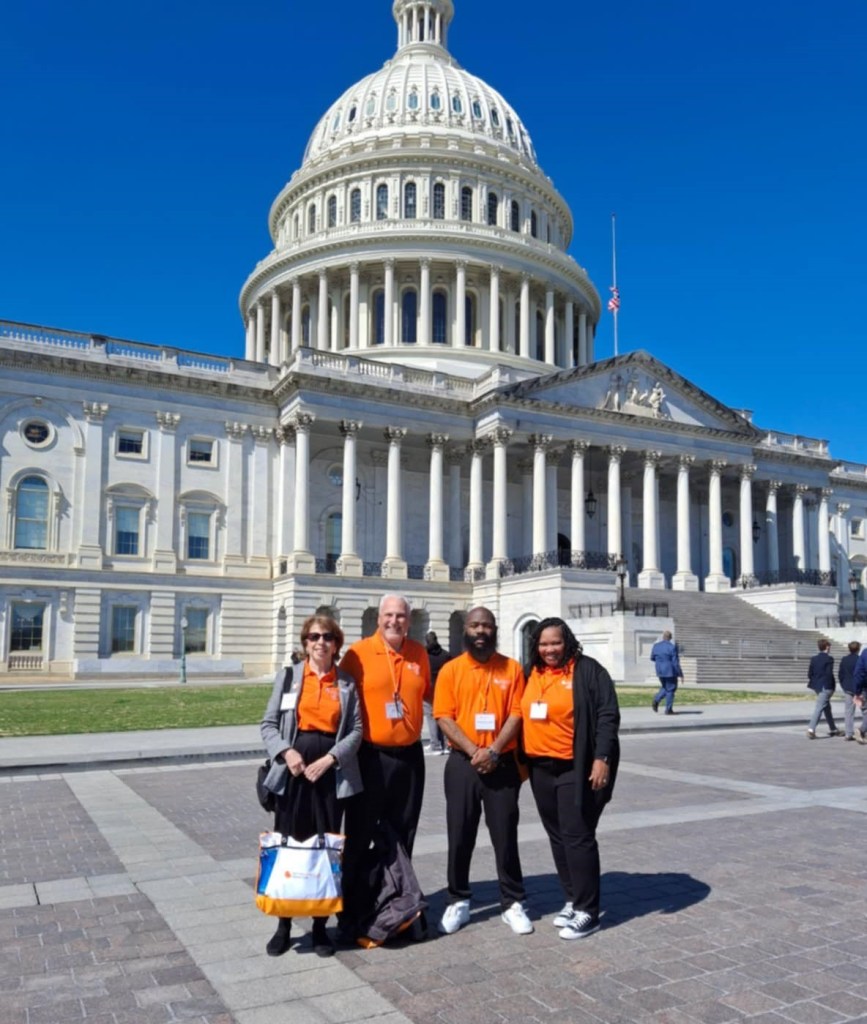
A Very Productive Day on Capitol Hill

I just figured out that I’ve now participated in more than thirty advocacy (aka lobbying) meetings for the kidney community, mostly at the federal level. My recent meetings in DC for the National Kidney Foundation’s Kidney Patient Summit definitely stand out. I thought I’d share some observations.

At their worst–perish the thought!–such meetings risk being dry, one-sided recitations of our “asks” (often cosponsoring legislation, signing on to a letter, voting to increase research funding) while a well-meaning but harried staffer listens quietly, taking notes, followed by our rushed awkward efforts to “tell our stories” before the staffer, obviously distracted by more pressing obligations, moves to end the meeting early.

Fortunately, the only ones I’ve ever had that were close to that scenario occurred years ago on Zoom, because of COVID, often without video. (I kept hoping that the disembodied voice was more engaged than it sounded and wishing desperately for a little eye contact to have a better idea if our message was “getting through.”)

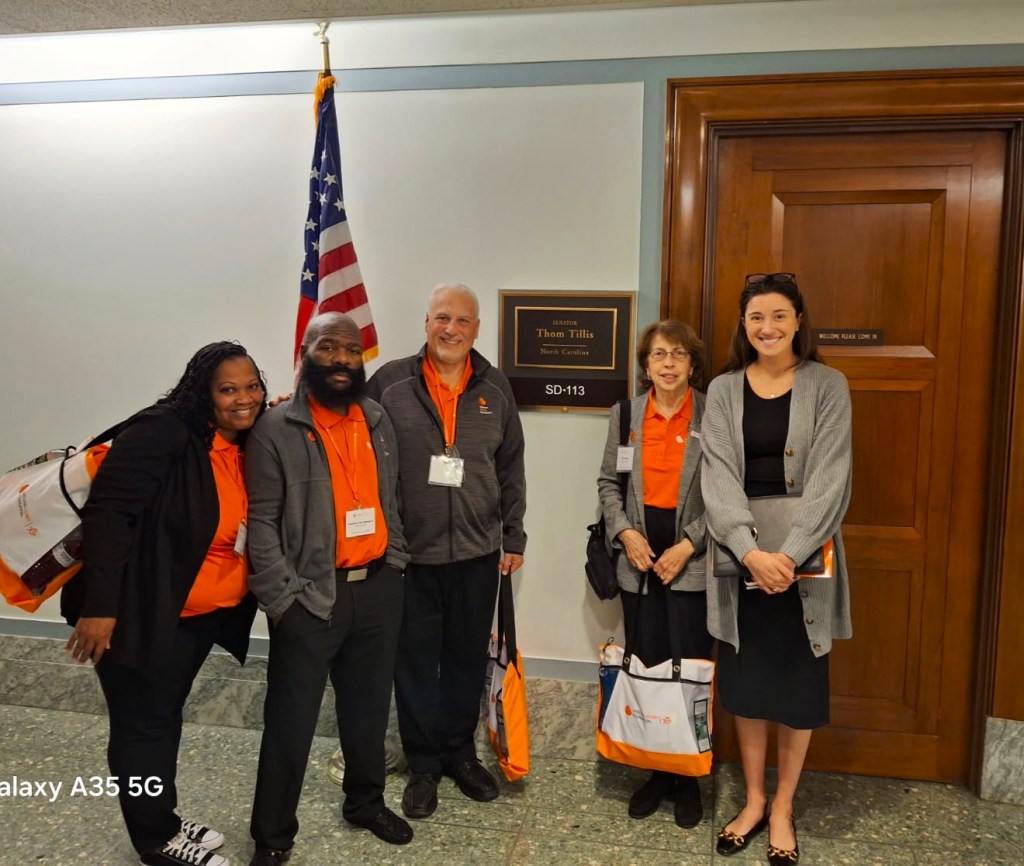
At their best, though, such as one our North Carolina team had recently with a seasoned Senate staffer, Garrett Daniel (Senator Thom Tillis’s legislative assistant), they can be exhilarating. Here are a few illustrations.

Instead of being one sided, they’re natural interactive conversations that happily go off script. I’d been in several excellent Zoom meetings with Garrett since 2020, but this was our first in-person meeting. He’s always engaged, well informed, and often alludes to other ideas in the senator’s pipeline–such as a plan for a framework for paid leave for caregivers–that dovetail with our efforts.

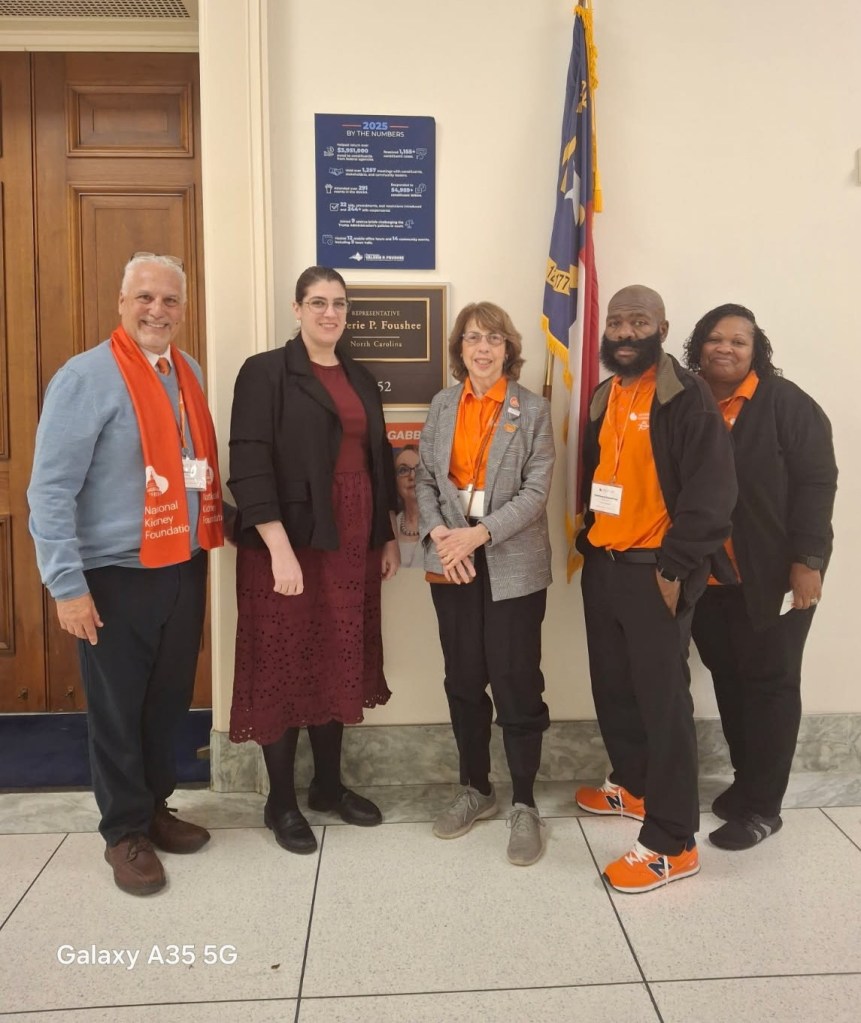
LA Garrett Daniel, standing next to name plaque, with our NC team this year (left to right: Alan Levy, me, Wendy Glod, Dre Roundtree, kneeling, and his wife, Necole Roundtree.

We all participated in the lively discussion, often, in response to his questions, mentioning additional aspects of our asks that we hadn’t touched on in our elevator pitch. After hearing comments from a kidney transplant recipient’s wife, Garrett was the one to raise the subject of the burden on the caregiver not just in the home but in terms of job issues.

He listened to our personal stories and then often gently asked questions to get a clearer picture of what our experiences entailed. In fact, when he prompted one of our team members to elaborate on her long journey to get a kidney transplant, she shared important and wrenching details that the rest of us hadn’t heard.

Because her insurance company would only cover her numerous appointments for essential tests if she went to a center three hours each way from her home in Charlotte–instead of one just fifteen minutes away–she had to wait more than two years before she could move ahead with the transplant she desperately needed. Then, after she went through all her testing and was just one test away from being listed for a transplant, she got a peritonitis infection–so the transplant was further delayed.

At the end of the meeting, in addition to concern, Garrett also offered critical pragmatic support. For example, Senator Tillis is already a cosponsor of the Living Donor Protection Act, so our ask in his case was to help us get a committee hearing for the bill. Garrett’s boss is not on one of the committees in question, so Garrett offered to reach out to his counterparts in the office of NC Senator Budd (who is) to bolster our efforts. He planned to do the same with other offices regarding another bill the kidney community is supporting, to help expand access to home dialysis.

It was late afternoon when we left the office, and in between meetings we’d been walking up and down long, imposing corridors and all over Capitol Hill for hours. Our feet hurt. But after meetings like this, everyone on our team left feeling energized.

For related posts and information on my book, The Insider’s Guide to Living Kidney Donation, be sure to explore the rest of my website.

ASKing Congress–for a “Friend”

My bags are packed, and I’m ready to approach federal legislators and/or their staffers again along with other advocates from the National Kidney Foundation. As usual, we have very important asks.

If you’ve read even a few of my posts since I launched this site in 2019, you know that I’ve been lobbying for the Living Donor Protection Act–both on Capitol Hill and in my state, North Carolina–for several years. So, yes, our number-one ask is for this session of Congress to finally move ahead with this bipartisan (yes!), noncontroversial, bare-bones legislation that’s been kicking around Congress since 2014.

This bill to prohibit discrimination by insurers against living donors–through higher premiums or coverage refusal–gets reintroduced every session. There may be a new sponsor, if one of the originals is no longer in office, more cosponsors…and then it sits. It’s yet to have a committee hearing, much less a vote. This shouldn’t be so hard.

The second ask is a newer one that could benefit so many people currently on dialysis. The majority (about 85%) of dialysis patients receive hemodialysis at a center, where they go three times a week for three to four hour sessions. Not everyone lives near a center and may need to travel more than an hour by car or city bus(es) to get there. We want Congress to improve access to home dialysis for patients who choose to do it, by providing funds for training and professionals to actually go to people’s homes in the first few months to help them learn how. It could be a game changer by enabling someone to do dialysis on their own schedule and even facilitate their being able to fit sessions around their work hours.

The third ask is about modernizing and improving the national transplant system that allocates deceased organs. Nearly 100,000 people are on national waiting lists (most of them for a kidney), and most wait several years. The system is extraordinarily complex and there are appalling instances of wasted organs. Most everyone agrees it needs to be more efficient and transparent, so more people can get a transplant after a shorter wait. Congress passed an act to modernize and improve the system last year. What we need now is for lawmakers to provide the necessary $100 million funding to carry it out.

The fourth ask, and in the long run arguably the one with the most lasting potential benefit, concerns early screening for kidney disease. My symbolic “friend” in the kidney community probably isn’t even aware of being among the estimated 37 million Americans with chronic kidney disease. Yup, 90% of that population haven’t even been diagnosed yet and don’t know that their kidneys are gradually–sometimes not so gradually–losing function.

Confused? Let me clarify the difference between chronic kidney disease and kidney failure. Diseased kidneys slowly lose function over years–even decades–before they reach kidney failure, during which time there may well be no obvious symptoms. Once they fail, though, the only way to save someone’s life is with a transplant, or, in the meantime, dialysis. People with diabetes and/or high blood pressure are at the highest risk of developing kidney disease. So if doctors routinely screened these patients for kidney disease (with a simple blood test), millions of lives could be saved.

With early detection, not only can that disease progression be slowed, it can often even be reversed, through behavioral changes–exercise, healthy diet, hydration–and medication. We’re asking members of Congress to sign a letter in support of official guidelines for screening.

These are pretty straightforward noncontroversial asks. I’ll let you know how it goes.

For related posts and information on my book, The Insider’s Guide to Living Kidney Donation, be sure to explore the rest of my website.

UPDATE: How States Rank in Living-Donor Protections

Last year about this time I published a post about living donation-related protections and benefits, by state. As I mentioned then, while awaiting passage of a federal Living Donor Protection Act, more than half of states have enacted their own version (it’s now 31). In fact, like the one we’ve been supporting in North Carolina, some state bills are actually are more generous than the federal version (by including paid leave for state employees who donate).

United States Map With State Names Pdf Valid Printable Map Of | Printable Map Of The United States Pdf – Printable US Maps

But the LDPA is just one way that states can encourage living donation. Financial supports and job protections are other critical ones. I decided to check on the status of those efforts and the resources I provided last year–to include updates and new links as needed.

Are you considering being a living donor, or have you donated recently? Do you know what the relevant tax provisions and protections are in your state–or in a state you may be looking at? It’s worth doing your homework.

The National Kidney Foundation has a terrific resource in a map you can click on to find out what donation-related laws and protections a particular state offers. Does it have a Living Donor Protection Act, or similar insurance-discrimination protections? Does it also have job-protected living donor leave for private employees? How about for state employees? What about paid leave? What about tax deductions? Even better, what about tax credits?

The American Kidney Fund website also features an invaluable resource: a state report card. It rates each state based on important donation-related measures and provides an overall rating on how well that state encourages living donation and removes barriers. Though I’m happy to report there has been some progress in the past year, it’s not nearly enough. Not surprisingly, only a few states still merit an A: Arkansas, Connecticut, and Louisiana. Glad to see that 16 now get Bs, and 14 (plus Washington, DC) have Cs, but several get Ds (including, alas, North Carolina).

Unfortunately, seven states rate an F–that is, these states failed miserably because they have no donation-related measures in place: Alabama, Michigan, Montana, New Hampshire, South Dakota, Tennessee, and Vermont. Earlier this year Nevada and Wyoming passed anti-insurance discrimination laws, moving them up to a D; Rhode Island just passed its version in late June, moving it up to a C. That brings the national average grade to a C, up from D when AKF began the report card system in 2021.

The irony–and real tragedy–is that none of these donation measures is really controversial–they shouldn’t be so damn hard to pull off. They are simple, reasonable, common-sense ways that a state can demonstrate its support for people who help save a life in this way. In fact, not only does encouraging living donation save lives, for kidney patients it reduces costs by reducing the number of people on dialysis (Medicare pays about $90,000 a year per dialysis patient).

With 103,600 people in this country on the national transplant waiting list (about 4 out of 5 needing a kidney), it seems that the very least we can do is remove the barriers to living donation.

For related posts, resources, and information on The Insider’s Guide to Living Kidney Donation, be sure to explore the rest of my website.

National Foundation for Transplants, Trees, and Me

When I launched this website in early 2019, my goal was simple: to raise awareness of living donation by sharing my story of donating to my son, along with timely posts and practical resources to help donors and would-be donors–and anyone interested in supporting people with chronic kidney disease. I threw in a dose of self-deprecating humor because I’ve seen how well it helps information go down.

Photo by Syed Qaarif Andrabi on Pexels.com

I had no sense of how many people I could reach. The website’s following has certainly grown but continues to be a modest audience. And if I don’t spread the word on social media about each new post, far fewer people see it (after all, if a tree falls in the forest and there’s no one there to tweet about it, how in the world does anyone know it fell?).

So, I’m excited, honored (and downright tickled) to announce that the National Foundation for Transplants discovered my blog and wants to amplify the sound of the falling trees–I mean, blog posts!

NFT has asked me to be a guest contributor and run one of my posts once a month on its site. Partnering with such a large, respected organization to spread the word about the importance of living donation–all kinds–is a fantastic opportunity.

An individual donor advocate–particularly a nontech-savvy one like me–can’t hope to make much of an impact alone. Certainly, for government-related aims, having a major, moneyed organization behind you is essential. Being an active kidney advocate for the National Kidney Foundation, and to a lesser extent, a UNOS Ambassador, has been extremely gratifying.

But I’ve also wanted to reach out personally to potential donors because I believe that my story is more relatable than most: I donated to my son, not a stranger; our family had no history of kidney disease; and, maybe this most of all, I’m not an adventurous person, I’m a wimp (I faint at flu shots). And, for goodness sake, I’m no saint or heroine. Most anyone in my situation would have done the same if they could.

I hope that NFT can help me share my perspective and my insights with a wider audience. When you join forces with dedicated, like-minded people and organizations, anything’s possible. Thank you, NFT, for helping this donor advocate amplify her passionate but quiet voice.

For related posts and information on my new book, The Insider’s Guide to Living Kidney Donation, be sure to explore the rest of my website.

How’s Your State Doing on Donor Protection Measures?

In my last post I promised information about living donation-related protections and benefits, by state. As I mentioned, while awaiting passage of a federal Living Donor Protection Act, more than half of states now have their own version (28 at last count). In fact, like the one we’re supporting in North Carolina, some actually are more generous than the federal version (by including paid leave for state employees who donate).

United States Map With State Names Pdf Valid Printable Map Of | Printable Map Of The United States Pdf – Printable US Maps

But the LDPA is just one way that states can encourage living donation. Financial supports and job protections are other critical ones. Are you considering being a living donor, or have you donated recently? Do you know what the relevant tax provisions and protections are in your state–or in a state you may be looking at? It’s worth doing your homework.

The National Kidney Foundation has a terrific resource in a map you can click on to find out what donation-related laws and protections a particular state offers. Does it have a Living Donor Protection Act, or similar insurance-discrimination protections? Does it also have job-protected living donor leave for private employees? How about for state employees? What about paid leave? What about tax deductions? Even better, what about tax credits?

The American Kidney Fund website also features an invaluable resource: a state report card. It rates each state based on important donation-related measures and provides an overall rating on how well that state encourages living donation and removes barriers. Not surprisingly, only a few states merit an A: Arkansas, Connecticut, and Louisiana. Glad to see that more than a dozen at least get Bs, but nearly as many have Cs, a few get Ds (including, alas, North Carolina).

Unfortunately, nine states rate an F–that is, these states failed miserably because they have no donation-related measures in place: Alabama, Michigan, Montana, Nevada, New Hampshire, South Dakota, Tennessee, Vermont, and Wyoming.

The tragedy is that none of these donation measures is really controversial–they shouldn’t be so damn hard to pull off. They are simple, reasonable, common sense ways that a state can demonstrate its support for people who help save a life in this way. In fact, not only does encouraging living donation save lives, for kidney patients it reduces costs by reducing the number of people on dialysis (Medicare pays about $90,000 a year per dialysis patient).

With 106,000 people in this country on the national transplant waiting list (most of them needing a kidney), it seems that the very least we can do is remove the barriers to living donation.

For related posts and information on my new book, The Insider’s Guide to Living Kidney Donation, be sure to explore the rest of my website.

Coronavirus, Kidney Patients, and Everyone Else

If you’re reading this, chances are you’re considering donating a kidney or have already done so–but you also very likely know and care very much about someone who has chronic kidney disease (in my case my son, Paul, and my friend/co-author, Betsy, for starters). Or maybe you have it yourself.

With kidney patients at a high risk of contracting COVID-19–whether they are transplant recipients, are undergoing dialysis, or contemplating treatment–this is a particularly important issue for all of us and others in the kidney community. I hope that you will share the resources below with your friends and family so that they can remain safe and healthy. These materials are provided by the National Kidney Foundation (NKF) and offer advice on keeping healthy during this horrific pandemic. These links will be updated as needed.

Photo by rawpixel.com on Pexels.com

The latest information and best practices to be prepared for COVID-19: https://www.kidney.org/…/be-prepared-kidney-patient-prep-co…
Information to help kidney patients and their families respond to emergency situations: https://www.kidney.org/help

And a blog post from NKF’s CEO Kevin Longino on Covid-19 and the kidney community: https://nkfadvocacy.blog/…/supporting-you-during-the-coron…/

Whatever your own health status, and wherever you live, please stay safe and closely follow recommendations and requirements in your area. Also, here’s clear, valuable information on the virus from someone who knows more than anyone on the subject, Dr. Anthony Fauci, interviewed by Trevor Noah. https://youtu.be/8A3jiM2FNR8

Protecting Living Donors from Discrimination

This week I met with North Carolina Rep. Verla Insko, my state legislator, and Katey Cipriani, the National Kidney Foundation’s regional community outreach director. The topic was living donation, of course. We were seeking Rep. Insko’s support for a Living Donor Protection Act in our state, as we had with other legislators just a few months ago at the legislature. The General Assembly is between sessions now, so this meeting was more informal, a pleasant chat in a quiet local coffee house in Chapel Hill. I was there to share my story of donating to my son and offer some personal insights into why we need to protect living donors from discrimination.

Katey (far right) and I (far left) with fellow donor Dolores McGrath and Young Bae, Rep. Insko’s legislative assistant, who set up our meeting with Rep. Insko.

So why might donors ever be discriminated against for saving a life? Let me give you an example. To be approved as a living donor, I had to pass numerous tests that looked at my heart, lung, kidney, general fitness, myriad blood tests… Thirteen and a half years post donation, my kidney function is fine and I’m still in excellent health at 71. I’m active, enjoy Zumba a few times a week, and walk regularly. Nothing remarkable there, but I have donor friends in their 50s and 60s who run marathons. And yet…

If we apply for a life insurance policy tomorrow, there’s a chance an insurer could either deny coverage or up the premiums. Some cap coverage much lower than requested. Doesn’t make sense, does it–not to mention that it’s morally indefensible? It doesn’t happen often, but a study found that about one in four living donors had experienced some type of insurance discrimination–mainly due to misinformation about the negligible impact of living with one kidney. Did you know that many healthy people were born with one kidney? Donors do lose some kidney function, but the other kidney gets plumper and takes on part of the job of the “missing” one. As a result, donors have sufficient function to live normal productive lives.

Among other things, a state Living Donor Protection Act would prohibit insurance companies from denying or limiting coverage–or charging higher premiums–for life, disability, or long-term care insurance for living donors. The proposed federal LDPA, which has been reintroduced in Congress and has dozens of sponsors, would also address job protections and a few other issues that can be disincentives to donation. With nearly 100,000 people waiting for a kidney from a deceased donor, removing those disincentives is critical.

Most people don’t realize how widespread chronic kidney disease is–it’s more common than breast cancer or prostate cancer. As I told Rep. Insko, I really think most people are no more than two degrees of separation from someone who’s had or needs a kidney transplant: a friend of a friend, a neighbor’s cousin, a PTA member’s spouse…

Rep. Insko listened attentively and asked how other states have approached the task of protecting living donors: How many have relevant laws (11, but several more are in process)? Which one do we want to model North Carolina’s on? Did those states encounter any pushback? What concessions did they have to make to get it passed?

She also had several helpful suggestions of people in the General Assembly to approach, including those who had some ties to health care. She promised to take a close look at the related materials Katey had brought and was interested in learning more. As it turns out, we have time–most new legislation can’t be introduced until the 2021 session of the General Assembly.

I’m learning that advancing legislation is a slow, stop ‘n start process. But we’re making progress, gathering support, and picking up some tips along the way.

A Cold But Successful Kidney Walk

This weekend my husband (Neil), son (Paul, my recipient), and I participated in our umpteenth National Kidney Foundation Triangle Kidney Walk [see my post on our long history of kidney walks], in Durham, NC. We were thrilled to learn that it set a record for donations: more than $97,000, with money still coming in. I think it broke another record, too–this may have been the coldest one (I know it’s the only time I’ve ever worn a winter coat over my Kidney Walk tee shirt).

Because of the damp chilly weather, the Walk organizers decided to shorten the route. What was supposed to be a 2.4-mile loop was reduced to just 1 mile total. True, my fingers were numb even before it was over, but we were still a bit disappointed.

It was long enough though to fall into conversation with a woman doing her first Walk. She’d driven all the way from the Pinehurst area because her mother had died recently from kidney failure, and she felt she had to do something. Like so many of us, she’d known very little about kidney disease before her mother started dialysis 4 years before. A few family members had planned to come along, she said with a little annoyance, but one by one they’d backed out. To her credit she came alone.

We talked about how little is known about kidney disease and how important it is to focus more attention on education in addition to research. We learned a startling statistic before the walk started: the U.S. National Institutes of Health, which is the main source of health-related research in this country, spends $568 per patient/year on cancer research. Kidney disease research accounts for…$29 per patient/year! I thought I’d heard it wrong and had to double-check before finalizing this post. And yet chronic kidney disease affects more than 30 million Americans. It’s yet another reminder of how important that new public awareness campaign is [see my previous post].

We saw lots of familiar smiling faces at the walk, many peering out from under wool hats. Friends from Donate Life NC/WELD (Women Encouraging Living Donation) were working a table this year. One of them, Dolores McGrath, a fellow NKF Kidney Advocacy Committee member, would be joining me for my first “official” visit to the state legislature this week. (More on that in my next post!)

That’s Dolores McGrath, center; and Deanna Kerrigan, Donate Life NC/WELD director, right.