More Living Donors Could Get Financial Help!

High on the list of ways to encourage living donation (after educating people about living donation, of course) is to make the experience financially neutral. That is, not that live donors earn money for their organs (though some experts have made a case that that actually might be done efficiently and fairly)–only that no one lose money in trying to save someone’s life (I think we can all agree on that part).

Well, guess what? A major source of aid, the federally funded National Living Donor Assistance Center, says that about 70% of U.S. households meet its income requirements to apply for living-donor financial aid.

If you already know that the recipient’s insurance (including Medicare) covers the donor’s evaluation and surgery (and some major insurers now cover travel expenses), you might wonder why a donor would need additional financial assistance. Let’s consider all the things that often need to be in place for someone to donate–apart from a clean bill of health and matching-related issues.

1–What if a donor lives hundreds or even thousands of miles from the recipient’s transplant center? Transportation and lodging expenses for a few days of evaluation plus surgery and post-op time can add up pretty quickly. They can easily be a deal breaker.

2–What if a potential donor doesn’t have paid sick leave? Two to four weeks lost pay for recovery plus time off work for evaluation tests and appointments can be prohibitive. So, covering lost wages is crucial.

3–And what if the donor needs to pay for childcare or eldercare for those weeks? That could clearly tip the balance, so reimbursement of dependent care expenses is right up there too.

Fortunately, not all donors require all three of those essentials. Back when I donated to my son in 2006, we were lucky that the transplant center was right in our town, I had sufficient paid leave between my own plus my colleagues’ kind shares, and we had no dependent care expenses.

Photo by Pixabay on Pexels.com

But for people who do, any one of those factors could nix the idea for donors who are otherwise eligible. Such expenses can run into several thousand dollars. Happily, NLDAC grants, usually in the form of a prepaid credit card, are sizeable: up to a total of $6,000 per donor.

You can download guidelines and application forms from the NLDAC website. Funds are available only for those donors who have no other reimbursement options, be it insurance, state or federal funding, or (for me, this is the part that still rankles) the recipient’s funds. Both donor and recipient must provide income and asset information, but the recipient’s matters most. I guess the assumption is that recipients “should” reimburse their donor if need be.

True, if a recipient doesn’t meet the guidelines but says he or she can’t afford to reimburse the donor, there’s a hardship exception, requiring more paperwork. In other words, at a time of ill health, lost wages, and great family stress, the recipient is expected to prove that he or she can’t help the donor. Shouldn’t the donor’s income be the major factor if we want “to reduce the financial disincentives to living organ donation” (per NLDAC’s mission statement)?

NLDAC has been a major source of financial assistance for nonmedical aspects of donation for many years. Until late 2020, that assistance was mostly limited to travel and lodging, so as a donation advocate, I certainly applaud the major expansion.

NLDAC needs to get the word out so more potential donors can take advantage of this much-needed additional assistance. I’m happy to help. Please do pass it on!

For related posts and information on my new book, The Insider’s Guide to Living Kidney Donation, be sure to explore the rest of my website.

Contributor Spotlight: Doing All They Can to Help Donors Donate

Some of the most dedicated, ardent advocates of living donation I know are neither living donors nor transplant recipients themselves. That’s surely the case for these two contributors–Tammy Wright and Jenine Lewis–to our book, The Insider’s Guide to Living Kidney Donation.

For Tammy, who has helped donor and recipient pairs as a transplant coordinator for nearly 30 years at Sharp Memorial Hospital in San Diego, it’s a profession she deeply loves. For Jenine, who came ever so close to donating one of her own kidneys, it’s a passion and an avocation.

Tammy Wright, a veteran donor nurse coordinator.

You may think that once someone is approved as a donor, it means smooth sailing ahead and just depends on everyone’s schedule. Alas, that’s not the case for many donors and recipients. Even before COVID came along, life always had a way of throwing complications in people’s paths even when the stakes are frighteningly high.

Example? Recipient gets so sick before the scheduled transplant that it has to be postponed indefinitely. Or donor gets the flu and needs to reschedule. Or an overweight donor learns that he’s prediabetic and has to start an extended period of dieting and nutrition counseling. I could go on.

In Tammy’s book chapter, “Helping Overcome Transplant Obstacles,” she relates several daunting situations she has helped her patients navigate. Many of the creative solutions she draws on were not available when she started out in this profession (or even when I donated in 2006). Paired donation (kidney exchange), notably, often holds the answer to a donation problem, and Tammy’s chapter describes some pioneering efforts.

Tammy movingly relates how she’s worked–and cried–with patients at each new disappointment. Named “Nurse of the Year” at Sharp in 2020, Tammy is as modest as she is private. “I am pretty boring but love what I do and enjoy helping people get transplanted,” she says simply.

When she’s not working, Tammy enjoys being active in Transplant Trekkers, a nonprofit San Diego group dedicated to raising awareness of living organ donation. (She proudly admits also to being a dog lover.)

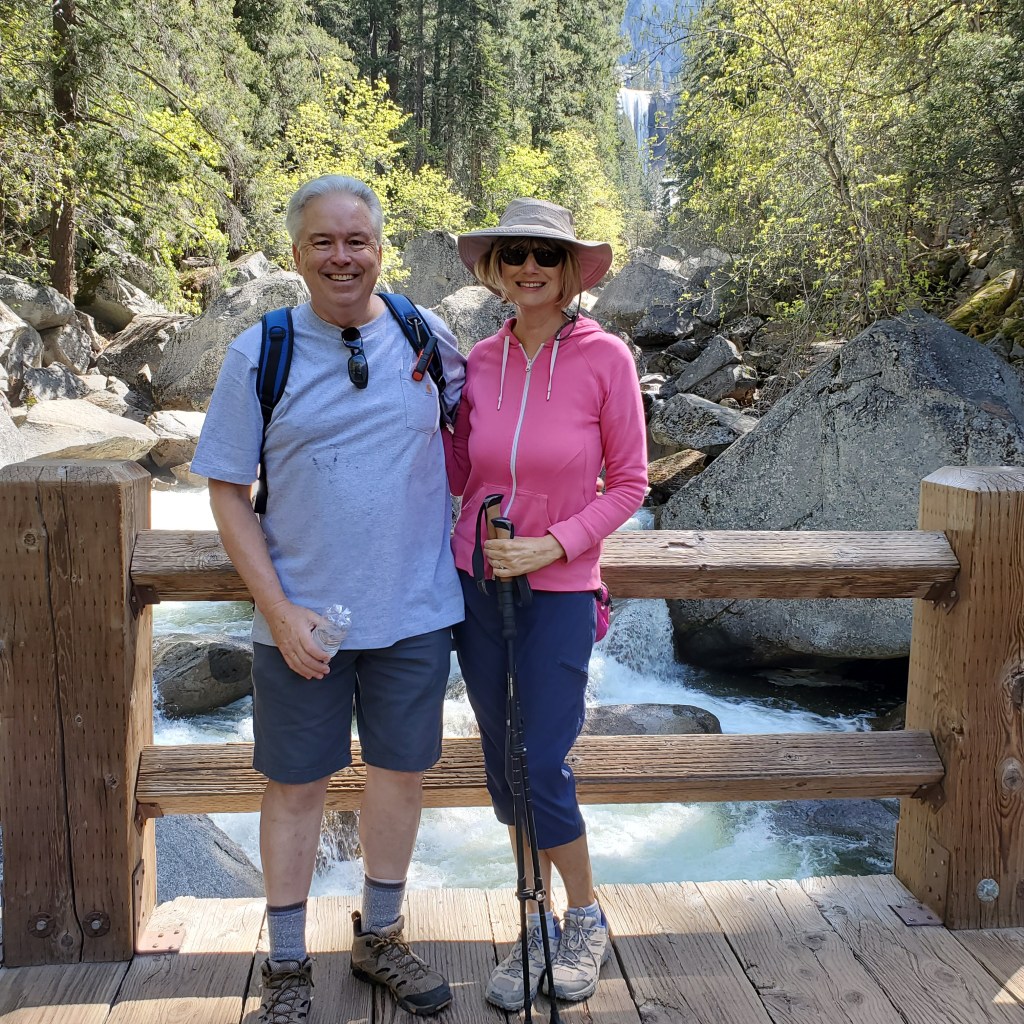
Jenine Lewis, a donation advocate, seen here at Yosemite National Park with her husband, Alan.

Like Tammy, Jenine is a San Diegan who does all she can to support living donation, through Transplant Trekkers. Jenine’s book chapter, “How a Would-be Donor Became an Advocate,” relates how she set out determined to donate her kidney to her good friend. After a very long, circuitous route, she finally got the green light for donor surgery in 2016 until…

We’ll let Jenine’s chapter tell what happened and why. Though she was initially heartbroken about not being able to gift her own kidney, Jenine says she soon learned that she could provide valuable help to other potential donors. She’s been an active volunteer in raising awareness of living organ donation in the San Diego area. She often counsels others who have been similarly disappointed and shows them how they can still help their intended recipient.

A youthful grandmother of three, Jenine enjoys hiking, as you can see from the photo. Obviously, Transplant Trekkers, which interestingly raises awareness of living organ donation through virtual, customized hikes, is a perfect fit.

Fun Fact: Transplant Trekkers is the (independent) re-creation of the original WELD (Women Encouraging Living Donation) San Diego group. WELD later teamed up with Donate Life America and added chapters around the country. It now accepts men, so the acronym officially stands for We Encourage Living Donation.)

Diane Brockington, herself a living donor and a tireless champion for living donation, founded WELD in 2015. She now leads the original San Diego group, which renamed itself the Transplant Trekkers. It was Diane who introduced me to WELD and all these impressive women.

Because of Organ Donation

As a living kidney donor, I launched this website primarily to share information about living donation. Because it was my son, Paul, who got my transplanted kidney, I also often write about chronic kidney disease and transplant recipients.

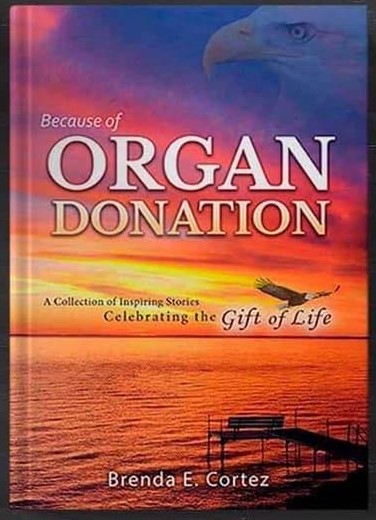
And, because I fervently believe in organ, eye, and tissue donation generally, I sometimes write, too, about the importance of signing up to be an organ donor. Now I want to tell you about a book that includes all these perspectives and more: Because of Organ Donation.

Brenda Cortez has compiled and edited this anthology of 25 moving, first-person stories by donors, recipients, and donor families (that is, family members of deceased donors). Brenda is a living-donor friend/author I’ve written about before concerning her Howl the Owl (it stands for Help Others With Love) children’s books about donation and related topics. She’s helped thousands of kids understand and cope with kidney disease and transplant in their families through her books and in visits to schools and hospitals with little Howl.

Full disclosure: when I began reading Because of Organ Donation, I think I expected that I’d mainly read the donor and recipient chapters and maybe just skim the ones about deceased donation. Instead I read it cover to cover, absorbed and touched by the powerful stories.

I naturally found old friends here from the kidney community, two of whom I’d met at the Guinness Records Living Donor Rally in Chicago in 2018: Brenda herself, who shares her own story of donating to another mom she knew slightly from her daughter’s school; and Kate Griggs, co-founder of the Guinness event, who was shunned by some friends and colleagues for donating to a stranger but still turned living donation into an avocation. (If you ever spot a living donor decal on a car, it was likely a gift from Kate, who’s mailed thousands of them gratis around the world).

The other old friend I found here is Jim Myers, a kidney transplant recipient who, years ago, became a full-time–and a half!–donation advocate (he serves on major kidney organization boards, expertly uses social media, and hosts an interview show (that Betsy and I were on).

I also encountered some of my newer Facebook donor friends, like Deb Kavanaugh (also a Guinness alum!) and Trish Phillips.

I expected to be moved by all these stories, but I didn’t know I would also learn, not only about deceased donation but even living donation (I was stunned that a donor was offered the option of taking back her kidney when her recipient died).

The stories from donor families illustrate clearly how honoring a loved one’s wish to be a donor allows grieving families to take comfort in knowing that he or she was able to dramatically change someone’s life. I was particularly touched by contributors who’d known the unimaginable pain of losing a child and their joy at connecting with their child’s recipient.

Most if not all of the contributors are obviously committed to furthering organ donation and are very active in related organizations and community activities. Because of Organ Donation will surely resonate with readers who share that commitment or have ever been touched by organ donation–but also with many others who can relate to these stories of love, grief, hope, and commitment.

Brenda’s newest book Voices-19 will be out soon. For related posts and information on my new book, The Insider’s Guide to Living Kidney Donation, be sure to explore the rest of my website.

A Big Week in the Life of a New Book!

A very big week for Betsy and me in garnering attention for our new book, The Insider’s Guide to Living Kidney Donation!

We taped two TV interviews: for ABC11TV (wIth Amber Rupinta, airing tomorrow, March 11) and for Spectrum TV (with Heather Fordham, airing next week)!

Plus the terrific article in Chapel Hill Magazine, by Renee Ambroso, is now out! Can’t wait to get my printed copy, but it’s online.

Kidney Patient Summit: Voices and Faces

As part of the annual National Kidney Foundation Kidney Patient Summit yesterday, I spent most of the day in virtual meetings with congressional staffers for my congressman, Rep. David Price; both senators, Thom Tillis and Richard Burr; and North Carolina representatives Deborah Ross and David Rouzer.

I was very fortunate to be joined by a wonderful group of warm, articulate fellow advocates who helped make the day a gratifying and enjoyable experience: Ashby Andrews, exec director of NC NKF, Marcelo Pena, and Jesse Harris.

Our three main asks were to support the Living Donor Protection Act, which bars insurance discrimination and protects a donor’s job; to facilitate home dialysis for those who want to do it but need professional and logistical support; and increased funding for research, kidney disease awareness, and early detection.

Marcelo and Jesse, who both have chronic kidney disease, shared their stories, particularly their perspective on what facilitating home dialysis can mean in the quality of life of a patient with kidney failure. I shared my story as an unlikely living kidney donor (a self-professed wimp) whose adult son/recipient, Paul, was diagnosed with kidney disease in college—as a result of a strep infection. We had no family history of kidney disease, and he had no risk factors. In other words, as I often point out, what happened to my son, and to our family, can happen to any family.

As always I was so struck by the value of sharing personal stories. When you hear that some 100,000 people have been waiting years for a kidney, it’s hard to digest. Lawmakers and their staff, who were all engaged and open minded in our meetings, are no different. When they hear someone describe what it’s like, both physically and psychologically, to be tethered to a machine for life-sustaining treatments a few hours a day, a few days a week, in a dialysis center–with bright lights and bells regularly going off on machines–the staffers will remember, not the numbers, not the dollars, but the pained look on the person’s face, the catch in his voice.

These are critically important, common-sense, noncontroversial legislative asks. For more information, please go to https://www.kidney.org/advocacy/legislative-priorities

For related posts, resources, and information on my new book, The Insider’s Guide to Living Kidney Donation, be sure to explore the rest of my website.

Black History Month and the Present 

Happy to share this important blog post from Gail Rae-Garwood, a fellow advocate, in honor of Black History Month. Given that African Americans are so disproportionately affected by chronic kidney disease, the low representation among nephrologists is all the more unfortunate. In August, we celebrate Minority Awareness Month, and March is National Kidney Month, but kidney disease is a reality for millions of African Americans all year long.

Gail Rae-Garwood's avatarSlowItDownCKD

I’ll bet you thought I’d forgotten all about Black History Month. Not at all, dear readers, not at all. It’s just that since this is a yearly occurrence and I’ve been blogging about kidney disease for 14 years, it becomes harder and harder to uncover Black nephrologists I haven’t written about before. Of course, including current Black nephrologists changes the picture somewhat. This year, I turned to Blackamericanweb for some help and found it, 

“Dr. Velma Scantlebury [Gail here: sometimes she is referred to as Scantlebury-White.] is the first African American female transplant surgeon in America. She is currently the associate director of the Kidney Transplant Program at Christiana Care in Delaware. [Gail here again: actually, she retired last year.] With more than 200 live donor kidney transplants under her career, she holds extensive research credit in African American kidney donation led by Northwestern Medicine Transplantation Surgeon Dinee C. Simpson, MD, Dr. Scantlebury…

View original post 774 more words

Living Donors Climbing Mt. Kilimanjaro?

Yes, you read that right.

In a recent magazine interview, I was explaining that I still lead a healthy active life, at 73, about 15 years postdonation. I was never an athlete, but I knew plenty of donors who ran marathons, I said. Being a donor typically rules out only activities like contact sports–and, say, mountain climbing, I joked.

Well, I’m happy to report that the joke was on me.

Twenty-two members of Kidney Donor Athletes from across the United States (and one from Canada), plan to do just that next month (March 2022). They’re training now to climb Mt. Kilimanjaro, Africa’s highest peak! I’m told you don’t need technical mountain-climbing skills per se for this one. However, you certainly need to be in excellent physical shape for any expedition that starts at the equator and gets colder and colder till it reaches the arctic zone at the top.

I was excited to see that one of the donor climbers, Matthew Harmody, hails from my state, North Carolina. In fact, he donated at the same transplant center as I did: the University of North Carolina at Chapel Hill.

Matt and I have something else in common: we both donated when we were in our late 50s. (More than a third of living donors are over 50.) Admittedly, that’s where the commonalities end. Unlike me, Matt is clearly no wimp.

Now 60, Matt, an emergency physician from Southern Pines, NC, was an endurance athlete (think ultra-marathons and 100K trail races) long before his 2017 donation. Also, he was a nondirected donor–he gave to someone he has yet to meet. (I gave my kidney to my adult son.)

Matt’s donation was in memory of his father, who had kidney failure and would not accept a donation from a family member (that’s not an uncommon parental instinct). “I felt that if I couldn’t help my father, I could at least make a difference in someone’s life with a non-directed kidney donation,” Matt explained.

Kidney Donor Athletes founder Tracey Hulick was also an ultra-athlete/nondirected donor in 2017. She formed the nonprofit in 2018 to encourage living donation and of course to inspire other athletes.

But why the dramatic One Kidney Climb?

“KDA is using this climb to bring awareness to living donation, demonstrate what is possible post-donation, and to launch initiatives which inspire, support and educate people about the experience of living donation,” according to the website. The March scheduling is significant: the group plans to reach the summit on March 10, World Kidney Day. (BTW, March is National Kidney Month in the United States.)

Come to think of it, Matt and I do have a few more things in common:

1-We’re both in excellent health, have good kidney function, and don’t see a nephrologist.

2-For pain relief, we opt for acetominophen (aka Tylenol) instead of ibuprophen (or other NSAIDS, which are all hard on the kidneys).

3-Most of all, we’re both champions for living donation.

For related posts, resources, and information on my new book, The Insider’s Guide to Living Kidney Donation, be sure to explore the rest of my website.

Kidney Donation: True or False

It occurred to me once again the other day that if we ever hope to increase awareness and encourage living donation, we still need to clear up a few misconceptions and teach the basics. Did you know the answers to these true or false questions?

Photo by Pixabay on Pexels.com

1—You have to be a blood relative to donate your kidney to someone.

2—You can’t lead a normal, healthy life with just one kidney.

3—Kidney donors can’t ever drink alcohol.

4—Living donors have to take medication for the rest of their lives.

5—Living donors need to see a nephrologist (kidney specialist) regularly.

Answers:

1. False. Though blood relatives have a higher chance of being a good tissue match, unrelated donors are a fast-growing group. And even if you are not a blood-type match, you can donate on behalf of someone in a paired donation–basically a swap.

2. False. Thousands of people are born with just one kidney and are perfectly healthy. When you lose a kidney, the other kidney takes on some of the function of the one that was removed. The result is sufficient to lead a normal life.

3. False. Alcohol is processed through the liver, not the kidneys. Living donors have no particular alcohol-related restrictions other than moderation and being hydrated.

4. False. Living donors who are otherwise healthy have no kidney-specific medications.

5. False. Healthy living donors have no need for specialized kidney care and are simply advised to see their primary care provider to monitor their kidney function and blood pressure annually.

Yup, all false. No doubt there are many more misconceptions about kidney donation. Check out the growing list of FAQs, and if you don’t see an answer to something you’ve heard, please let me know. It too may be a myth.

For related posts, resources, and information on my new book, The Insider’s Guide to Living Kidney Donation, be sure to explore the rest of my website.

Spotlight on Our Contributors

In the coming weeks, periodically I’ll be introducing a few of the wonderful contributors to our book, The Insider’s Guide to Living Kidney Donation. They candidly and often movingly shared their experiences and their insights with our readers.

I already knew from personal experience and Facebook support groups that relationships both before and well after donation are fraught with complicated emotions that sometimes surface in unexpected ways. In our research Betsy and I noticed that family issues come up repeatedly even when donor and recipient are not related.

Considering its outsize impact on the donation and transplant experience, the subject of family dynamics typically gets insufficient attention. So we decided to devote a whole section of the book to this important topic. Donors and potential donors and recipients alike will be able to relate to many of the contributors’ diverse situations.

You may know that siblings enjoy the best chance of being a so-called “perfect match” (I have to keep remembering that the only true perfect matches are between identical twins): a 1 in 4 chance of matching on 6 out of 6 antigens. Sibling donor-recipient pairs are likely to have a particularly large impact on the whole family plus the extended family.

In the case of contributors Mike Collins and his sister Wendy Withers, the relationship was and remains especially close.

Wendy had had kidney disease most of her life and recalls “not knowing what it felt like to feel good.” She was raising her two young children alone after she and her husband separated when she learned that her kidneys were suddenly failing. Three of her siblings tested and qualified to be her donor, but her big brother Mike aced it: 6 out of 6.

He had a fledgling business and young family in North Carolina, but when the time came he and his wife, Mimi, and kids flew out to Texas so he could donate. They all shared a big farmhouse with two of his sisters and their families–with their parents nearby–while they waited out a series of frustrating delays.

Some 25 years later Wendy feels “great” and enjoys a very full personal and professional life. She remarried and enjoys time with her grandkids. She’s the Town Administrator for Shady Shores, Texas, which is in the midst of a major project, constructing “a fiber backbone that will connect all the government facilities for the four Lake Cities, to be able to offer high-speed Internet to all of our residents. Many areas are currently underserved.”

Mike, whose donor surgery was done back in pre-laparoscopy days (think 12-inch incision), also leads a very full life. He’s healthy and active, enjoying tandem bike rides several times a week with Mimi. His business, aptly named Tandem Translations, has grown. He translates technical materials into English from a jaw-dropping list of languages: German, Russian, French, Italian, Dutch, Spanish, Serbian, and Croatian.

Even though Mike and Wendy still live in different regions of the country, their families spend as much time together as possible. Check out their complete stories in the book.

A Right to Refuse?

A letter writer in The New York Times Ethicist column this week raises an interesting question: “Must I Donate a Kidney to My Awful Brother?” (Spoiler alert: I’m not going to tell you how the Ethicist answers.)

If you believe that blood is thicker than water in every case, then maybe the answer seems crystal clear, but I think it’s an intriguing ethical dilemma.

Background: Nearly 100,000 people in the United States are waiting–usually for several years–for a kidney from a deceased donor. Finding a living donor helps shorten that wait and saves lives. For me and for thousands of others, being a living kidney donor is a powerful, positive experience, but it’s a big deal.

First of all, before making a big decision like this, you should of course be well informed.

Then you need to consider all the personal issues. If you believe as I do that donating a bodily organ is an intensely personal decision (as much as I value living donation, I would never judge someone who has an open mind and chooses not to donate), it’s still difficult to land squarely on one side or the other of the question to the Ethicist.

Ultimately, anyone considering donating a kidney (or part of a liver) to anyone should carefully think about how they will feel about their decision whatever happens down the road–to the donor or the recipient.

Photo by Olya Kobruseva on Pexels.com

In this particular case, for example, what if the brother continues to be a jerk to the donor? What if he doesn’t take proper care of the gifted kidney? What if the brothers never see each other again? The answers to these questions might or might not be a factor in your decision.

I remember interviewing a donor who admitted that she’d hesitated to donate her kidney to her brother with diabetes because he had long been irresponsible in caring for his condition and his general health. She went ahead with the donation anyway because she’d concluded that the decision felt right for her personally–whatever happened. She never regretted it. Interestingly, her brother turned out to be a very responsible steward of her kidney, but it was certainly wise of her to consider how she would feel if that were not the case.

I know of people who’ve donated to their ex-, other donors who later broke up with their girlfriend/recipient, people who lost touch with their recipient–and yes, even some donors who later developed health problems. In other words, not every donation situation is as straightforward as donating to a beloved spouse or son with a happy outcome like mine.

So do read the Ethicist exchange, and then think it over. Please let me know what you think.

For related posts, resources, and information on my new book, The Insider’s Guide to Living Kidney Donation, be sure to explore the rest of my website.