UPDATE: How States Rank in Living-Donor Protections

Last year about this time I published a post about living donation-related protections and benefits, by state. As I mentioned then, while awaiting passage of a federal Living Donor Protection Act, more than half of states have enacted their own version (it’s now 31). In fact, like the one we’ve been supporting in North Carolina, some state bills are actually are more generous than the federal version (by including paid leave for state employees who donate).

United States Map With State Names Pdf Valid Printable Map Of | Printable Map Of The United States Pdf – Printable US Maps

But the LDPA is just one way that states can encourage living donation. Financial supports and job protections are other critical ones. I decided to check on the status of those efforts and the resources I provided last year–to include updates and new links as needed.

Are you considering being a living donor, or have you donated recently? Do you know what the relevant tax provisions and protections are in your state–or in a state you may be looking at? It’s worth doing your homework.

The National Kidney Foundation has a terrific resource in a map you can click on to find out what donation-related laws and protections a particular state offers. Does it have a Living Donor Protection Act, or similar insurance-discrimination protections? Does it also have job-protected living donor leave for private employees? How about for state employees? What about paid leave? What about tax deductions? Even better, what about tax credits?

The American Kidney Fund website also features an invaluable resource: a state report card. It rates each state based on important donation-related measures and provides an overall rating on how well that state encourages living donation and removes barriers. Though I’m happy to report there has been some progress in the past year, it’s not nearly enough. Not surprisingly, only a few states still merit an A: Arkansas, Connecticut, and Louisiana. Glad to see that 16 now get Bs, and 14 (plus Washington, DC) have Cs, but several get Ds (including, alas, North Carolina).

Unfortunately, seven states rate an F–that is, these states failed miserably because they have no donation-related measures in place: Alabama, Michigan, Montana, New Hampshire, South Dakota, Tennessee, and Vermont. Earlier this year Nevada and Wyoming passed anti-insurance discrimination laws, moving them up to a D; Rhode Island just passed its version in late June, moving it up to a C. That brings the national average grade to a C, up from D when AKF began the report card system in 2021.

The irony–and real tragedy–is that none of these donation measures is really controversial–they shouldn’t be so damn hard to pull off. They are simple, reasonable, common-sense ways that a state can demonstrate its support for people who help save a life in this way. In fact, not only does encouraging living donation save lives, for kidney patients it reduces costs by reducing the number of people on dialysis (Medicare pays about $90,000 a year per dialysis patient).

With 103,600 people in this country on the national transplant waiting list (about 4 out of 5 needing a kidney), it seems that the very least we can do is remove the barriers to living donation.

For related posts, resources, and information on The Insider’s Guide to Living Kidney Donation, be sure to explore the rest of my website.

Word of the Day: “Eplets”

As I wrote last week, I recently was very fortunate to attend two memorable donation-related events in New York City. Between the National Kidney Registry Awards Gala and the National Kidney Donation Organization‘s living kidney donation symposium, I heard fascinating research updates, applauded impressive awards and presentations by dedicated donation advocates, and learned so much.

I met and talked with people I admire and felt an immediate bond with. That held true from the first person I met when I sat down to breakfast at the NKDO symposium, held at the New York City Bar Association–a woman in a Kidney Donor Athletes tee shirt, who said she knew me from this website(!)–to the last person I met, after they’d closed the building and people were lingering outside: a donor/writer who started a nonprofit, Rock1Kidney, and was clearly moved when I talked about being at the Guinness Records gathering of living donors at the Bean.

It always takes time to digest all the new information and remarks, and invariably one or two strong takeaways emerge. This time it was a single word and dramatic new concept for me: eplets. They’re the key to what NKR calls the “Kidney for Life Initiative.”

It turns out that compatibility is way more nuanced than I ever imagined. You may have heard about HLA antigens (you know, the 6-out-of-6 match being the so-called “perfect match”?) . Well, apparently, “matching” antigens may look the same, but they differ by their eplet pattern (think of them as “immunologic hot spots”).

Photo by Pixabay on Pexels.com

Fair warning: I am not a transplant surgeon, a scientist, or a medical writer, so please do not quote me on this. Rather, use the occasion to go ask someone who is–or, better yet, google Kidney for Life.

Dr. Dorry Segev, NYU Langone transplant surgeon (photo by Carol Offen)

I’d seen the word eplet on charts and even heard it referenced at the NKR Gala presentations. I got the basic gist from the context, but it wasn’t until Dorry Segev, transplant surgeon at NYU Langone, explained it so well at the symposium that I “got it.” From what I understand, it’s time that potential donors and transplant recipients started using the term, as in “Do you test for eplets?”

Yup, Dr. Segev says “everyone should ask” that before a donation/transplant, so be sure to add it to your list of questions. Not all transplant centers do the necessary “high-resolution typing” that can see how many eplets are in the antigens. The number of eplet mismatches can make the difference between a kidney transplant that starts to deteriorate months later, and leads to rejection, and one that can conceivably last “for life,” requiring a lower level of immunosuppressants.

Wow–what a potential game changer! Though “eplets” are new to me, and probably to you, they’re hardly new to transplant professionals, who have been studying this “latest generation in DNA sequencing technology” (per the NKR website) for years. Dr. Segev thinks that within about five years, we’ll all be talking about eplets. I know I will and I hope you will too.

For related posts, resources, and information on The Insider’s Guide to Living Kidney Donation, be sure to explore the rest of my website.
A Week to Celebrate!

Last week was quite a memorable one, jam-packed with kidney-donation milestones and special events.

First, on  June 27, my husband, son/recipient Paul, and I marked kidneyversary no. 17 with our traditional celebratory dinner out (no, no special cakes–we save those for biggies like nos. 10 and 15).

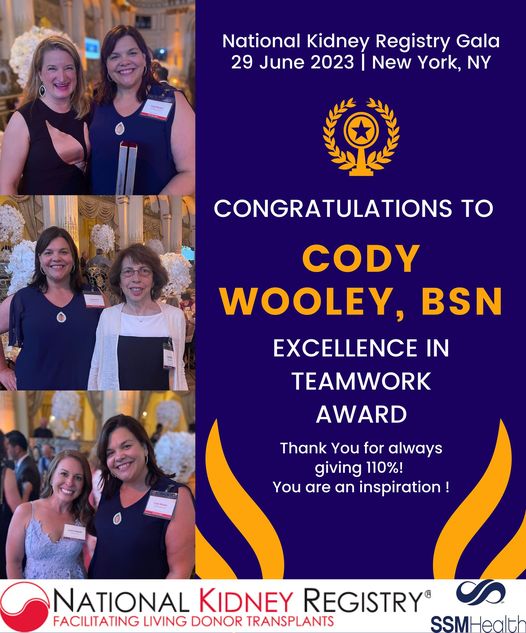
Next, two days later found me in New York City at—of all places!—the Plaza. The occasion was the lavish National Kidney Registry Awards Gala honoring living donors, with a champagne reception followed by a delicious sit-down dinner in a gorgeous hotel ballroom.

I was one of more than a hundred living donors, plus donation professionals, attending from all over the country. One of the dedicated professionals I got to chat with was Cody Wooley, a very engaging donor coordinator from St. Louis University Nephrology Division. Cody was actually one of the professionals honored, and I was delighted to have my photo taken with her before she received the award.

NKR is the world’s largest paired-exchange (aka “kidney swap”) program. Founder/CEO Garet Hil (a living donor himself) started the nonprofit following his family’s desperate search for a matching kidney for his young daughter in 2007.

Since then NKR has facilitated more than 7,000 living donations.Its goal is to increase and improve living donation while removing all the disincentives to being a donor. Here are just a few of the “what ifs” that NKR has successfully addressed, largely through its Donor Shield protections:

… a family member later needs a kidney at some unknown date? Living donors can receive a voucher for their intended recipient to get a kidney months or even many years later.

… I can’t afford the lost wages and extra childcare costs while I’m recovering? Donor Shield reimburses donors up to $17,000 (up to $12,000 for lost wages and up to $5,000 for travel/lodging and dependent care costs).

—I need a kidney transplant myself one day? Living donors through NKR have priority for a living kidney should they ever need one. (Note: Of the 7,000-plus living donations it’s facilitated, NKR has never had a donor need one.)

In addition to the dinner and the impressive stats, the evening included dramatic video presentations on (and talks by) super-athlete living donors who have done multiple marathons, ultramarathons, and summit climbs. The memorable takeaway, of course, is that donating a kidney does not mean a change in an active lifestyle. Full disclosure: most living donors are more like you or me (a healthy daily walker/zumba fan) than an ultramarathoner–but the point is that those who were runners or swimmers or whatever before donation can certainly continue to exercise their passion (other than contact sports) with just one kidney.

Then, on June 30, I attended the National Kidney Donation Organization‘s living donation symposium. There I learned so much exciting new information about kidney transplants that I’ll cover it in a separate post. Stay tuned!

For related posts, resources, and information on The Insider’s Guide to Living Kidney Donation, be sure to explore the rest of my website.

What Country Leads the World in Living Kidney Donation?

I honestly don’t know what I would have guessed if asked which country has the highest rate of living donors. Surely not the United States, with all the financial disincentives—yes, we’re chipping away at them—that still exist.

The answer is Israel, and a recent article in the Forward explains why: largely a result of a dedicated effort spearheaded by a nonprofit group called Matnat Chaim, Hebrew for “gift of life.” Matnat Chaim was founded in 2009 by Rabbi Yeshayahu Heber (a transplant recipient himself, who died years later from covid) and his wife, Rachel.

I’ve long lobbied for and reported here on efforts to support living donation in the United States through the Living Donor Protection Act and other measures. The LDPA is really a very modest step to ensure that life, disability, and long-term care insurance plans can’t discriminate against/penalize living donors; it also would codify the federal regulation that now allows living donors to claim Family and Medical Leave Act protections so they don’t risk losing their job while on leave. Closer than it’s ever been to passage, even this meager legislation has been in the works since 2014!

In contrast, Israel grants one-month paid leave and lower health insurance premiums to living donors—a requirement that began in 2008. If only that were the law here! So many people who can’t afford to take time off work to donate (and may not qualify for financial assistance from the National Living Donor Assistance Center, National Kidney Registry, or other major sources) might be able to consider donation.

Good job, Matnat Chaim! Thanks for setting such a good example. I hope the rest of us can catch up soon.

For related posts, resources, and information on The Insider’s Guide to Living Kidney Donation, be sure to explore the rest of my website.

Let’s Stop Spread of Misinformation on Living Donors

Where is Nicholas Kristof when we need him? Every few months or so I come across a nervous comment from a recent living donor in a Facebook living donors group who has been told she (yes, more often than not, living donors are women) has stage 3 kidney disease– despite being healthy and having relatively normal kidney function. It used to make me mad, now it makes me sad. When I saw one again a few days ago, I meant to go back armed with links to some important articles and one of my blog posts, but I never did. So, as usual, I find I need to dust off this topic and post something again. Please read here. But my platform is just a fraction of what a respected journalist/advocate like @NickKristof can employ. Please, Nick, we need you!

Photo by Pixabay on Pexels.com

For related posts, resources, and information on The Insider’s Guide to Living Kidney Donation, be sure to explore the rest of my website.

She Paid It Forward!

“…One day soon, multiple surgeons, donors and recipients will converge in Gainesville, and like a fine-tuned performance, an intricate ballet of donors and recipients, following multiple operations, lives will be changed. I am honored to be able to donate my kidney to help a stranger in need, to ultimately pay it forward just like the selfless donor family did for Brecon.”  

UPDATE: You may recall the blog post I wrote a few months ago about a woman whose stepson had just gratefully received a long-awaited kidney from a deceased donor this winter in Florida. It indeed changed Brecon’s life, and now his stepmother’s kidney has just changed another young man’s. Stormi Murtie successfully donated her kidney to Justin in a paired donation earlier this month. (Justin’s wife also donated that day to get him into the paired exchange.) Like Brecon, Justin’s search for a kidney was all the more challenging because he reportedly had a 1% chance of finding his match. To everyone’s relief, Stormi was that 1%.

Congratulations, everyone!

Photo by Andrea Piacquadio on Pexels.com

Active Athletes, Artists, Academics All Illustrate After-Transplant Benefits

Riddle: What has three transplanted organs and works full time in a demanding, important career into her seventies?

Answer: Elizabeth (Betsy) Crais, my co-author and friend–the academic energizer bunny–whose retirement party I just attended at the University of North Carolina at Chapel Hill.

Betsy Crais (right, looking the picture of heath) had a kidney transplant in 2004 and a kidney-liver transplant in 2021.

In addition to her regular responsibilities as a professor and researcher, Betsy has taken on numerous roles such as leading a professional association, mentoring students, writing for publication, and more.

Impressive with or without a transplant! It occurred to me that you’ve probably seen stories about athletes who are transplant recipients and have gone back onto the court (Alonzo Mourning went on to win an NBA championship) or singers who’ve gone back on tour or into the studio (think Stevie Wonder), or actors who’ve gone back onto the stage or film set (think Selena Gomez).

But there are many more professors, researchers, contractors, plumbers, lawyers, gardeners–people you pass unknowingly throughout your day–who have been able to lead a full, productive, and rewarding life thanks to an organ donor. It may have even been a living donor (Betsy’s first kidney transplant was from a university colleague friend) or a deceased one (Betsy’s second was a dual kidney and liver transplant from a deceased donor).

Organ transplants give recipients like my son, Paul, a second–sometime a third or more–chance at a full life. If you’re not already registered as an organ donor, please take a couple of minutes to sign up (at organdonor.gov or many other sites).

For related posts, resources, and information on The Insider’s Guide to Living Kidney Donation, be sure to explore the rest of my website.
Alonzo Mourning had a kidney transplant in 2003, returned to the court in 2004, and helped win an NBA championship with the Miami Heat in 2006.
Paul Offen (my son/recipient) had his kidney transplant in 2006.
Actress/singer Selena Gomez had a kidney transplant in 2017.

Stevie Wonder had his kidney transplant at the end of 2019.

Why NOT Donate Life?

As you surely know by now, April is National Donate Life Month. The vast majority of my posts, naturally, are about living donation and transplant and kidneys. I haven’t written much about the more well known topic of organ donation—that is, after death. It’s one of those subjects that make some people uncomfortable (I was one of them, when I was young).

That said, I’m going to give it a try anyway and hope that you’ll keep reading. No matter what I’m writing about, you may have noticed by now, I prefer a light touch and maybe go for a smile or two. So I’m not going to berate anyone who’s not already signed up to be a donor. And I’m not going to drone on about how important it is and how it’s our duty to our community yada yada. You already know that, right? (If not, I might note that more than 100,000 people are waiting for a lifesaving organ in this country—most of them for a kidney—and about 17 people die each day because they didn’t get one in time.)

So what am I going to do here? I’m just going to ask a few simple questions:

1-What percentage of people in this country do you suppose die in a way that even makes it possible for their organs to be donated?

2-If a registered organ donor is dying in a hospital, do you imagine that the doctors and nurses will throw in the towel that much sooner?

3-Are you afraid you might not be “completely dead” when they get ready to recover your organs?

Answers:

  1. Less than 1% (If you’re stunned by that news, you’re not alone. Years ago my guess would have been less than half, but maybe 20% or 30%, but I honestly had no idea.) In other words, the pool is very small.
  2. First of all, they don’t even know—or care—whether you’re a donor or not. Their only concern is saving you, their patient (remember “first, do no harm”?). Secondly, transplant teams don’t get involved until after death is pronounced. In fact, most deceased donors actually come from hospitals that don’t even have transplant centers.
  3. Lots of tests are done—even more than usual–to make absolutely sure that someone is in fact dead.

So, if you’ve read this far, thank you! If you weren’t already signed up, I hope this post has given you something to think about and maybe you’ll go to organdonor.gov–or any of a dozen or more sites (don’t wait to renew your driver’s license!)–to register. If you’re already registered, please share this post with others who may not be or who might know someone who would like to share it.

For related posts, resources, and information on The Insider’s Guide to Living Kidney Donation, be sure to explore the rest of my website.
A Personal Record for Donate Life Month

Happy Donate Life Month! I just got terrific news. This site just surpassed 20,000 hits! Most of course were from the United States but also from 78 other countries since I launched it in 2019!

If you value what you’ve read here, please consider sharing the link and help me spread awareness of living donation, organ transplant, and kidney disease. Thank you!