NC Will “Soon” Have a Living Donor Protection Act!

It’s so close I can taste it.

I actually wrote much of this blog post in late June thinking it was days away, then put it aside thinking I’d wait till it was official that North Carolina would join the other 35 states that currently have living donor protections.

I decided not to wait because nearly three months later, it’s still not official–though it’s closer than it’s ever been.

NC Senate Bill 101 is currently in the Rules Committee of the State Senate just to approve the changes made to the bill by the House. It shouldn’t take long but…

We–donation advocates, donors and recipients alike–have been working to prohibit discrimination against living donors by insurance companies and to provide various job protections for several years. I personally have been in the fight since 2019.

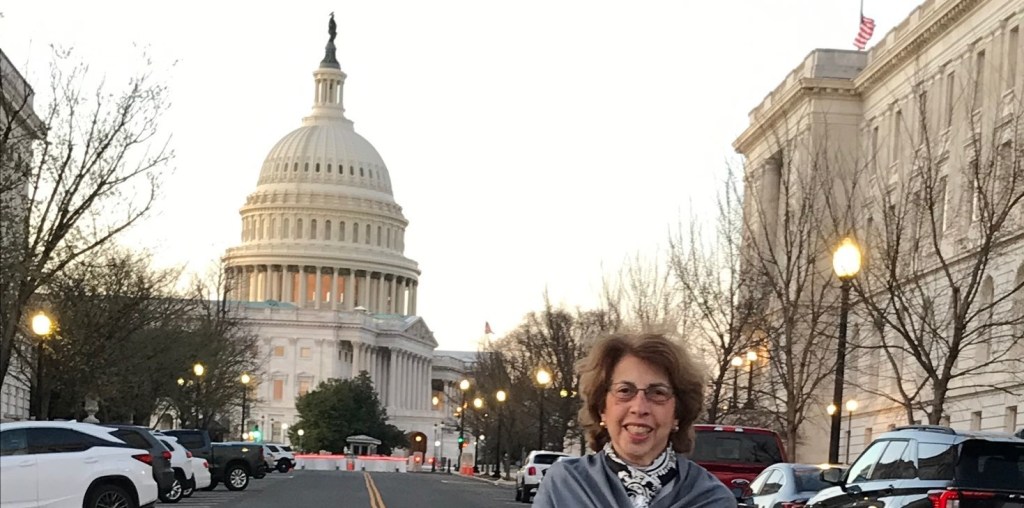
Nearly six years ago, I first met with a NC state legislator (Rep. Willingham, center of photo) and several aides for other lawmakers at the General Assembly; five years ago I had coffee in district with a state legislator; four yeas ago I gave public comment; three years ago I attended a legislative breakfast with a few state legislators to give them a personal perspective on living donation. Throughout, I’ve made countless phone calls and written several blog posts to demonstrate support.

Each legislative session, we thought this would be the one, we’d finally make it–only to miss out at the last minute and we’d need to start from scratch in the next legislative session. Last year it was because a feud between state legislators had led one of them to block the bill.

And then, in June, to my shock and delight, I learned in a meeting that the General Assembly had just passed the bill. I couldn’t find anything online about it as it went through its final formal paces.

Then about a month later I learned that it was headed to the governor’s desk, awaiting his signature.

It wasn’t.

There’s one more hurdle: the Rules Committee, which is where it’s been sitting since late June.

So this week, along with other advocates, I called the bill’s primary sponsors to urge them to try to persuade the Rules Committee to bring it to a vote.

If you’re in North Carolina, please contact your state senator and ask them to do the same. Note that this bill has been approved by both the House and the Senate.

For living donors in the state, I’m happy to report that the bill goes a little further than the national version that’s been hiccuping through Congress since 2014. The NC version gives public employees two weeks of paid leave to donate. In addition to protections for living donors, the bill protects tax-advantaged accounts such as college tuition programs and ABLE accounts for individuals with disabilities.

Here’s hoping that the next post I write on this topic will be a clear-cut triumphant one.

For related posts and information on my book, The Insider’s Guide to Living Kidney Donation, be sure to explore the rest of my website and my articles at Medium.com/@caroloffen.

New Year’s Resolutions No Matter How Many Kidneys You Have

Every year before I make new new year’s resolutions, I look back to see how I did on last year’s. Alas, they’re almost always still relevant. I don’t think I’m unusual in that respect. I know that in a few weeks, for example, my Zumba classes and the workout area of my gym are going to be jammed. I used to be alarmed about overcrowding but soon saw that in a matter of weeks, the crowds invariably start to thin, and by late February they’re always back to near-usual levels.

So, once again I’m dusting off my old new year’s resolution blog post with a few updates. They’re relevant for everyone–if you’re a donor or never plan to be one.

Whether you’re already being evaluated as a living donor, or just thinking about it, here are a few suggestions that will benefit you and your kidneys–wherever they happen to be.

1- Take good care of yourself (and your kidneys). That means

–Exercising regularly. My friends all seem to like pickle ball, but I’m sticking with Zumba and strength training.

–Getting plenty of rest. Alas that’s a hard one for many of us. We can at least follow the simplest rules: no screen time a couple of hours before bedtime, no late meals, and avoid caffeine and alcohol late in the day. Also be sure to factor in some quiet downtime before bed.

–Staying hydrated. This one was reinforced for me just recently when I had a scare about my kidney function.

–Eating a healthy diet. Mostly that means a balanced diet with fresh foods–no extremes on any component. And avoid ultra-processed foods!

2-For your safety and your future recipient’s, be sure to get the latest Covid booster. Many people who were vigilant about that earlier have slacked off, but Covid is still around. The boosters are still important! Also, transplant recipients and anyone else who is immunocompromised, such as people with cancer or autoimmune diseases, can’t count on full protection from the vaccines. It’s all the more important that the rest of us add that extra layer of protection.

3-Avoid ibuprofen and other NSAIDs. They’re hard on the kidneys for anyone—particularly important if you’re a donor or recipient.

4-Learn about kidney function and get yours checked. Kidneys are amazing!

5-Read up on all facets of kidney donation. For example, order a copy of The Insider’s Guide to Living Kidney Donation.

To all of you and your loved ones: a happy and healthy new year!

For related posts and information on my book, The Insider’s Guide to Living Kidney Donation, be sure to explore the rest of my website.

Help Is on the Way: HOLD Act Advances!

If you’ve never heard of the HOLD (Honor Our Living Donors) Act, I can assure you this is good news! Great news, in fact, for potential living donors, so, by extension, for potential kidney recipients. If this bill becomes federal law, the National Living Donor Assistance Center, or NLDAC, would consider only the donor’s income–not the recipient’s, too–when deciding whether to provide critical financial assistance and reimbursement to donors. Seems logical, don’t you think? And yet, for years, NLDAC has perversely considered both.

Photo by Nataliya Vaitkevich on Pexels.com

As a living donor to my son, I can tell you that the very idea of putting both potential donor and recipient in such an untenable position makes me want to scream. I explained more when I wrote about it here last fall when the bill was introduced.

Okay, but that was in November. What’s the great news?

Remember, now, this is federal legislation so everything moves very slowly (need I remind you about the Living Donor Protection Act?). That said, this particular bill has had bipartisan support, has already been referred to a committee (Energy and Commerce) and, last month, passed unanimously!

The HOLD Act now awaits consideration by the House as a whole. Please contact your member of Congress and urge him or her to lend support to the HOLD Act, HR 6020. If they are already sponsors or cosponsors, be sure to thank them!

For related posts and information on my book, The Insider’s Guide to Living Kidney Donation, be sure to explore the rest of my website.

Living Donors Don’t Get Paid (Yet) But the Rewards Are Still Real

Maybe you’ve heard that there’s a growing movement to find a way to fairly compensate living donors as a way to address the dire kidney shortage. It’s in the form of the Coalition to Modify NOTA (the National Organ Transplant Act). Simply put, NOTA is the reason that though we can pay people to donate blood or sperm or even to carry our baby, we can’t do the same for living donors. I’ll be writing more about this in the coming weeks.

Photo by Pixabay on Pexels.com

But in the meantime, most people who have donated their kidney will tell you that the nonmonetary rewards of donation are undeniable (which by no means makes compensation any less justified). I update and dust off the blog post below every year or so because it really bears repeating.

Living donors have told me they’d nodded in agreement while reading it, and many people point out that even though these things are pretty obvious to donors, transplant centers usually don’t give them sufficient weight.

**********************************************

In previous posts, I’ve described some of the enormous benefits of a live vs. deceased-donor kidney transplant for the recipient, but did you know that there are many very real benefits to the living donor, too? For family members or couples, the benefits are nothing short of dramatic. And I’m not just talking about feel-good points.

For a family, the practical benefits can be as concrete as money in the bank. A spouse or parent whose ability to work was limited by dialysis for a long period may gradually be able to resume a full-time schedule–maybe even launch a new career. That can substantially improve the family’s ailing financial health as well.

For family caregivers, particularly, donating a kidney to the loved one you’ve been caring for can bring huge relief. The reduced stress and no doubt improved sleep can have considerable benefits in energy, mood, overall outlook, and, as a result, even job satisfaction.

Then there’s the extraordinary motivation of saving a loved one’s life or turning it around. A living donor I know who’d donated to her husband described her decision as “purely selfish. I wasn’t about to lose him,” she insisted. I know the feeling.

Seeing someone you love–in my case, my adult son–who’d been pale, weak, and listless for months or years gradually become their old self again is pretty powerful. And a donor whose partner wasn’t interested in intimacy during a long period of ill health may see a positive change in their relationship.

Want to improve your social life? Give your partner a kidney! Couples who have been uncomfortable for a long time about socializing—whether because of physical obstacles or simply due to the dialysis patient’s lack of energy or interest—may soon be able to enjoy evenings out with friends or family.

For anyone who donates a kidney—even to someone they don’t know—the benefits are nearly universal:

The feeling of personal gratification is indescribable. Knowing that you’ve helped give someone—anyone—a shot at a healthy, productive life—is an extraordinary feeling. Living donors in studies report a boost in self-esteem, and 9 out of 10 say they would do it again. Through donor-support groups I’m active in on Facebook, I’ve been struck by how life changing the experience has felt for most of us, including the few who have later had complications or whose recipient didn’t fare well for as long as expected.

A fascinating journal article inspired this post. The researchers argue that for the above reasons and more, transplant centers considering a potential donor’s relative risk might do well to acknowledge and give weight to the undeniable tangible benefits for certain donors.

“Van Pilsum Rasmussen, S. E., M. Henderson, J. Kahn, and D. Segev. “Considering Tangible Benefit for Interdependent Donors: Extending a Risk–Benefit Framework in Donor Selection.” American Journal of Transplantation 17, no. 10 (Oct. 2017): 2567-2571.

For related posts and information on my book, The Insider’s Guide to Living Kidney Donation, be sure to explore the rest of my website.

My Favorite Activist: Maggie Kuhn

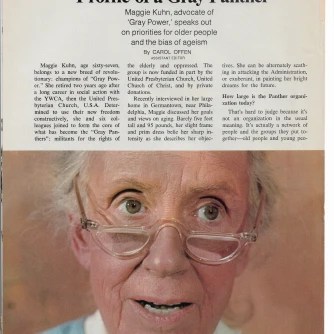
Today (August 3) is the birth date of someone you may not have heard of but who deserves to be remembered and honored: Maggie Kuhn, the engaging founder of the Gray Panthers. Maybe you saw my recent recollection on Medium of my interview with her in the 1970s or recall my blog post here You’re Never Too Old to Be an Activist.

Full disclosure: Maggie Kuhn had nothing to do with kidney donation or protections for living donors–not directly, anyway. But she was a role model for me and should be for anyone who’s ever hesitated to step outside their comfort zone to advocate for something they believe in.

“Speak your mind,” she famously said, “even if your voice shakes.” After having to take mandatory retirement at age 65, Maggie spoke hers at rallies, before boards, and congressional committees as she fought for rights of older Americans and protections for the most vulnerable in society.

I hope you’ll check out the links in this post to learn a bit about Maggie Kuhn and be inspired by her, as I was.

For related posts, resources, and information on The Insider’s Guide to Living Kidney Donation, be sure to explore the rest of my website.

UPDATE: How States Rank in Living-Donor Protections

Last year about this time I published a post about living donation-related protections and benefits, by state. As I mentioned then, while awaiting passage of a federal Living Donor Protection Act, more than half of states have enacted their own version (it’s now 31). In fact, like the one we’ve been supporting in North Carolina, some state bills are actually are more generous than the federal version (by including paid leave for state employees who donate).

United States Map With State Names Pdf Valid Printable Map Of | Printable Map Of The United States Pdf – Printable US Maps

But the LDPA is just one way that states can encourage living donation. Financial supports and job protections are other critical ones. I decided to check on the status of those efforts and the resources I provided last year–to include updates and new links as needed.

Are you considering being a living donor, or have you donated recently? Do you know what the relevant tax provisions and protections are in your state–or in a state you may be looking at? It’s worth doing your homework.

The National Kidney Foundation has a terrific resource in a map you can click on to find out what donation-related laws and protections a particular state offers. Does it have a Living Donor Protection Act, or similar insurance-discrimination protections? Does it also have job-protected living donor leave for private employees? How about for state employees? What about paid leave? What about tax deductions? Even better, what about tax credits?

The American Kidney Fund website also features an invaluable resource: a state report card. It rates each state based on important donation-related measures and provides an overall rating on how well that state encourages living donation and removes barriers. Though I’m happy to report there has been some progress in the past year, it’s not nearly enough. Not surprisingly, only a few states still merit an A: Arkansas, Connecticut, and Louisiana. Glad to see that 16 now get Bs, and 14 (plus Washington, DC) have Cs, but several get Ds (including, alas, North Carolina).

Unfortunately, seven states rate an F–that is, these states failed miserably because they have no donation-related measures in place: Alabama, Michigan, Montana, New Hampshire, South Dakota, Tennessee, and Vermont. Earlier this year Nevada and Wyoming passed anti-insurance discrimination laws, moving them up to a D; Rhode Island just passed its version in late June, moving it up to a C. That brings the national average grade to a C, up from D when AKF began the report card system in 2021.

The irony–and real tragedy–is that none of these donation measures is really controversial–they shouldn’t be so damn hard to pull off. They are simple, reasonable, common-sense ways that a state can demonstrate its support for people who help save a life in this way. In fact, not only does encouraging living donation save lives, for kidney patients it reduces costs by reducing the number of people on dialysis (Medicare pays about $90,000 a year per dialysis patient).

With 103,600 people in this country on the national transplant waiting list (about 4 out of 5 needing a kidney), it seems that the very least we can do is remove the barriers to living donation.

For related posts, resources, and information on The Insider’s Guide to Living Kidney Donation, be sure to explore the rest of my website.

What Country Leads the World in Living Kidney Donation?

I honestly don’t know what I would have guessed if asked which country has the highest rate of living donors. Surely not the United States, with all the financial disincentives—yes, we’re chipping away at them—that still exist.

The answer is Israel, and a recent article in the Forward explains why: largely a result of a dedicated effort spearheaded by a nonprofit group called Matnat Chaim, Hebrew for “gift of life.” Matnat Chaim was founded in 2009 by Rabbi Yeshayahu Heber (a transplant recipient himself, who died years later from covid) and his wife, Rachel.

I’ve long lobbied for and reported here on efforts to support living donation in the United States through the Living Donor Protection Act and other measures. The LDPA is really a very modest step to ensure that life, disability, and long-term care insurance plans can’t discriminate against/penalize living donors; it also would codify the federal regulation that now allows living donors to claim Family and Medical Leave Act protections so they don’t risk losing their job while on leave. Closer than it’s ever been to passage, even this meager legislation has been in the works since 2014!

In contrast, Israel grants one-month paid leave and lower health insurance premiums to living donors—a requirement that began in 2008. If only that were the law here! So many people who can’t afford to take time off work to donate (and may not qualify for financial assistance from the National Living Donor Assistance Center, National Kidney Registry, or other major sources) might be able to consider donation.

Good job, Matnat Chaim! Thanks for setting such a good example. I hope the rest of us can catch up soon.

For related posts, resources, and information on The Insider’s Guide to Living Kidney Donation, be sure to explore the rest of my website.

A Playful Homage to My (Remaining) Kidney

In honor of National Kidney Month, I try to do my part as an advocate–and a living donor–to spread awareness of kidney disease, kidney donation, and organ transplant. I’ve had a healthy respect for kidneys ever since I first accompanied my son to his dialysis sessions many years ago–before I gave him my kidney in 2006, of course. If, like me, high school biology class was not your favorite, reading about what kidneys do may make you run the other way–or at least stop scrolling. So, I offer here this playful homage to kidneys–in an updated blog post. I hope you read it through to the end and share it with anyone who would otherwise run the other way.

Like most people, I was born with two kidneys and they’ve served me well. Since 2006, the left one has been working in my son’s body and doing a terrific job. That’s the one that gets all the attention. So, at the beginning of National Kidney Month, I thought it only fair to devote this blog post to that unsung hero, my remaining kidney.

It (he? she?) has worked solo ever since its partner moved to my son’s body so many years ago. Is it lonely? Does it feel abandoned, I wonder.

I’m a bit ashamed to admit that she (yes, I’ve decided it’s a she) doesn’t even have a name. After an informal contest among friends and family, my son’s (formerly my) kidney was dubbed “the Comeback Kidney.”

But my righty has never clamored for attention or tried to claim the spotlight from her perch above my waist toward the back. She’s been doing a masterful job, taking up the slack ever since her partner upped and left, with nary a complaint.

Initially, as was expected, I lost 25% to 35% of overall kidney function. But my little fist-sized pal gradually got a little plumper, and my kidney function built up to a normal level. As I’ve written before, even if she hadn’t managed her own “comeback,” a slightly higher new normal for a living donor is just fine.

Not only did she rise to the task, in fact, she exceeded expectations. Filtering waste from my blood, reflected in creatinine level, is probably her biggest job.  A “normal” creatinine reading for most women is under about 1.0. At my last check-up, mine was .81, enviable at any age. Even my GFR, a formula that uses creatinine plus age, sex, (no longer race!), and weight to estimate overall kidney function, is an impressive .76 (anything over 60 is normal). It’s common for anyone’s kidney function to decline with age, so at nearly 75 years old, I’m very proud of that reading.

If keeping toxins out of my blood were all that she did, I’d still be justifiably proud of her. But she does so much more. She keeps my blood pressure down, removes extra fluid, makes urine, balances nutrients, makes red blood cells to keep me from being anemic… I could go on. Think about it: she’s been doing all that alone. You’d never know it from my lab work, of course, which would be impressive for a healthy nondonor of any age.

Thank you for all that you do, righty! (True, it’s not the most original name, but I think I’ll use it till I can think of something more creative.)

I’ve never seen a lung-shaped swimming pool, have you? Or a pancreas bean? Other than the heart, can you think of any bodily organ that’s so recognizable and endearing enough to inspire cuddly plush toys? Obviously, there’s good reason for that honor.

For related posts, resources, and information on The Insider’s Guide to Living Kidney Donation, be sure to explore the rest of my website.

Contributor Spotlight: Emotional Challenges of Caregiving

Some people support living donors and transplant recipients not only on a practical basis but emotionally. Two of The Insider’s Guide to Living Kidney Donation‘s contributors are authorities on the subject. One is a licensed professional counselor, Kathleen Fitzgerald, whose clients often include families contending with the emotional fallout of kidney failure, transplant, or any serious chronic illness. The other, Sharon Williams, also has a professional perspective. She is a researcher who specializes in family caregivers for someone with a severe chronic illness.

Contributor Sharon Williams blows out the candles at a recent birthday celebration with family and friends.

Sharon also knows the subject firsthand, because for nearly 20 years she was a caregiver for her spouse while he was dealing with chronic kidney disease, liver disease, and later a transplant. In her chapter of the book, she explains that she eventually realized that her research hadn’t prepared her for the difficult emotional challenges of this kind of caregiving. She shares the valuable lessons she learned along the way. Spoiler alert: it’s wise to let the patient take the lead in planning how to proceed and be ready to support those very personal decisions.

Sharon has since transitioned to phased retirement, working roughly half-time until she retires from her current university position in two years. Today she enjoys spending time with family and friends, including her church family, “a blessing I treasure more and more each day.” Sharon also enjoy walks with her dog and dancing, especially line dancing.

Contributor Kathleen Fitzgerald counsels families facing emotional challenges of a health crisis.

Kathleen’s chapter describes the various ways that families contend with highly charged emotional situations related to health crises. She explains the diverse approaches people try–often unsuccessfully–and then offers helpful case studies of different scenarios, describing why some approaches were beneficial. These different perspectives will resonate with many readers–regardless of whether or not their family member is considering donation or transplant.

It all comes down to the undeniable truth that donation and transplant are far more than medical decisions and experiences. They touch families and friends in profound, multifaceted ways. The ripple effect extends far beyond the individual and even the family unit.

Be sure to read Sharon’s and Kathleen’s complete chapters. If you haven’t already ordered your copy of The Insider’s Guide, you can do so here.

For related posts, resources, and more information on The Insider’s Guide to Living Kidney Donation, be sure to explore the rest of my website.

Why Is Living Donation So Important?

According to polls, the vast majority (90%) of Americans favor organ donation after death–yet, only about 60% are registered to be organ or tissue donors.

Just curious, what percentage of people in the United States would you guess die in such a way that traditional organ donation is possible? A third? A fifth? Not even close! Less than 1 percent: typically, in a hospital following an accident. So, no, not at home in their beds, not on impact in a car crash, often not even after a slow death from myriad diseases.

That little heart on your driver’s license is just one way to make it known that you want to be a donor. It takes just a minute to register online at many sites.

Traditional organ donation 101: When a dying person has been determined to be brain dead—no activity, no chance of survival—but the heart is still beating, blood is flowing to their internal organs. Once the organ has been removed from the blood supply, the sooner it’s placed in the recipient’s body, the better. With luck it’s off the blood supply for only a few minutes or hours. When it’s necessary to put it on an airplane, that interruption may last several hours—technically, 24 to 36 hours is acceptable, but the sooner it can be hooked up to the recipient’s veins, the better.

So most of the 100,000 people on the national waiting lists may languish several years–5 to 10 is not uncommon–before they receive a lifesaving organ (most of them are waiting for a kidney), and thousands don’t get one in time. Clearly, we need more people to be registered donors.

So, absolutely, register to be an organ and tissue donor (organdonor.gov is one of many sites where you can register in just a couple of minutes), and tell your family of your desire (and then urge them to do the same). But even if everyone complied, we’d still have an organ shortage because of that 99% that can’t be used in traditional donation.

That’s where live donation comes in. Not only does it add to the pool and shorten the wait, it even improves the outcome for most transplant recipients. And we need to remove obstacles for potential donors so that more people will consider being living donors. Tell your representatives–in your state and nationally–to support the Living Donor Protection Act and to increase funds for financial assistance for living donors and for early detection of chronic kidney disease.

An important health crisis as urgent and daunting as an organ shortage deserves more attention, more funding, and a meaningful commitment to finding creative solutions.

For related posts, resources, and information on my new book, The Insider’s Guide to Living Kidney Donation, be sure to explore the rest of my website.