Why You Should Know More About Your Kidneys Than You Do

The following article, which I wrote, appeared originally in Wise & Well, a Medium.com publication, on Feb. 13, 2025.

If you saw recent headlines about clinical trials for transplanting modified pig kidneys into humans, you may have wondered why scientists would even think about doing such a thing.

The simple reason is that there aren’t nearly enough human kidneys available, living or deceased, to meet the growing need. About 800,000 people in the United States have kidney failure. About 37 million people — one in seven — in this country have chronic kidney disease, meaning that they’re slowly losing kidney function. The real tragedy is that 90% of them don’t know it.

Photo by Pixabay on Pexels.com

Simply knowing the level of your kidney function–that is, how effectively your kidneys are working–could save your life.

Chronic kidney disease is usually asymptomatic until it’s progressed to kidney failure and sometimes not even then. Often it’s discovered when someone gets a screening at a Kidney Walk event to raise awareness of kidney disease. Or someone may go to the emergency room for a possibly unrelated problem.

If the kidneys are failing, that person immediately is put on dialysis, a process that removes toxins and excess fluid if the kidneys can’t do the job. The patient will need dialysis — but, ideally, a new kidney — to stay alive.

If kidney disease is caught in the early stages, however, the condition can frequently be reversed through healthful eating, exercise and possibly medication. In any case, disease progression typically can be slowed with proper treatment. Once the disease reaches kidney failure, though, it‘s too late to turn it around.

Contrary to popular notions, kidney disease can strike anyone, not only older people or those with diabetes or poor eating habits.

When my family got the news

My son was diagnosed with kidney disease when he was in college, and the news came out of left field for us. We did not have a family history of kidney disease, and he had none of the usual risk factors (diabetes, hypertension, obesity). His condition, discovered in lab work, was the unexpected and devastating result of a strep infection.

We were told that because he was young and otherwise healthy, the disease might never progress to kidney failure; in any case it could take many years. His condition was monitored for a few years, and then, inexplicably, his kidneys failed just months after his college graduation.

He spent 20 long months clinically depressed as he underwent in-center dialysis, until I could donate my left kidney to him. Eighteen years later, the one I gave him is still going strong. My right one still gives me normal kidney function–that is, a GFR, or glomerular filtration rate, of 60 or higher; mine is 76. At nearly age 77, I have an active, healthy life, as do most living donors.

Before my son’s initial diagnosis I knew nothing about kidneys and kidney disease. I was not alone in my lack of awareness. As an active kidney donation advocate for almost a decade since then, I’ve met dozens of fellow living donors and even more transplant recipients. Interestingly, almost all of them say that they too knew nothing about this all-important organ until the disease affected their own family.

Don’t wait till you have a personal connection to learn about your kidneys and kidney transplantation.

A Quiz

How well are your kidneys functioning?

Chances are good that you don’t know this extremely important piece of health information. If that’s the case, ask your doctor to check ASAP so you can start taking control of your health care. All that’s needed is a simple blood test.

Now test your knowledge of some basic kidney-related facts. True or false?…

1. More than 100,000 people in the United States are waiting for an organ (most of them for a kidney) from a deceased donor.

True.

The number currently waiting for a kidney is about 90,000. Not every patient is a candidate for a transplant, depending on their condition and comorbidities. About 27,000 kidney transplants — from both living and deceased donors — were performed last year. That obviously leaves a huge gap.

Most of the people with kidney failure are on dialysis.

2. For patients with kidney failure, dialysis is a simple, comfortable treatment that can replace all or most of normal kidney function.

False.

Dialysis is not a substitute for a new kidney; it provides only about 20% of normal kidney function. The process also exacts a heavy toll on the body: although many kidney patients live on dialysis indefinitely, the average survival rate after five years is less than 50%.

For most people on dialysis, the quality of life is very difficult. Patients are tethered to a machine for hours at a time at least three days a week. After each session they typically feel fatigued for hours. Depression is common.

Some people adjust better to dialysis than others, particularly if they can do home dialysis relatively comfortably. That usually entails overnight treatments that may enable them to have a normal work schedule.

3. Most people in kidney failure have to wait several weeks to get a lifesaving kidney.

False.

Most wait several years for a call that an appropriate deceased-donor kidney has become available, depending on where they live, their blood type, their condition, and other factors. It’s not uncommon to wait 10 years in some states. More than a dozen people die every day because they didn’t get one in time — or they are removed from the list because they became too sick for a transplant to be feasible.

If a person finds a living donor, however, the wait can be dramatically shortened to a matter of months, the transplant can be performed at an optimal time for both donor and recipient, and the recipient can be removed from the long national waitlist, making the wait that much shorter for everyone else on the list.

An added bonus: Live-donor kidneys typically have a better outcome and last twice as long on average as one from a deceased donor.

4. If I’m registered to be an organ donor after I die, I know that my organs will save someone’s life.

False.

Currently, about 58% of Americans are registered as organ donors even though more than 95% are said to favor organ donation. Signing up is extremely important, and we need to increase that percentage (sign up here). Even so, however, less than 1% of people die in such a way that their organs can be donated (typically in a hospital on a ventilator, once someone is brain dead, to keep the heart pumping blood).

5. We have two kidneys and we need both for good health.

False.

Most of us have two kidneys, but many people are born with just one kidney and usually live healthy productive lives. Sometimes they don’t even know they have only one. That’s why living kidney donors, like me, gradually regain normal kidney function as the remaining kidney takes on much of the work of its former mate.

6. Living donors must be a biological relative of the person to whom they want to donate their kidney.

False.

That has historically been the case (I am), but it’s less so in recent years. Increasingly, spouses, partners, friends and neighbors — even strangers — are choosing to donate. Thanks to improved antirejection medications, you don’t need to be a so-called “perfect match” at all. However, you do need to be the same blood type for starters.

Even that criterion is no longer a deal breaker when there’s an otherwise eligible healthy donor. Thanks to the practice of paired donation, an incompatible donor and recipient can “swap” with another mismatched pair to find a good match. The National Kidney Registry, for example, has a huge computer database to help potential recipients find the best possible match among potential donors.

7. You have to be young to be a living kidney donor.

False.

I was 58 when I donated, and I know people who donated in their mid-70s. What’s most important is the health of the donated kidney and the potential donor’s overall health, to ensure that donation will not jeopardize the donor’s own health and quality of life.

8. Donors need to take kidney-related medication and restrict activity for the rest of their lives. And they can’t drink alcohol.

False.

Donors should simply eat a healthy diet, stay hydrated and exercise regularly. Because alcohol is processed through the liver, not the kidneys, there are no kidney-specific cautions concerning alcohol. Most living donors have an active lifestyle. Many even run marathons and some have climbed mountains. (I’ve never been athletic but I do Zumba twice a week — and it’s not Zumba Gold!)

9. Living donors can get paid for donating their kidney.

False.

The recipient’s insurance pays for the donor surgery and evaluation, and several organizations will now reimburse donors for related expenses such as lost wages, childcare and eldercare, transportation and lodging if applicable. However, direct payment for donating an organ is illegal in the United States.

In an effort to dramatically increase the number of living donations, which has remained static for many years, there is a growing movement to change the law. The End Kidney Deaths Act, which would provide nonrefundable federal tax credits for nondirected donors–that is, donors who do not have a specific recipient in mind–was introduced in the last session of Congress.

10. If a celebrity or millionaire needs a kidney, he or she can go to the top of the waitlist for a deceased donor.

False.

No one can break into the line. The waitlist doesn’t work that way anyway. It’s managed by the Organ Procurement & Transplantation Network, or OPTN, a public-private partnership that links donation professionals in the United States. Deceased-donor kidneys are allocated based on a highly complex system that considers blood and tissue match, how long someone has been on dialysis, the kidney patient’s condition, geographic location and myriad other factors.

I hope this has piqued your interest in kidneys and organ donation. Start by finding out your own kidney function number. If you want to learn more about these important topics, here are a few respected websites:

For related posts and information on my book, The Insider’s Guide to Living Kidney Donation, be sure to explore the rest of my website and my other articles on Medium.

Minority Donor Awareness Needs to Be on Our Radar Year-Round

Last year I wrote a blog post here in August about it being National Minority Donor Awareness Month and mentioned several of the inequities stemming from both medical realities and policies. The medical ones are caused by the ripple effect from minorities being more at risk for certain diseases: chronic kidney disease, for example, rates of kidney failure in black people are 3x as high as those in white people. The policy ones–more complicated–result from many of the inherent and pervasive inequities in our healthcare system.

I started and ended that post by saying that this important subject deserves to be on everyone’s radar every month, not just in August. So…when I realized it was now September and I hadn’t written a blog post about it yet, for a variety of unrelated reasons, I decided to make my point by choosing to spread the word in September–and beyond.

So please do read that post about minority donor awareness, including the links on where to get even more information, plus printed and social media materials. We’ll never succeed in substantially reducing those inequities if we don’t increase awareness equally substantially.

For related posts, resources, and information on The Insider’s Guide to Living Kidney Donation, be sure to explore the rest of my website.

ASKing Congress–for a “Friend”

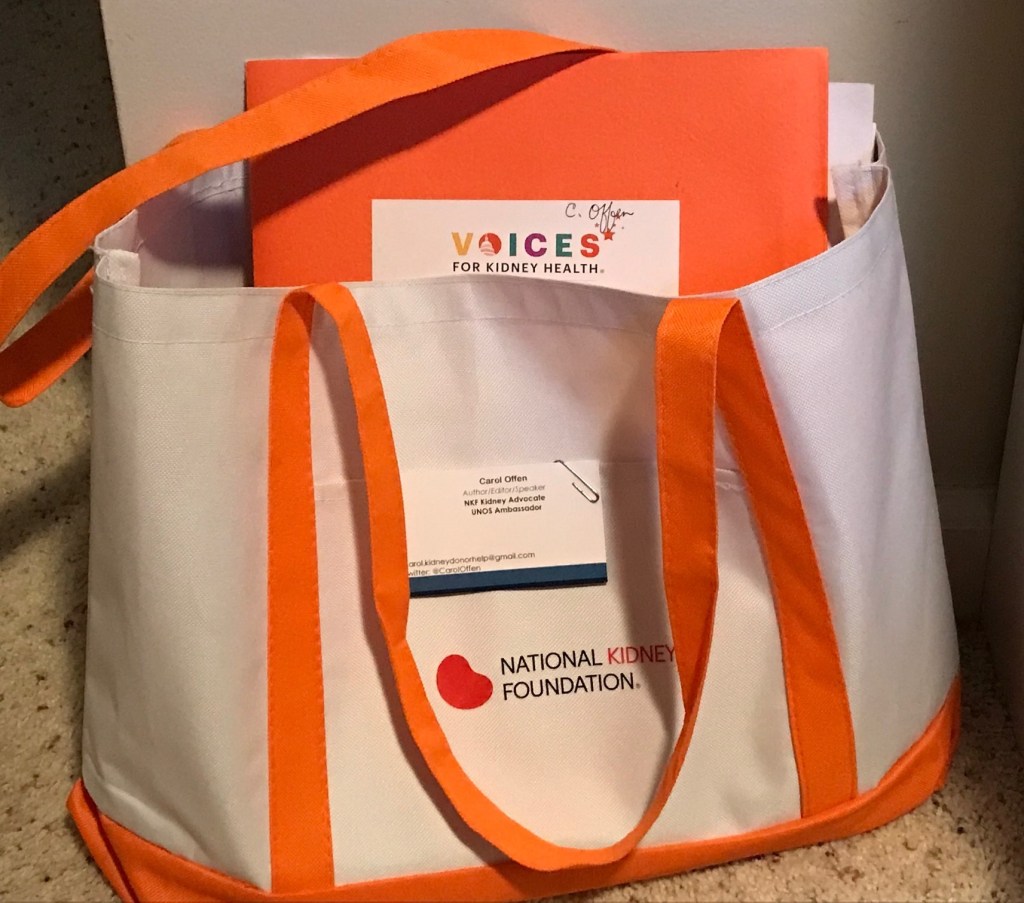
My bags are packed, and I’m ready to approach federal legislators and/or their staffers again along with other advocates from the National Kidney Foundation. As usual, we have very important asks.

If you’ve read even a few of my posts since I launched this site in 2019, you know that I’ve been lobbying for the Living Donor Protection Act–both on Capitol Hill and in my state, North Carolina–for several years. So, yes, our number-one ask is for this session of Congress to finally move ahead with this bipartisan (yes!), noncontroversial, bare-bones legislation that’s been kicking around Congress since 2014.

This bill to prohibit discrimination by insurers against living donors–through higher premiums or coverage refusal–gets reintroduced every session. There may be a new sponsor, if one of the originals is no longer in office, more cosponsors…and then it sits. It’s yet to have a committee hearing, much less a vote. This shouldn’t be so hard.

The second ask is a newer one that could benefit so many people currently on dialysis. The majority (about 85%) of dialysis patients receive hemodialysis at a center, where they go three times a week for three to four hour sessions. Not everyone lives near a center and may need to travel more than an hour by car or city bus(es) to get there. We want Congress to improve access to home dialysis for patients who choose to do it, by providing funds for training and professionals to actually go to people’s homes in the first few months to help them learn how. It could be a game changer by enabling someone to do dialysis on their own schedule and even facilitate their being able to fit sessions around their work hours.

The third ask is about modernizing and improving the national transplant system that allocates deceased organs. Nearly 100,000 people are on national waiting lists (most of them for a kidney), and most wait several years. The system is extraordinarily complex and there are appalling instances of wasted organs. Most everyone agrees it needs to be more efficient and transparent, so more people can get a transplant after a shorter wait. Congress passed an act to modernize and improve the system last year. What we need now is for lawmakers to provide the necessary $100 million funding to carry it out.

The fourth ask, and in the long run arguably the one with the most lasting potential benefit, concerns early screening for kidney disease. My symbolic “friend” in the kidney community probably isn’t even aware of being among the estimated 37 million Americans with chronic kidney disease. Yup, 90% of that population haven’t even been diagnosed yet and don’t know that their kidneys are gradually–sometimes not so gradually–losing function.

Confused? Let me clarify the difference between chronic kidney disease and kidney failure. Diseased kidneys slowly lose function over years–even decades–before they reach kidney failure, during which time there may well be no obvious symptoms. Once they fail, though, the only way to save someone’s life is with a transplant, or, in the meantime, dialysis. People with diabetes and/or high blood pressure are at the highest risk of developing kidney disease. So if doctors routinely screened these patients for kidney disease (with a simple blood test), millions of lives could be saved.

With early detection, not only can that disease progression be slowed, it can often even be reversed, through behavioral changes–exercise, healthy diet, hydration–and medication. We’re asking members of Congress to sign a letter in support of official guidelines for screening.

These are pretty straightforward noncontroversial asks. I’ll let you know how it goes.

For related posts and information on my book, The Insider’s Guide to Living Kidney Donation, be sure to explore the rest of my website.

Contributor Spotlight: Emotional Challenges of Caregiving

Some people support living donors and transplant recipients not only on a practical basis but emotionally. Two of The Insider’s Guide to Living Kidney Donation‘s contributors are authorities on the subject. One is a licensed professional counselor, Kathleen Fitzgerald, whose clients often include families contending with the emotional fallout of kidney failure, transplant, or any serious chronic illness. The other, Sharon Williams, also has a professional perspective. She is a researcher who specializes in family caregivers for someone with a severe chronic illness.

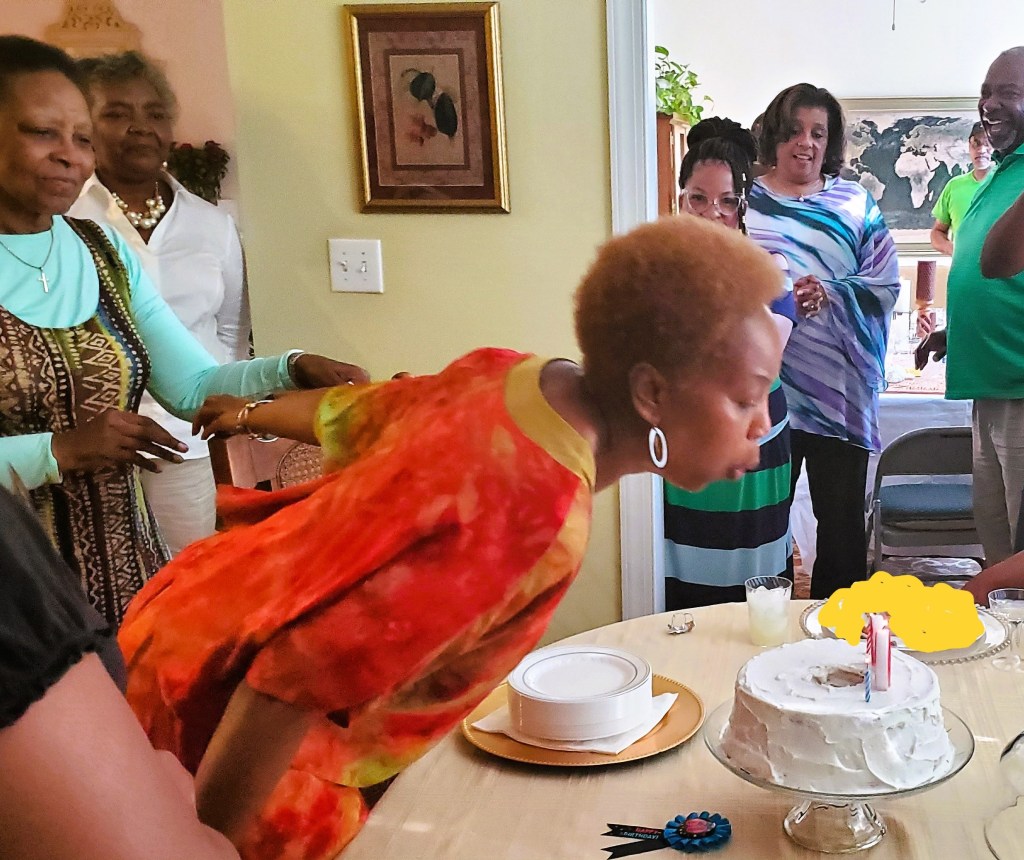
Contributor Sharon Williams blows out the candles at a recent birthday celebration with family and friends.

Sharon also knows the subject firsthand, because for nearly 20 years she was a caregiver for her spouse while he was dealing with chronic kidney disease, liver disease, and later a transplant. In her chapter of the book, she explains that she eventually realized that her research hadn’t prepared her for the difficult emotional challenges of this kind of caregiving. She shares the valuable lessons she learned along the way. Spoiler alert: it’s wise to let the patient take the lead in planning how to proceed and be ready to support those very personal decisions.

Sharon has since transitioned to phased retirement, working roughly half-time until she retires from her current university position in two years. Today she enjoys spending time with family and friends, including her church family, “a blessing I treasure more and more each day.” Sharon also enjoy walks with her dog and dancing, especially line dancing.

Contributor Kathleen Fitzgerald counsels families facing emotional challenges of a health crisis.

Kathleen’s chapter describes the various ways that families contend with highly charged emotional situations related to health crises. She explains the diverse approaches people try–often unsuccessfully–and then offers helpful case studies of different scenarios, describing why some approaches were beneficial. These different perspectives will resonate with many readers–regardless of whether or not their family member is considering donation or transplant.

It all comes down to the undeniable truth that donation and transplant are far more than medical decisions and experiences. They touch families and friends in profound, multifaceted ways. The ripple effect extends far beyond the individual and even the family unit.

Be sure to read Sharon’s and Kathleen’s complete chapters. If you haven’t already ordered your copy of The Insider’s Guide, you can do so here.

For related posts, resources, and more information on The Insider’s Guide to Living Kidney Donation, be sure to explore the rest of my website.

Because of Organ Donation

As a living kidney donor, I launched this website primarily to share information about living donation. Because it was my son, Paul, who got my transplanted kidney, I also often write about chronic kidney disease and transplant recipients.

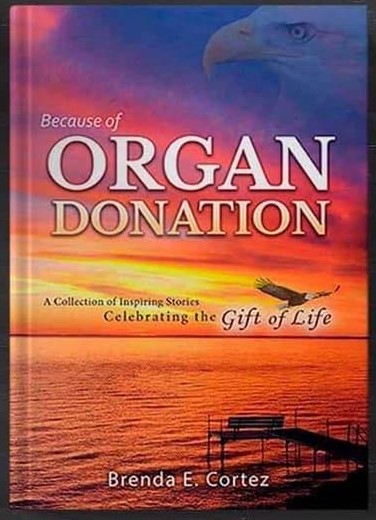
And, because I fervently believe in organ, eye, and tissue donation generally, I sometimes write, too, about the importance of signing up to be an organ donor. Now I want to tell you about a book that includes all these perspectives and more: Because of Organ Donation.

Brenda Cortez has compiled and edited this anthology of 25 moving, first-person stories by donors, recipients, and donor families (that is, family members of deceased donors). Brenda is a living-donor friend/author I’ve written about before concerning her Howl the Owl (it stands for Help Others With Love) children’s books about donation and related topics. She’s helped thousands of kids understand and cope with kidney disease and transplant in their families through her books and in visits to schools and hospitals with little Howl.

Full disclosure: when I began reading Because of Organ Donation, I think I expected that I’d mainly read the donor and recipient chapters and maybe just skim the ones about deceased donation. Instead I read it cover to cover, absorbed and touched by the powerful stories.

I naturally found old friends here from the kidney community, two of whom I’d met at the Guinness Records Living Donor Rally in Chicago in 2018: Brenda herself, who shares her own story of donating to another mom she knew slightly from her daughter’s school; and Kate Griggs, co-founder of the Guinness event, who was shunned by some friends and colleagues for donating to a stranger but still turned living donation into an avocation. (If you ever spot a living donor decal on a car, it was likely a gift from Kate, who’s mailed thousands of them gratis around the world).

The other old friend I found here is Jim Myers, a kidney transplant recipient who, years ago, became a full-time–and a half!–donation advocate (he serves on major kidney organization boards, expertly uses social media, and hosts an interview show (that Betsy and I were on).

I also encountered some of my newer Facebook donor friends, like Deb Kavanaugh (also a Guinness alum!) and Trish Phillips.

I expected to be moved by all these stories, but I didn’t know I would also learn, not only about deceased donation but even living donation (I was stunned that a donor was offered the option of taking back her kidney when her recipient died).

The stories from donor families illustrate clearly how honoring a loved one’s wish to be a donor allows grieving families to take comfort in knowing that he or she was able to dramatically change someone’s life. I was particularly touched by contributors who’d known the unimaginable pain of losing a child and their joy at connecting with their child’s recipient.

Most if not all of the contributors are obviously committed to furthering organ donation and are very active in related organizations and community activities. Because of Organ Donation will surely resonate with readers who share that commitment or have ever been touched by organ donation–but also with many others who can relate to these stories of love, grief, hope, and commitment.

Brenda’s newest book Voices-19 will be out soon. For related posts and information on my new book, The Insider’s Guide to Living Kidney Donation, be sure to explore the rest of my website.

Why Not Just Wait for a Deceased Donor? Here’s Why

According to polls, about 90% of Americans say they favor organ donation, but only about 60% are registered donors.

Just curious: what percentage of people in the United States would you guess die in such a way that traditional organ donation is possible? A third? A fifth? Not even close. The answer is “less than 1%”: typically in a hospital following an accident. So, no, not at home in their beds, not on impact in a car crash, often not even after a slow death from myriad diseases.

Traditional organ donation 101: When a dying person has been determined to be brain dead—no activity, no chance of survival—but the heart is still beating, blood is flowing to their internal organs. Once the organ has been removed from the blood supply, the sooner it’s placed in the recipient’s body, the better. With luck it’s off the blood supply for only a few minutes or hours. When it’s necessary to put it on an airplane, that interruption may last several hours—technically, 24 to 36 hours is acceptable, but the sooner it can be hooked up to the recipient’s veins, the better.

So most of the 100,000 people on the national waiting lists may languish several years (5 to 10 is not uncommon) before they receive a lifesaving kidney, and thousands don’t get one in time. Clearly we need more people to be registered donors.

So, absolutely, register to be an organ and tissue donor after you die and tell your family of your desire (and then urge them to do the same). But even if everyone complied, we’d still have a kidney shortage because of that 99% that can’t be used in traditional donation.

That’s where live donation comes in. Not only does it add to the pool and shorten the wait, it even improves the outcome for most transplant recipients. And we need to remove obstacles for potential donors so that more people will consider being living donors. Tell your representatives–in your state and nationally–to support the Living Donor Protection Act and to increase funds for financial assistance for living donors and for early detection of chronic kidney disease.

An important health crisis as urgent and daunting as an organ shortage deserves more attention, more funding, and a meaningful commitment to finding creative solutions.

For related posts, resources, and information on my new book, The Insider’s Guide to Living Kidney Donation, be sure to explore the rest of my website.

Relax, Living Donors: Your Kidney Function Is Probably Just Fine

Anyone who’s been reading this blog for awhile knows that I periodically post in frustration about the subject of donors being needlessly upset when their kidney function appears slightly lower than “normal.” It’s usually because their provider has wrongly concluded that the donor thus has stage 2 or 3 chronic kidney disease. That’s not merely my opinion–I have no medical credentials–that’s according to respected medical writings on the subject.

The eGFR (kidney function) scale they’re referencing is relevant mainly for people with two kidneys who may be showing signs of kidney disease.Well-meaning but uninformed providers–sometimes even nephrologists (kidney specialists)–often forget that a healthy donor is probably registering lower kidney function simply because he or she has one kidney.

Donors do lose kidney function, but the remaining kidney gets plumper and takes on some of that burden; their creatinine level (toxins in the blood) may be borderline for a few months but then typically stabilizes at a perfectly acceptable level. Mine, for example, 15 years after donation, is fine even for someone with two kidneys.

I recently heard of other examples of confusion on this point, so it bears repeating: a slightly higher creatinine and a slightly lower kidney function in an otherwise healthy living donor is just fine!

Transplant teams need to do a better job of preparing their donors for the likelihood of their having a “new normal.” Equally important, teams should routinely alert a donor’s PCP to this eventuality from the start–that is, when the donor leaves the team’s care soon after the donation.

Some frightened donors have run to consult a nephrologist, worried that they had developed chronic kidney disease. (I’m not suggesting that there are never instances of a living donor developing kidney disease, but those are rare. We’re talking here about a donor who is in good health and showing no signs of kidney disease.)

In Facebook support groups, even well-informed donors often describe having had to get a letter from the transplant team to “convince” their provider that the donor knew what he or she was talking about.

If even health care providers are not fully informed, is it any wonder that donors–not to mention the general public–are not fully informed about living donation? Given the urgent need for more living donors, our health care system and the kidney community need to do a better job of raising awareness about kidney disease and donation.

Photo by Pixabay on Pexels.com

For related posts, resources, and information on my new book, The Insider’s Guide to Living Kidney Donation, be sure to explore the rest of my website.

Save $$ and Spread the Word

I’m always appreciative when people spread the word about this website and related issues that are important to me: organ donation, living kidney donation, chronic kidney disease, and, most recently, our book, The Insider’s Guide to Living Kidney Donation. There are lots of ways you can do that.

#1. Whether you buy the book on Amazon or any other site (see below), please consider posting a review of the book on Amazon.

#2. This week only, click here to get 30% off the price of the paperback! Use promotion code KIDNEY (okay, so it’s not very original, but it IS easy to remember, right?) at checkout.

#3. Share all this information and the links on your social media posts, and, of course with friends and family.

Donors, Your New-Normal Numbers Don’t = Kidney Disease!

I always tell potential kidney donors to keep an open mind but to do their homework and be as well informed about living donation as they can be. Turns out that that advice even applies years later.

Through social media donor support groups, I recently was stunned and outraged to learn that some donors have been told that they have stage 3 chronic kidney disease. One donor said she cried all night. Before you conclude that their “disease” is a result of kidney donation, I hasten to add that these were people with normal kidney function. In other words, as researchers have demonstrated, those living donors DO NOT HAVE CHRONIC KIDNEY DISEASE! Their slightly low readings are perfectly normal for them.

Photo by rawpixel.com on Pexels.com

Apparently, their primary care providers—and, unbelievably, sometimes even nephrologists—were referring to the eGFR (estimated glomerular filtration rate) scale based on people with two kidneys and/or real kidney disease. Donors lose 25 to 35% of their pre-donation kidney function, but that’s still sufficient to lead a healthy normal life. It’s meaningless and patently wrong to look at the numbers in a vacuum and say that these people have chronic kidney disease.

As we get older, no matter how many kidneys we have, our kidney function declines. It’s especially common for people over 70, like me, to have a slightly low eGFR. At my last check-up, though, 13 years after donating my kidney to my son, my eGFR was 69 (normal is over 60).

So, if you are a kidney donor, don’t be alarmed at news of a slightly high eGFR. Ask questions (how long has it been in that range? what’s your creatinine?), and always remind your provider that you have one kidney. You may well be relieved to know that your new normal is just fine!

Powerful Push to Promote Public Awareness of Kidney Disease

I’ve long been amazed and frustrated that most people know little about kidney disease and are unaware of the public health crisis: nearly 100,000 people in this country are waiting for a kidney from a deceased donor, and most will wait several years. For many, that’s too long, and thousands die every year because they didn’t receive a kidney in time.

That lack of information is widespread and includes educated, otherwise knowledgeable, well-informed people. Most of the 30 million-plus people in this country with chronic kidney disease don’t even know it yet, so if people paid more attention to their kidneys, and healthcare providers focused on early detection, kidney disease could be treated before it reached life-threatening kidney failure. Just think of the thousands—maybe millions—of lives that could be saved!

That’s why I was very excited to learn that the public awareness part of that amazing kidney health initiative just got some real teeth. The National Kidney Foundation (NKF) is forming an important partnership with the Department of Health and Human Services (HHS) and American Society of Nephrologists (ASN) to promote the Public Awareness Initiative portion of what’s officially called Advancing American Kidney Health initiative. 

Did you know that one-third of Americans are at risk for developing kidney disease, not only because of diabetes and high blood pressure, but also cardiovascular disease, obesity, and family history of kidney disease? For certain groups, particularly African Americans and Hispanics, the risks are especially high: African Americans are three times as likely as whites, and Hispanics nearly 1.5 times as likely as non-Hispanics, to develop end stage kidney failure.

Even for people who are not at increased risk, my family knows well that our kidney health should never be taken for granted. If you read my son’s post on this site on the anniversary of his transplant, you may recall that he developed his kidney disease from a lingering strep infection. He was young and otherwise healthy, but 5 years later he was on dialysis, and 2 years after that, I gave him my kidney.     

The collaboration by HHS, NKF, and ASN will provide education about the risks of kidney disease and promote the early detection and management of kidney disease to improve patients’ results.

 For more information on the partnership, the Initiative, and kidney disease in general, read the complete announcement here.