Real Funds and Real Sun for a Virtual Kidney Walk

Well, my husband, son, and I participated in the 2020 North Carolina virtual kidney walk this weekend. Yes, it was different from all the others we’ve walked in, but many things were familiar. Most important was the opportunity to raise sorely needed funds for kidney disease research and awareness. By the end of the day, with fundraising still going on, they’d already raised more than $100,000!
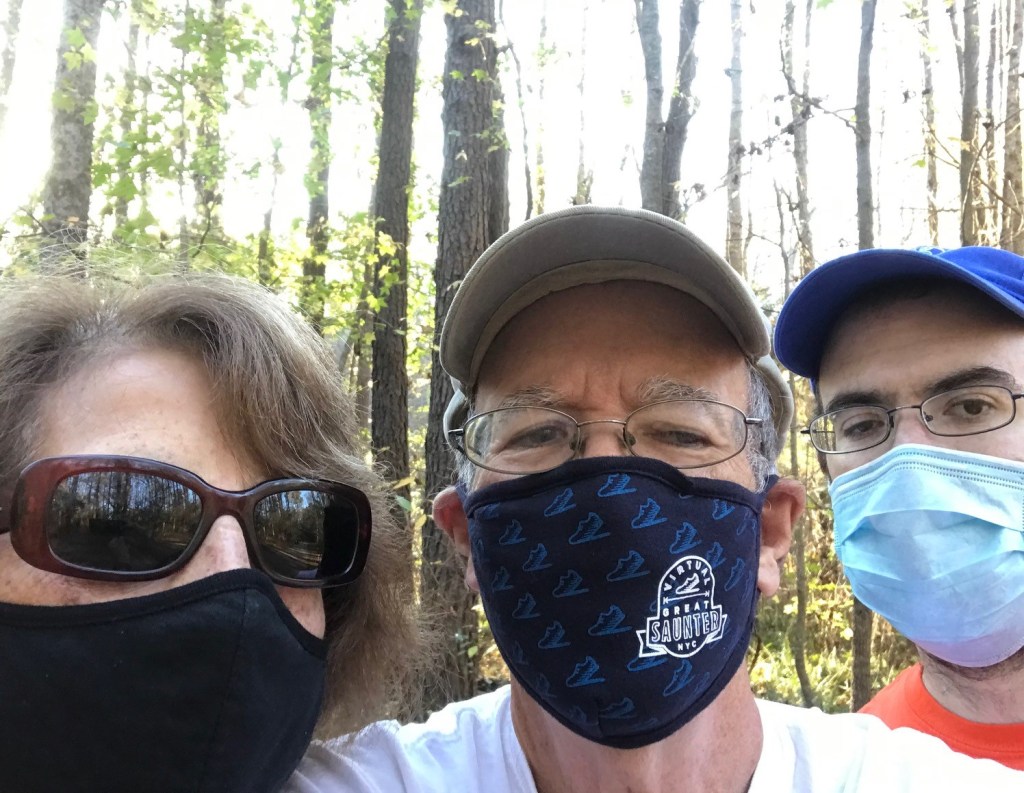
All laced up, and masked up, of course, and ready to walk! That’s Paul on the end and my husband, Neil, in the middle.

And it’s always special to have an opportunity to hear moving stories from kidney recipients and donors, even if they had to do it online. It would have been great to meet them in person. A few takeaways:

A familiar, sobering one, came in hearing from transplant recipients and dialysis patients and learning that, like my son, Paul, their kidney disease diagnosis had come as a shock. One young woman said she’d felt sick one day and gone to the ER, and learned that she had only 15 percent of kidney function. Another was a seemingly healthy, young fitness instructor who developed baffling and serious symptoms. After multiple biopsies she was diagnosed with a rare kidney disease, FSGS. She was fortunate to receive a transplant 4 years ago.

It bears repeating–the symptoms of chronic kidney disease are usually not apparent until it’s advanced nearly to kidney failure and the need for dialysis or transplant. That’s why prevention is so critical and early detection so important. And when a kidney is needed, living donation is the key to shorter waits and better outcomes.

When a couple of the donors spoke, I found myself nodding in agreement, as always, at what a positive experience donation is for the donor, not only the recipient. Eerily, one of them used almost the exact words I’d used a couple of weeks ago in a video I filmed for Donate Life/WELD: I was surprised at how incredibly gratifying it was for me personally…I never expected the impact it would have on my own life…

Luckily, this walk may have offered the best weather we’ve ever had for a kidney walk: a breezy, sunny day in the 70s. And that was real, not virtual.
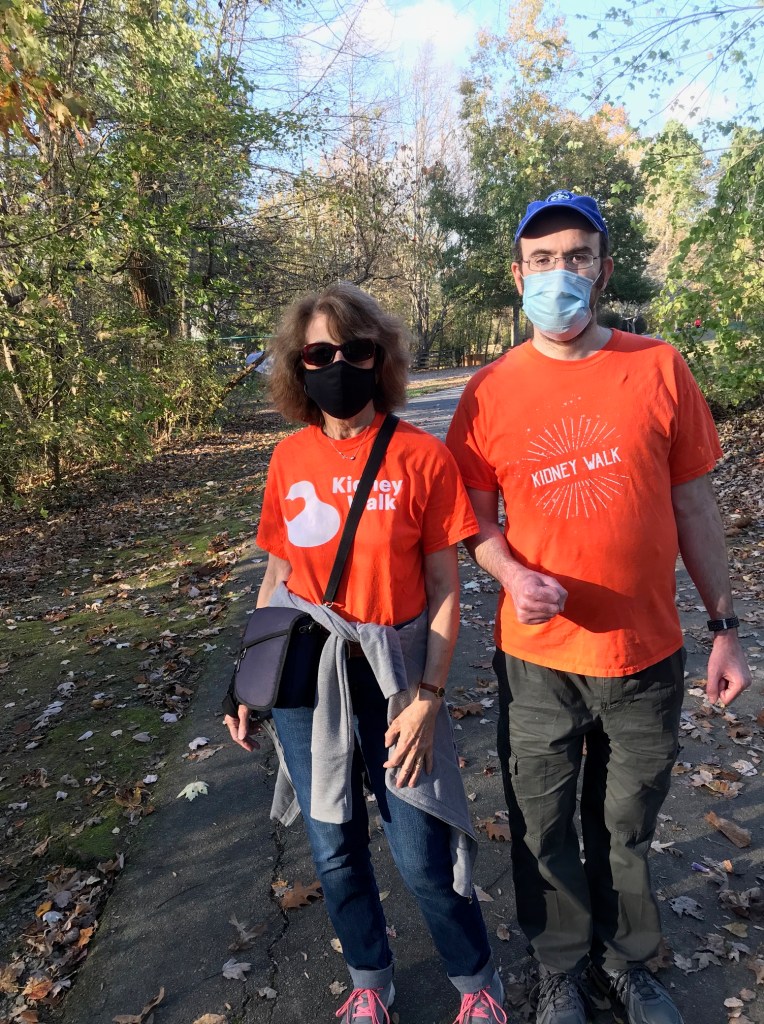
Still Walking After All These Years–But Virtually

Another Kidney Walk date is approaching: Sunday, November 15. My husband, son, and I (our daughter’s up in Brooklyn) will be “there” as usual. Because of the pandemic, this year everyone will be walking in their own neighborhood or location of their choice in the 2020 North Carolina Virtual Kidney Walk. That’s a first.

We’ve walked in more kidney walks than I can count: four or five recent National Kidney Foundation events starting at the Durham Bulls Ballpark location (including last year’s coldest one ever); maybe another four or five NKF walks in Research Triangle Park, which wove through the campus of my long-time employer, RTI International, often a sponsor; plus a few Kidney Kare run/walks in Carrboro, NC, sponsored by the University of North Carolina Transplant Center, where I donated a kidney to my son in 2006.

Just a small sample of my collection of tee shirts from many years of Kidney Walks in North Carolina.

We’ve walked in blistering heat, when the water bottles the helpful volunteers were distributing were downright hot; in chilling cold, with our hoods up and gloved hands clutching thermoses; stepping gingerly over deep puddles, dripping wet as we shunned umbrellas (so far never in snow). Still, the events are usually fun and always inspiring. In the midst of the upbeat music, entertainment, and snacks, there are of course speeches, information, organizations with handouts (so excited that Donate Life/NC WELD–Women Encouraging Living Donation–had a table last year), and health screening booths.

I remember the middle-aged man who spoke to the gathered walkers before the start of the walk a couple of years ago. He described being at one such walk a few years before and deciding to do the screening. There he’d discovered to his shock that he had stage 4 kidney failure. That Kidney Walk saved his life: he began dialysis within a few months and was able to have a transplant a couple of years later.

It bears repeating: chronic kidney disease is a silent killer. Most of the more than 30 million people in this country who have it don’t know it because they don’t have symptoms yet—and may not until it’s too late. The transplant center and NKF have mobile units that do screenings around the state throughout the year. Education, screenings, and research all cost money.

That’s why we walk, wherever. Proudly wearing bibs that say DONOR (me), RECIPIENT (my son), or DONOR FAMILY (my husband), we chat with other walkers (this year it will be through masks). We’ve met hopeful families of kidney patients desperately in need of a kidney, transplant recipients happily walking with a bounce in their step for the first time in years, patients who’ve been on dialysis for more than a decade and may never have a transplant because they have too many other serious health conditions–some are not strong enough for the walk but come out to volunteer and help raise funds for awareness, education, and research.

Please consider donating whatever you can or just share this post on social media or email it to your families and friends. But whether or not you donate to this virtual kidney walk, or to any kidney disease organization, please spread the word about the importance of kidney health—and be sure to get your kidneys checked.

Rewrapping the Greatest Gift

If you’ve been following this blog and are familiar with my site, you already know that I’ve been writing a book on living kidney donation with a live-donor kidney recipient, Betsy Crais. It’s long been tentatively titled The Greatest Gift: The Insider’s Guide to Living Kidney Donation. Now that we’re down to the review process and planning for publication in 2021, we’ve made a big decision.

This book has never been just for people considering donating a kidney. We’ve always looked at our task as lending readers a hand before, during, and after the actual surgery. Similarly, there’s plenty in there for people living with end stage renal disease (kidney failure), throughout the transplant process (including dialysis) and beyond, as we touch on delicate family dynamics and relationships.

Anyone who has experienced donation or transplant–or has a loved one who has–knows that both are so much more than medical decisions and events. That’s why we wanted the title to reflect the book’s broader role. So, drum roll please, our new title is The Insider’s Guide to Living Kidney Donation: Everything You Need to Know If You Give (or Get) the Greatest Gift.

Watch this space for more news. We’ll let you know when we have a specific publication date.

Photo by Pixabay on Pexels.com

Donors: Your New-Normal Numbers Are Just Fine

Being well informed about living donation before you donate a kidney is obviously extremely important, but it doesn’t stop there. Continuing to be well informed is not only good for your physical health but your mental health as well.

Through social media donor support groups, I continue to hear of some donors being told that they have stage 3 chronic kidney disease, purely on the basis of their eGFR (an estimated formula for kidney function). One stunned donor said she cried all night. Before you conclude that her “disease” was a result of kidney donation, I hasten to add that she and other such donors usually have normal kidney function and no kidney disease. In other words, as researchers have demonstrated, in the absence of other factors, donors’ slightly low readings are just the new normal for them. That’s particularly true in the months following donation, and their readings may well improve.

Photo by Pixabay on Pexels.com

These donors’ primary care providers—and sometimes even nephrologists—were referring to a scale based on people with two kidneys and/or diseased kidneys. Donors lose 25% to 35% of their pre-donation kidney function, but that’s still sufficient to lead a healthy normal life. It’s meaningless and patently wrong to look at the numbers in a vacuum and say that these people have chronic kidney disease.

As we get older, no matter how many kidneys we have, our kidney function declines. It’s especially common for people over 70, like me, to have a slightly low eGFR. However, at my last check-up, 14 years after donating my kidney to my son, my eGFR was 69 (normal for anyone is over 60).

So, if you are a kidney donor, don’t be alarmed at news of a slightly high eGFR. Ask questions (how long has it been in that range? what’s my creatinine?), and always remind your provider that you have one kidney. If they’re still unconvinced, refer them to a paper that makes it clear that low GFR does not mean kidney disease in donors.

Celebrity Kidney Recipients: Please Share Your Stories!

They’re athletes, actors, and musicians of different ages, races, and ethnicities. So, what do the celebrities listed below have in common? They’re all healthier, and very likely happier, because a living kidney donor gave them a shot at a better quality of life. The best way to shorten someone’s wait for an organ–rich or poor, famous or not–is to find a living donor. Sometimes it’s a biological family member who steps up–sometimes it’s a future or former partner. And sometimes it’s a Good Samaritan, who chooses to donate to an unknown person in need.

Fortunately, some of these famous live-kidney transplant recipients have become spokespersons for National Kidney Foundation campaigns, and some, like former NBA star Alonzo Mourning, comic George Lopez, and former NFL star John Brockington have gone so far as to launch their own kidney disease awareness foundations. (Did you know that my dear WELD [Women Encouraging Living Donation] started as an offshoot of the John Brockington Foundation before joining forces with Donate Life?)

Other celebrities have individually turned to the media to share their personal transplant experiences. Singer Selena Gomez and her donor, actress Francia Raisa, gave several helpful major interviews in 2019 about Gomez’s transplant, shedding light on the donation process and the aftermath. And actress Sarah Hyland candidly shared details of her two kidney transplants, first from her father and most recently from her brother, and of her struggles with depression.

Even though chronic kidney disease is more common than breast cancer or prostate cancer, the general public knows very little about it. If more celebrities who’ve been touched by kidney disease and transplant would openly talk about their life-changing stories, it could encourage more people to have their kidneys checked, register as organ donors, and even consider being living donors. All those actions would go a long way toward reducing the years-long wait for a kidney and ultimately saving more lives. By the way, celebrity status and money offer no privileges on the national waiting lists for a deceased donor.

How many of these celebrities did you know had had kidney transplants (the year of their transplant is next to each name)?

Stevie Wonder, Dec. 2019 (he says he feels “40 right now”!)

Ed Kranepool, 2019

Selena Gomez,  2017

Tina Turner, 2017

Sarah Hyland, 2012 and 2017

Tracy Morgan, 2010

George Lopez, 2005

Alonzo Mourning, 2003

John Brockington, 2002

Sean Elliott, 1999

 I wish them all continued good health with their adopted kidney. My son has had more than 14 years with his (that is, mine).

You’re Never Too Old to Be an Activist

When I launched this website, my stated goal was to encourage people to consider living donation. By sharing my story of donating a kidney to my son, plus information and resources, I was hoping to make a difference and ultimately save lives of people with chronic kidney disease. Not being very tech savvy (I can hear my husband chuckling as he reads this understatement), I had to learn to speak a new “language” as a 70-year-old.

But I think now that subconsciously, I also had another goal: to inspire other people, particularly those of retirement age–and especially women–to get outside their comfort zones for what they believe in: whether it’s by dipping a toe into social media, phone banking, talking to community groups, meeting with members of Congress, or donating a kidney. (In my case, I did the last one first. The decision was easier.)

My Q & A with Maggie Kuhn was published in Retirement Living Magazine, December 1972. At only 67, as you can see, she embraced the “little old lady” look, declaring “I say we should admit we’re old and take pride in it.”

I made this discovery just a few weeks ago when I came across a New York Times article about a truly inspiring woman I interviewed for a magazine article when I was in my twenties. Maggie Kuhn, younger then than I am now, had been a social worker in Philadelphia. She had to take mandatory retirement (very common back then) at 65, when she still had so much more to offer. Maggie continued to be an activist, notably against injustices experienced by older people (she hated the term senior citizens), but also as a fighter for social justice in general.

She founded a movement called the Gray Panthers, admonishing her fellow retirees to get involved in social justice: “we have nothing to lose,” she pointed out–no fear of jeopardizing career advancement, for example. Maggie also famously said, to all of us: “speak your mind, even if your voice shakes.”

The New York Times article about her and the movement prompted my epiphany–and this blog post. It may be hubris, but I like to think that Maggie would be proud of me now for actively joining forces with other advocates and activists of all ages and continuing to try to make a difference.

Maggie, dear lady, you were a helluva role model. Thank you (by the way, my daughter is a social worker, fighting the good fight every day. You’d like her.).

Wait Till You See My eGFR!

I hate to brag (no, actually, I’m proud of it!), but today I had my best creatinine and eGFR test results since I donated my kidney to my son 14 years ago. Creatinine reflects the amount of toxins in the blood (lower is obviously better), and GFR is an overall measure of kidney function (the clinical term is glomerular filtration rate). The little “e” before GFR just means estimated. The exact measure requires a 24-hour urine collection, which I vividly remember doing for my donor evaluation.

For the estimate, they use a formula based on creatinine, age, sex, and a few other factors. My creatinine is 0.75 (normal is under 1.00 for females, and mine’s been under 1.00 for about the past 5 years but never this good)! My eGFR is 80 (normal is over 60). To give you an idea, kidney failure–meaning the imminent need for dialysis or transplant–is below 15.

Given that it’s natural for kidney function to decrease as we age, at 72 years old, I would expect mine to be lower. Plus, as a living donor, there’s no cause for concern even if it’s slightly under 60 (categorized technically as “stage 3 of kidney disease”).

Those stages are based on people with two kidneys and/or patients who are continually losing kidney function. So, I wasn’t at all concerned a few years back when my eGFR was 59 but my creatinine was under 1.00.

And now 0.75! So, if you or anyone you know is worried about living donors’ losing too much kidney function, please tell them about my results. (And, no, I don’t have a water bottle attached to me all day, though I’m not knocking those who do.)

Donors Say (and Get Asked) the Darndest Things!

Living donors and about-to-be donors in Facebook support groups (among other places!) are an incredibly supportive, caring bunch of people. I discovered these terrific groups just a few years ago, long after I donated to my son in 2006. We rejoice at one another’s exciting news and “kidneyversaries” and try to offer comfort in times of sadness. We turn to one another for advice, practical tips, recommendations, prayers, stories–you name it.

In a much lighter request recently, one soon-to-be donor reached out to a group to ask what were the silliest questions people had been asked about donating. It led to a delightful exchange of funny questions and moments—and yes, nearly every donor has them—in the donation process. Here are some of them:

Oh my God! Ohmygod! They didn’t wait till you died? Asked by a proud registered organ donor who’d just met a living donor and learned the key difference.

Are you aware that you cannot at any point have your kidney back?” Asked by a doctor as the donor was being wheeled into the operating room.

Can you get it back if your kidney doesn’t work out for your recipient? Asked by a donor’s sister.

Did you donate both kidneys or just one of them? Asked by a TV news anchor.

Photo by Snapwire on Pexels.com

Should I register for the Full Mumbai Marathon or the Half? Asked by a donor in India during her donor evaluation. “The Half” was the answer. So she did it, in January 2020–just 3 months after she donated her kidney!

“So, you drink alcohol once or twice a week?” Asked by staff after the nondrinking potential donor said she might drink once or twice a year. “Is this a trick question?” the donor asked.

You take no medications at all? Asked by the incredulous doctors, nurses, and other staff, when the very healthy 50-something donor didn’t list any medications.

Where’s the rest of your medical chart? Asked by the doctor who’d assumed the folder was missing because the middle-aged donor had no prior hospitalizations other than childbirth.

Say, have you ever done this before? Asked of the surgeon on the way into the operating room.

Can you do a tummy tuck while you’re at it? Asked of the donor’s surgeon (the answer was no), who reported that it was the question he gets asked most often.

If you have a funny story to add, please send it to me (carol.kidneydonorhelp@gmail.com). I’ll bet I could fill another blog post!

Minority Donor Awareness Month

Did you know that about 60% of the 112,000 patients on the deceased-donor waiting list for an organ (most of them for a kidney) are minorities? African Americans are the single largest group, at about 29%. Making this sad statistic even worse is that registered minority organ donors make up only about 14% of total donors. Yes, you can receive an organ from someone of another race, but within-race matches have a better chance of success.

That’s why National Minority Donor Awareness Month is shining a light on this critical issue. The idea is to educate, debunk some myths (I’ve written about a few), and shorten everyone’s wait for a successful transplant. We want everyone to register, of course, but it’s all the more important for minorities. Registering to be an organ donor after you die takes only 2 minutes. You can do it online anytime on many sites, such as organdonor.gov. You needn’t wait till you renew your driver license and get that little red heart.

When we look at living donation, the gap is even wider. For example, only about 8% of living donors are African American. It’s a double whammy because the very conditions that make somebody need a transplant also rule out someone with those conditions from being a donor– such as uncontrolled high blood pressure and diabetes. Those are the two biggest risk factors for kidney disease, and African Americans and Hispanics have a much higher risk than white individuals.

Living donation has traditionally been uncommon in the African American community. A black woman I know who donated to her mother was expecting friends and family to oppose her decision. Instead, fortunately, she was able to start many meaningful conversations. People who had never thought about living donation before told her they were willing to consider it.

So start a conversation whenever you can. We need to increase those registrations and living donations–not just during Minority Donor Awareness Month.

Why All the Fuss about Finding a Living Donor?

Did you ever read about the kidney patient who wore a tee shirt at Disney World emblazoned with a plea for a donor (and found one)? Or maybe you’ve heard of people putting up a sign on their car or on a sandwich board saying they’re looking for a type O donor. Were you moved–or puzzled?

If you have a loved one or acquaintance who needs a kidney, you probably have a good idea of why people might go to such lengths to find a live donor.  Aside from the inescapable reality that there simply aren’t enough deceased-donor organs available in general (about 113,000 Americans are waiting for one), live donation offers very real advantages. Here are just few big ones:

Photo by Andrea Piacquadio on Pexels.com

1-The wait is much shorter. Kidney patients in the United States may spend 5 to 10 years on the wait list for a deceased donor. About 16 patients die every day because they haven’t received the life-saving organ in time. If you have a live donor, your wait could be a matter of months instead of years.

2-Because a live-donor transplant can be scheduled—as opposed to a patient waiting for “the call” that a potential kidney match has become available (and needing to get to the transplant center within hours)—it can be done under optimal conditions. That means at the donor’s convenience but also when the patient is at his or her strongest. If one or the other is even mildly sick when the transplant is scheduled, it can be postponed for a few weeks till conditions are just right.

3-The two surgeries are typically done at the same time and often on the same corridor (with the notable exception of some paired donations, which often are hundreds of miles apart). The shorter time that the kidney is removed from the blood supply—sometimes a matter of minutes—the sooner it will “wake up” and start to function in the recipient’s body.

4-Because the kidney starts to work immediately, the patient often begins to “pink up” and feel better the same day. With a deceased-donor kidney, there’s sometimes a delay of a few weeks, during which the patient generally needs to be on dialysis.

5-For all of these reasons and more, a live-donor kidney typically lasts significantly longer than one from a deceased-donor: an average of 15 to 20 years versus 10 to 15 with a deceased donor. But I know of many recipients of live kidneys who have had theirs for more than 30 years—the record is a jaw-dropping 50 years! Deceased-donor kidneys only rarely last more than 30 years.

If you think the benefits of live donation are only for the recipient, see my post on the benefits of live donation for the donor!