Sometimes More Like a Whisper than a Shout: Spreading the Word about Organ Donation

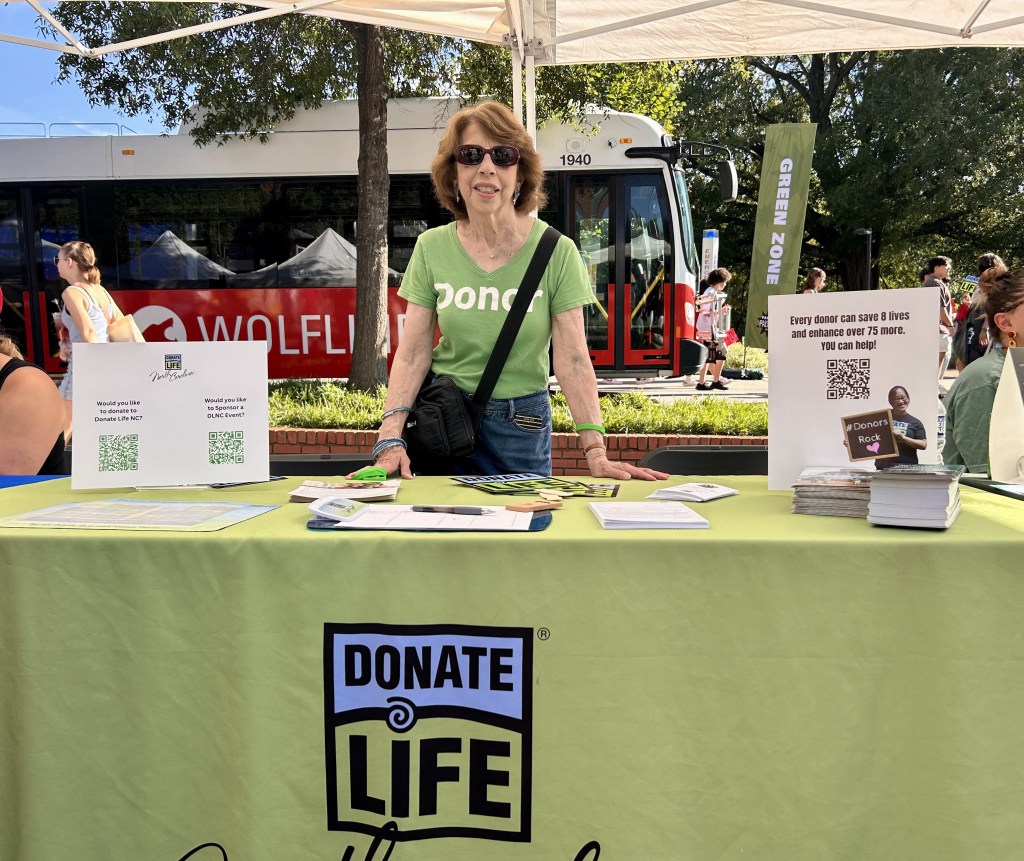
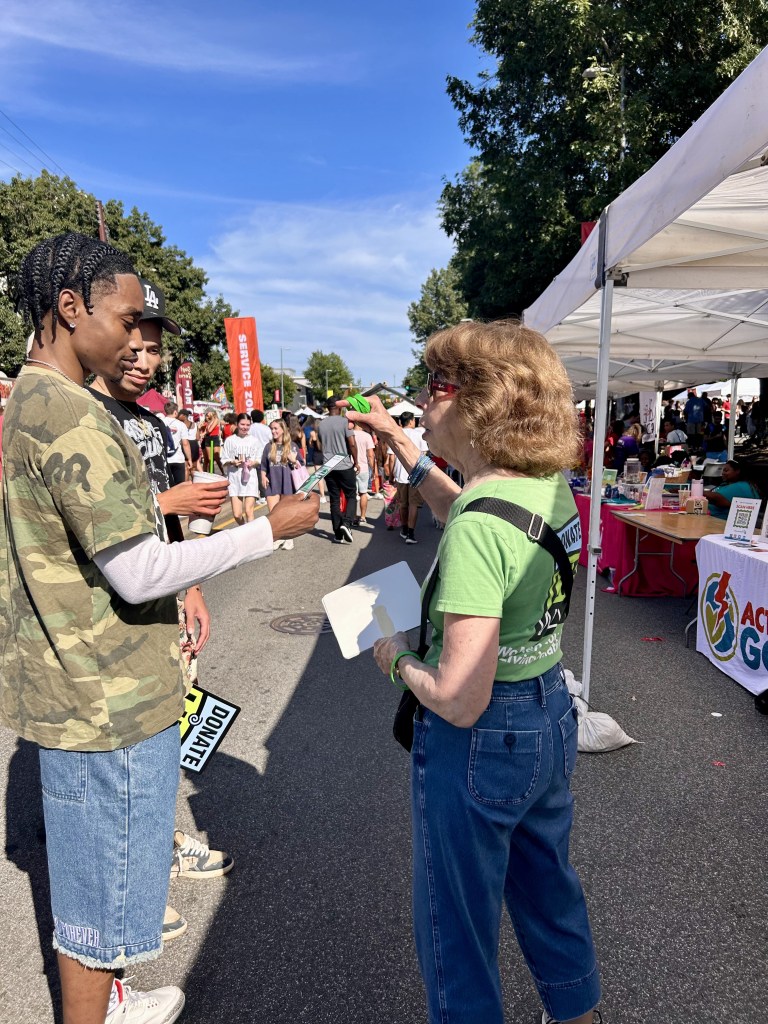
“Would you like a fan?” we asked passersby, enthusiastically waving our colorful Donate Life cardboard fans. It was a hot day but the crowds streaming past our table at “Packapalooza,” the annual all-day street festival at NC State University in Raleigh, NC, were in search of better freebies, games, goodies, or just cold lemonade. Not many were eager to talk about organ donation.

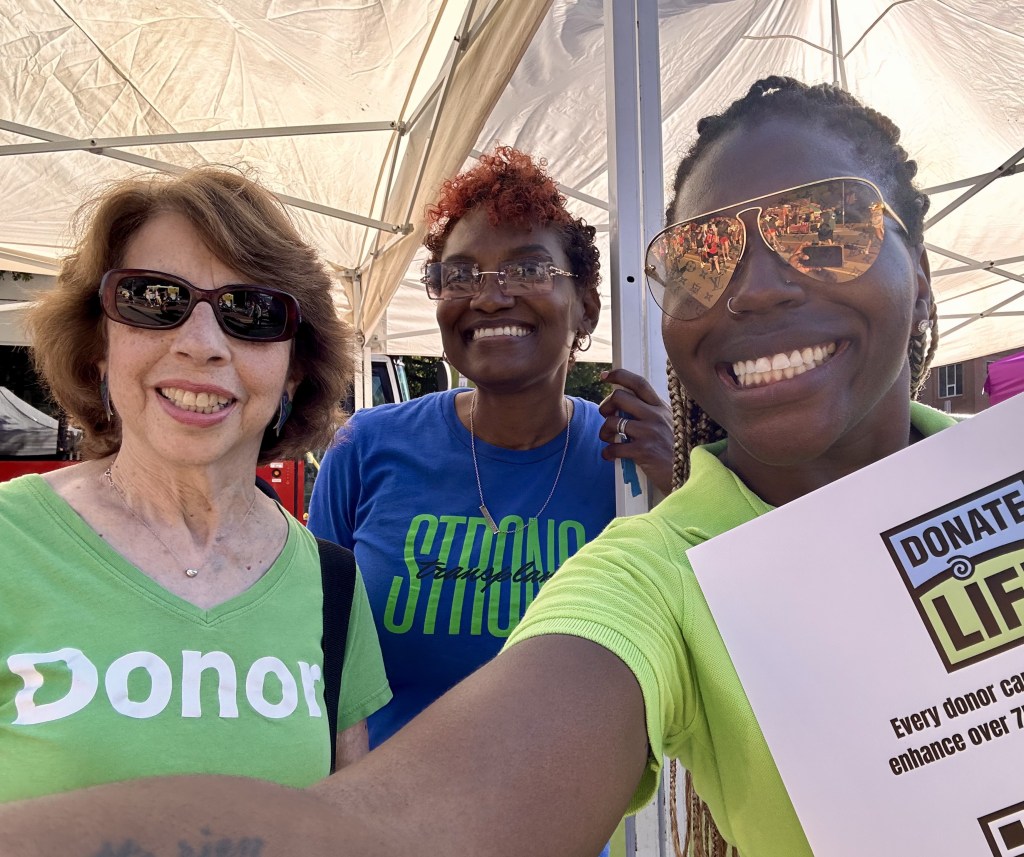
Our Donate Life team: at right E’onswaye Leiser, DL’s outreach program manager; center, Raven Martin, who is a liver transplant recipient; and me, a kidney donor, at left.

I’ve often described my post-kidney- donation desire to spread the word as wanting to “shout it from the rooftops” so everyone would learn how important and gratifying living donation is. Alas, sometimes it feels more like a whisper than a shout.

But…

When we did engage folks in what sounded like a whisper–even though we needed to shout to be heard above the din of loud music and crowds–people were blown away to learn a few basic truths about organ donation. I teased several of them with a quiz:

“What percentage of people who die in this country would you guess can be organ donors– whether they’re registered or not?”

“I don’t know–a lot. Maybe 70%?”

“Umm, I guess about 60%.”

The guesses got a bit closer. “50%?”

The closest to the correct answer came from a young woman who said 20%. She was pleased to hear that hers was the best guess–till she learned the answer.

Less than 1%.

That never fails to get a reaction. Their eyes widened. “Really?!” It made such an impression, in fact, that I’m guessing they’ll remember it and proudly show off their newly learned factoid to someone soon.

From there it was an easy segue to emphasizing how critical it is that everyone be registered as an organ donor. And if I still had their attention, I explained that that still wouldn’t be enough to meet the need and that’s why living donation is so important. That’s when I told them I’d donated my kidney to my son, and their eyes widened again. I suspect many didn’t know you could. I sometimes gave them a bookmark featuring my book, The Insider’s Guide to Living Kidney Donation.

Those who chatted with Raven (see our threesome selfie above) were surprised to learn that this radiant, healthy-looking woman had had a liver transplant two years ago. Raven was a seemingly healthy grad student in her thirties when she began to feel ill and later discovered that her liver was failing. She’s paying it forward by volunteering to spread the word about organ donation and by creating a business to help others find a living donor with tee shirts and other donation-related merchandise.

So maybe we’re not shouting from the rooftops, but we’re changing people’s knowledge and perceptions a little at a time and that’s still valuable. The more people learn about organ donation, the more they’ll know that it isn’t a remote subject that only affects “other people.” Knowledge is power, and it can save lives.

For related posts, resources, and information on The Insider’s Guide to Living Kidney Donation, be sure to explore the rest of my website.

Kidney for Life? “Eplets” Is the Key Word

One of the biggest myths about a kidney transplant is that it’s a cure for kidney failure. A new, healthy kidney–problem solved, right? Alas, that’s hardly the case even though transplant is the gold standard for the “treatment” of kidney failure (far better than dialysis). The better the match, the better the person’s overall health, and the patient’s diligence in safeguarding that kidney, the longer the new kidney will last.

Statistically, that’s an average of 10 to 15 years for a deceased-donor kidney and 15 to 20 for a living-donor kidney. Statistics and averages never give the whole picture, so, fortunately, many kidney recipients have been able to keep their transplant for 25, even 35 years or more.

Photo by Pixabay on Pexels.com

The National Kidney Registry has a mission not only to increase the number of kidney transplants and improve the matches, but to work toward a long-lasting transplant. Last year I attended a fascinating symposium on important research and developments in donor-recipient matching, sponsored by the National Kidney Donation Organization, or NKDO. Invariably one or two strong takeaways emerge from any important presentation. This time it was a single word and dramatic new concept for me: eplets.

They’re the key to what NKR calls the “Kidney for Life Initiative.”

After the symposium last year I wrote a blog post on this game-changing concept of low-eplet mismatch. The rest of this post is mostly excerpted from that one.

It turns out that compatibility is way more nuanced than I ever imagined. You may have heard about HLA antigens (you know, the 6-out-of-6 match being the so-called “perfect match”?) . Well, apparently, “matching” antigens may look the same, but they differ by their eplet pattern (think of them as “immunologic hot spots”).

Fair warning: I am not a transplant surgeon, a scientist, or a medical writer, so please do not quote me on this. Rather, use the occasion to go ask someone who is–or, better yet, google Kidney for Life.

Dr. Dorry Segev, NYU Langone transplant surgeon (photo by Carol Offen)

I’d seen the word eplet on charts and even heard it referenced at the NKR Gala presentations the night before. I got the basic gist from the context, but it wasn’t until Dorry Segev, transplant surgeon at NYU Langone, explained it so well at the symposium that I “got it.” From what I understand, it’s time that potential donors and transplant recipients started using the term, as in “Do you test for eplets?”

Yup, Dr. Segev says “everyone should ask” that before a donation/transplant, so if you’re a donor candidate be sure to add it to your list of questions. Not all transplant centers do the necessary “high-resolution typing” that can see how many eplets are in the antigens. The number of eplet mismatches can make the difference between a kidney transplant that starts to deteriorate months later, and leads to rejection, and one that can conceivably last “for life,” requiring a lower level of immunosuppressants.

Wow–what a potential game changer! Though “eplets” are new to me, and probably to you, they’re hardly new to transplant professionals, who have been studying this “latest generation in DNA sequencing technology” (per the NKR website) for years. Dr. Segev thinks that within about five years, we’ll all be talking about eplets. I know I will and I hope you will too.

If you’re sufficiently intrigued now and wonder if waiting for that “low eplet mismatch” is really worth the wait, here’s Dr. Robert Montgomery, director of NYU Langone’s Transplant Center, explaining why it is worth waiting a little longer for an ideal match.

For related posts, resources, and information on The Insider’s Guide to Living Kidney Donation, be sure to explore the rest of my website.

Help Is on the Way: HOLD Act Advances!

If you’ve never heard of the HOLD (Honor Our Living Donors) Act, I can assure you this is good news! Great news, in fact, for potential living donors, so, by extension, for potential kidney recipients. If this bill becomes federal law, the National Living Donor Assistance Center, or NLDAC, would consider only the donor’s income–not the recipient’s, too–when deciding whether to provide critical financial assistance and reimbursement to donors. Seems logical, don’t you think? And yet, for years, NLDAC has perversely considered both.

Photo by Nataliya Vaitkevich on Pexels.com

As a living donor to my son, I can tell you that the very idea of putting both potential donor and recipient in such an untenable position makes me want to scream. I explained more when I wrote about it here last fall when the bill was introduced.

Okay, but that was in November. What’s the great news?

Remember, now, this is federal legislation so everything moves very slowly (need I remind you about the Living Donor Protection Act?). That said, this particular bill has had bipartisan support, has already been referred to a committee (Energy and Commerce) and, last month, passed unanimously!

The HOLD Act now awaits consideration by the House as a whole. Please contact your member of Congress and urge him or her to lend support to the HOLD Act, HR 6020. If they are already sponsors or cosponsors, be sure to thank them!

For related posts and information on my book, The Insider’s Guide to Living Kidney Donation, be sure to explore the rest of my website.


AKF Summit: Spotlight on My Fellow Advocates

When surveyed about “the best part” of a kidney summit, I almost always find myself replying “my interactions with other advocates”: meeting new ones, finally meeting in person the individuals whom I knew only online but already considered friends, and of course seeing familiar faces from previous summits and events.

Natalia Brama, far left; Ama Sakyi far right
Bryan McVae, Rep. Fox’s LA, with Madelynn and me

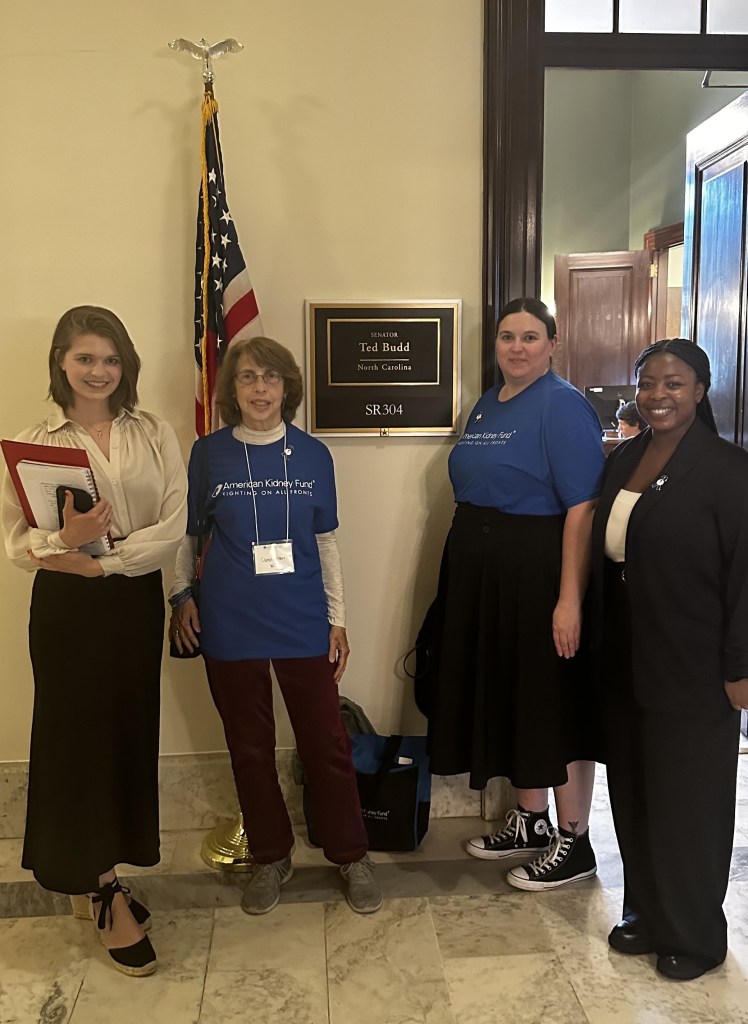
My after-summit posts usually focus on our legislative meetings (such as at the National Kidney Foundation summit in February). At the recent AKF summit in May I was fortunate to meet again with Natalia Brama for North Carolina Senator Ted Budd, and, for the first time, with Bryan McVae, for NC Congresswoman Virginia Fox.

I’ve decided to devote this post to my fellow advocates.

with Madelynn Karathanos

Most attendees at the recent AKF summit, as is typical, were kidney patients or transplant recipients. Individuals who have had a transplant are often moved by their markedly improved health–something no one takes for granted at these gatherings–to want to pay it forward to others in the kidney community. Their personal stories and their perseverance are always inspiring.

And then there are the dedicated family members of transplant recipients. My North Carolina teammate, for example, Madelynn Karathanas, has been advocating for several years (first from California, then North Carolina) on behalf of her adolescent daughter who first became ill at the age of three. Alyssa fortunately received a life-changing transplant 3 years ago.

donors l to r: Callie Gilmore, Beth Burbridge, Elizabeth Kay, me, Brian Martindale, Jamie Galanti
with Elizabeth Kay, living donor and Milwaukee radio show host

The living donors (like me) always happily find one another at such events. It may sound hokey, but living donors tend to feel an instant bond when we meet. At the AKF summit, there were just 6 of us out of 27, a fairly typical ratio. I particularly remember a few of them for having a special impact: Brian Martindale (on my left in group pic), founded a unique organization called Kidneys for Kids; Elizabeth Kay, a Milwaukee radio host, has shared her own story on the air but also featured other inspiring stories of donation/transplant, in an ongoing effort to educate her listeners about kidney donation; and Beth Burbridge (second from left in group pic) has been very active in spreading awareness in Kentucky and was instrumental in efforts to pass the state’s Living Donor Protection Act.

I was happy to meet advocates who don’t have any personal connection to kidney disease but recognize the tremendous need and choose to join the effort. Candace Turner, for example, is a clinical research diversity coordinator at NOWINCLUDED, an agency working to overcome racial disparities in patient care. She’s also an AKF kidney health coach. We surely need more people like Candace to get involved.

with transplant recipient (and old friend) Jim Myers (photo taken at the Feb. NKF summit)

I always leave these gatherings inspired by all the committed advocates and especially admire transplant recipients like Jim Myers, who has overcome so much and even at low points still manages to generate the energy to interview advocates, lobby members of Congress, and advocate through social media. Incidentally, Jim also hosts the Kidney Stories 2 video broadcast, which was the first to interview my co-author and me when our book came out.

with Ben Shlesinger of AKF

Last but not least I want to give a shout-out to the dedicated professionals at AKF who warmly hosted us advocates at the summit. After many zooms and phone calls, it was great to finally meet Ben Shlesinger, AKF’s enthusiastic director of government relations, and associate government relations director Katy Gross, who has been so helpful in answering my many emails. And I was glad I was able to meet and chat with Holly Bode, vice president of government affairs.

Katy Gross, at work at the recent AKF summit

By the way, besides the government affairs staff, the summit included numerous staff from across AKF. Madelynn and I were delighted to be teamed with Ama Sakyi, who works in patient education; this was her first summit. We enjoyed getting to know one another during a long break between meetings. What a terrific idea: introducing everyone to the myriad avenues available to support the kidney community (fyi, donating a kidney is just one of them).

For related posts and information on my book, The Insider’s Guide to Living Kidney Donation, be sure to explore the rest of my website.

Paying Living Kidney Donors Could Save Thousands of Lives

I thought I was still on the fence about directly compensating living donors because though I agreed in principle–yes, tweaking a very broken system around the edges hasn’t been working–I still had some hesitations. Isn’t there a risk of it becoming a matter of poor people giving to middle and upper class patients?

But was I really on the fence? Significantly, I’d already signed the mission statement of the Coalition to Modify NOTA (that’s the 1984 law that says living donors can’t be compensated). I agreed with that critical first step. I’d also called my senators asking them to support the End Kidney Deaths Act.

It took a one-hour video interview by “Uncle Jim” Myers with Ned Brooks and Elaine Perlman, the prominent nondirected living donors behind this effort, to dispel my qualms. I’ve met them both at kidney-related events and know that they are knowledgeable, caring, and committed donation advocates. Listening to their well-articulated argument was all I needed.

Interestingly, it’s not that I really learned anything new in that hour. I was obviously predisposed, and they carefully pointed out facts I already knew and showed how those factors reinforce the rightness of the concept.

Surely, if you look at supply and demand, the numbers speak volumes: more than 90,000 people in this country are on waiting lists for a kidney from a deceased donor. Last year a total of about 27,000 kidney transplants (from both living and deceased donors) were performed. In the past 20 years, while the number of living donors has roughly stayed the same, the number of patients on the wait list has doubled. As a result, thousands die each year because they didn’t receive a kidney in time.

Also, tragically, about 12,000 kidney patients are removed from the list each year simply because they became too sick to undergo a transplant. Think of it: If they could have received the kidney sooner, they would have been able to benefit from a lifesaving transplant.

Clearly, the current system isn’t working. In addition to closing the huge gap between supply and demand, living donation is the gold standard for kidney transplants. It shortens an individual’s wait, it works quickly, and typically lasts far longer–on average twice as long as a kidney from a deceased donor.

Creating incentives for people to consider living donation could be a game changer. In the meantime, removing disincentives would seem to be a no-brainer, and that has been the noble goal for decades. Admittedly, there has been some slow progress, mainly in the form of expanding sources of financial assistance and getting closer to passing the Living Donor Protection Act, which prohibits discrimination by insurance companies.

It’s simply not been enough.

If you’re still hesitant to get behind this effort and call your member of Congress, here are a few more compelling points:

1-It would not be an unregulated system with the inherent risks of jeopardizing the health of donors and/or recipients.

The same safeguards that are built into the transplant process at all U.S. transplant centers now would remain in place. That means rigorous physical and psychological testing, including interviews with social workers, and psychologists.

Photo by Nataliya Vaitkevich on Pexels.com

2-The financial incentives would not favor the wealthy over the very poor, who arguably wouldn’t benefit from tax credits. The government would be providing $50,000 (at $10,000 a year for 5 years) in the form of “refundable tax credits,” the type used now to encourage certain types of behavior, such as home-ownership or use of electric vehicles.

People whose income is too low to pay taxes would instead be given a check for $10,000/year.

3-The increased number of donated organs actually would be more likely to benefit lower socioeconomic groups. A disproportionately large chunk of those 90,000 people on the wait lists are minorities and lower-income individuals, who have higher rates of kidney disease. These patients are less likely to have a living donor: their family members often have similar or related health issues that could prevent them from being donors. And healthy friends and family members who might be candidates are more likely to face lost wages or unsupportive work situations.

As a result, the percentage of black kidney transplant recipients who have a living donor is less than half that of white kidney recipients.

4–It won’t cost the healthcare system money–it will actually save tax dollars. Transplants cost the system less than dialysis (at roughly $90,000/year) to begin with. Every patient who stops or avoids dialysis because of a transplant saves Medicare money. So, it not only saves lives–it saves dollars.


Note that the tax credits would go only to nondirected (unspecified) donors, so family members of patients, who would be more likely to consider donating to a loved one anyway, would not be eligible. Down the road, supporters hope to expand the compensation to all living donors.

[For an expanded version of this post (directed particularly to people with less knowledge of kidney donation and kidney disease), see my story in Wise and Well on Medium.com.]

For related posts and information on my book, The Insider’s Guide to Living Kidney Donation, be sure to explore the rest of my website.
GIFTED: A Novel and Now a Docuseries

As part of National Donate Life Month, I’ve written recently about the public’s preconceived erroneous notions about organ donation–both living and deceased. These myths tragically keep the numbers of donors down and the number of needless deaths up.

More than 100,000 people in this country need a lifesaving organ, for most of them a kidney. Thousands die each year while waiting–or are removed from the list because they have become too sick to benefit from a transplant.

I just read a memorable novel that’s been on my radar for a long time (I remember meeting the author, Robert Horsey, in 2018 at the Living Donor Rally at the Bean in Chicago). The book is drawn from his professional experience as a critical care registered nurse who has served as an organ procurement coordinator. That’s the compassionate individual who coordinates the entire process, making delicate arrangements, and sensitively communicating with the donor’s family and physicians and the organ recipient.

An important and sobering subject, and Horsey’s story is engaging, relatable, moving, and educational.

The novel Gifted was published in 2017, but the topic is timeless. And now, with a docuseries, it’s very timely.

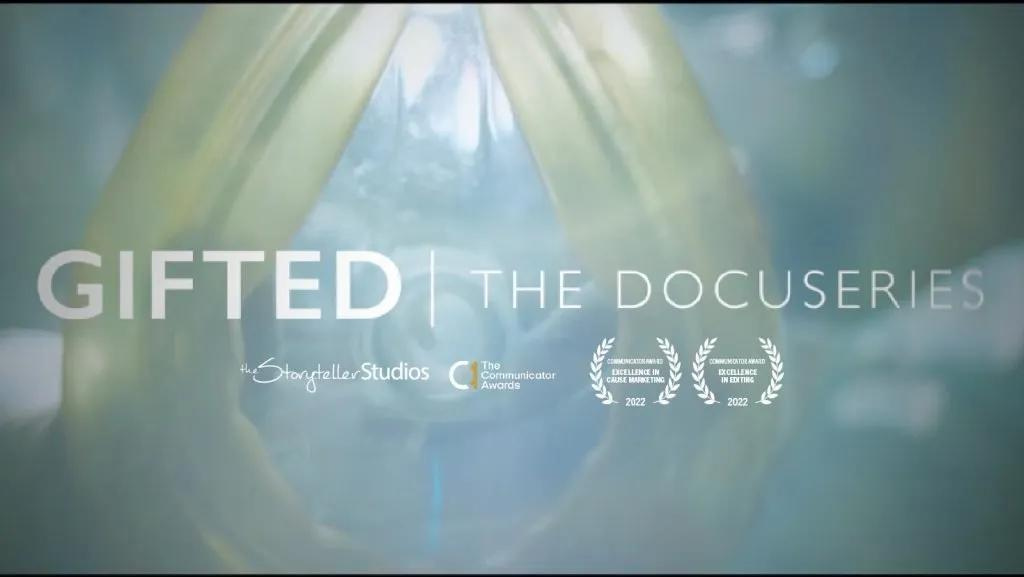
For Gifted: The Docuseries, Horsey has teamed up with award-winning video producers and filmmakers. Their Gifted Productions company was created to educate the general public about organ donation through real people’s stories. The docuseries has five episodes. The team hopes to dispel myths so often reinforced by feature films and popular television series, and, ultimately, to increase the numbers of organ donors.

Episode One follows the inspirational story of the donor family of Heather Miller, who tragically died soon after her graduation from West Virginia University.

A public screening is scheduled for July 2024 at the Transplant Games in Birmingham, Alabama. Gifted has had a few private showings in different states, and more are being scheduled. For information or to donate to its fundraising partner, The Maddog Strong Foundation public 501(c)(3) nonprofit, go to Gifted Productions.

For related posts, resources, and information on The Insider’s Guide to Living Kidney Donation, be sure to explore the rest of my website.

Donate Life–In Any Way You Can

As a living donor, I’ve chosen to focus the majority of my posts on the lesser-known subject of living donation (most recently, preconceived notions about donors). I haven’t written much about the other kind of organ donation—that is, after death. It’s one of those sobering subjects that often make people uncomfortable (I used to be one of them).

That said, I’m going to give it a try here anyway and hope that you’ll keep reading. If you’ve read many of my blog posts, you probably have noticed that no matter what I’m writing about, I prefer a light touch and maybe go for a smile or two. So I’m not going to berate anyone who has not already signed up to be a donor. And I promise you I’m not going to drone on about how important it is and how it’s our duty to society yadayadayada.

You already know that, right? (If not, I might note here that more than 100,000 people in this country are waiting for a lifesaving organ—most of them for a kidney—and about 17 people die each day because they didn’t get one in time.)

So what am I going to do here? I’m just going to ask a few simple questions:

1-What percentage of people in this country do you suppose die in a way that even makes it possible for their organs to be donated?

2-If a registered organ donor is dying in a hospital, do you imagine that the doctors and nurses will throw in the towel that much sooner?

3-Are you afraid you might not be “completely dead” when they get ready to recover your organs?

Answers:

  1. Less than 1% (If you’re stunned by that news, you’re not alone. Years ago my guess would have been less than half, but maybe 20% or 30%, but I honestly had no idea.) In other words, the pool is very small.
  2. First of all, they don’t even know—or care—whether you’re a donor or not. Their only concern is saving you, their patient (remember “first, do no harm”?). Secondly, transplant teams don’t get involved until after death is pronounced. In fact, most deceased donors actually come from hospitals that don’t even have transplant centers.
  3. Lots of tests are done—even more than usual–to make absolutely sure that someone is in fact brain dead.

So, if you’ve read this far, thank you! If you weren’t already signed up, I hope this post has given you something to think about and maybe you’ll go to organdonor.gov–or any of a dozen or more sites (don’t wait to renew your driver’s license!)–to register. If you’re already registered, please share this post with others who may not be or who might know someone who would like to share it.

For related posts, resources, and information on The Insider’s Guide to Living Kidney Donation, be sure to explore the rest of my website.

Living Donors Are….

If you finished the statement by saying “saints,” then you’re just the reader I’m looking for. I want to dispel that very idea! Please read on.

How about living donors are…”risk takers”? That one too.

You see, so many people have preconceived notions about us living donors, that I think it gets in the way of more people even considering the possibility of doing it themselves.

With nearly 100,000 people waiting years for a deceased-donor kidney, and more than a dozen dying each day while waiting, we clearly need to increase the fairly static number of living donors: roughly 6,000 each year. The first step, as always, is information–we need to give a clearer picture of what living donors are and are not so that people don’t automatically take themselves out of the running. After that, I just want people to have an open mind as they continue to inform themselves about the process.

I’m neither a saint nor a risk taker, and most living donors I know (and I know plenty!) aren’t either. And so, in honor of Living Donor Day today (April 3), I’m dusting off a blog post about these myths and a Medium article on this very subject. Hope you’ll check them out and share them.

For related posts and information on my book, The Insider’s Guide to Living Kidney Donation, be sure to explore the rest of my website.
A Very Productive Day on Capitol Hill

I just figured out that I’ve now participated in more than thirty advocacy (aka lobbying) meetings for the kidney community, mostly at the federal level. My recent meetings in DC for the National Kidney Foundation’s Kidney Patient Summit definitely stand out. I thought I’d share some observations.

At their worst–perish the thought!–such meetings risk being dry, one-sided recitations of our “asks” (often cosponsoring legislation, signing on to a letter, voting to increase research funding) while a well-meaning but harried staffer listens quietly, taking notes, followed by our rushed awkward efforts to “tell our stories” before the staffer, obviously distracted by more pressing obligations, moves to end the meeting early.

Fortunately, the only ones I’ve ever had that were close to that scenario occurred years ago on Zoom, because of COVID, often without video. (I kept hoping that the disembodied voice was more engaged than it sounded and wishing desperately for a little eye contact to have a better idea if our message was “getting through.”)

At their best, though, such as one our North Carolina team had recently with a seasoned Senate staffer, Garrett Daniel (Senator Thom Tillis’s legislative assistant), they can be exhilarating. Here are a few illustrations.

Instead of being one sided, they’re natural interactive conversations that happily go off script. I’d been in several excellent Zoom meetings with Garrett since 2020, but this was our first in-person meeting. He’s always engaged, well informed, and often alludes to other ideas in the senator’s pipeline–such as a plan for a framework for paid leave for caregivers–that dovetail with our efforts.

LA Garrett Daniel, standing next to name plaque, with our NC team this year (left to right: Alan Levy, me, Wendy Glod, Dre Roundtree, kneeling, and his wife, Necole Roundtree.

We all participated in the lively discussion, often, in response to his questions, mentioning additional aspects of our asks that we hadn’t touched on in our elevator pitch. After hearing comments from a kidney transplant recipient’s wife, Garrett was the one to raise the subject of the burden on the caregiver not just in the home but in terms of job issues.

He listened to our personal stories and then often gently asked questions to get a clearer picture of what our experiences entailed. In fact, when he prompted one of our team members to elaborate on her long journey to get a kidney transplant, she shared important and wrenching details that the rest of us hadn’t heard.

Because her insurance company would only cover her numerous appointments for essential tests if she went to a center three hours each way from her home in Charlotte–instead of one just fifteen minutes away–she had to wait more than two years before she could move ahead with the transplant she desperately needed. Then, after she went through all her testing and was just one test away from being listed for a transplant, she got a peritonitis infection–so the transplant was further delayed.

At the end of the meeting, in addition to concern, Garrett also offered critical pragmatic support. For example, Senator Tillis is already a cosponsor of the Living Donor Protection Act, so our ask in his case was to help us get a committee hearing for the bill. Garrett’s boss is not on one of the committees in question, so Garrett offered to reach out to his counterparts in the office of NC Senator Budd (who is) to bolster our efforts. He planned to do the same with other offices regarding another bill the kidney community is supporting, to help expand access to home dialysis.

It was late afternoon when we left the office, and in between meetings we’d been walking up and down long, imposing corridors and all over Capitol Hill for hours. Our feet hurt. But after meetings like this, everyone on our team left feeling energized.

For related posts and information on my book, The Insider’s Guide to Living Kidney Donation, be sure to explore the rest of my website.
ASKing Congress–for a “Friend”

My bags are packed, and I’m ready to approach federal legislators and/or their staffers again along with other advocates from the National Kidney Foundation. As usual, we have very important asks.

If you’ve read even a few of my posts since I launched this site in 2019, you know that I’ve been lobbying for the Living Donor Protection Act–both on Capitol Hill and in my state, North Carolina–for several years. So, yes, our number-one ask is for this session of Congress to finally move ahead with this bipartisan (yes!), noncontroversial, bare-bones legislation that’s been kicking around Congress since 2014.

This bill to prohibit discrimination by insurers against living donors–through higher premiums or coverage refusal–gets reintroduced every session. There may be a new sponsor, if one of the originals is no longer in office, more cosponsors…and then it sits. It’s yet to have a committee hearing, much less a vote. This shouldn’t be so hard.

The second ask is a newer one that could benefit so many people currently on dialysis. The majority (about 85%) of dialysis patients receive hemodialysis at a center, where they go three times a week for three to four hour sessions. Not everyone lives near a center and may need to travel more than an hour by car or city bus(es) to get there. We want Congress to improve access to home dialysis for patients who choose to do it, by providing funds for training and professionals to actually go to people’s homes in the first few months to help them learn how. It could be a game changer by enabling someone to do dialysis on their own schedule and even facilitate their being able to fit sessions around their work hours.

The third ask is about modernizing and improving the national transplant system that allocates deceased organs. Nearly 100,000 people are on national waiting lists (most of them for a kidney), and most wait several years. The system is extraordinarily complex and there are appalling instances of wasted organs. Most everyone agrees it needs to be more efficient and transparent, so more people can get a transplant after a shorter wait. Congress passed an act to modernize and improve the system last year. What we need now is for lawmakers to provide the necessary $100 million funding to carry it out.

The fourth ask, and in the long run arguably the one with the most lasting potential benefit, concerns early screening for kidney disease. My symbolic “friend” in the kidney community probably isn’t even aware of being among the estimated 37 million Americans with chronic kidney disease. Yup, 90% of that population haven’t even been diagnosed yet and don’t know that their kidneys are gradually–sometimes not so gradually–losing function.

Confused? Let me clarify the difference between chronic kidney disease and kidney failure. Diseased kidneys slowly lose function over years–even decades–before they reach kidney failure, during which time there may well be no obvious symptoms. Once they fail, though, the only way to save someone’s life is with a transplant, or, in the meantime, dialysis. People with diabetes and/or high blood pressure are at the highest risk of developing kidney disease. So if doctors routinely screened these patients for kidney disease (with a simple blood test), millions of lives could be saved.

With early detection, not only can that disease progression be slowed, it can often even be reversed, through behavioral changes–exercise, healthy diet, hydration–and medication. We’re asking members of Congress to sign a letter in support of official guidelines for screening.

These are pretty straightforward noncontroversial asks. I’ll let you know how it goes.

For related posts and information on my book, The Insider’s Guide to Living Kidney Donation, be sure to explore the rest of my website.