Why All the Fuss about Finding a Living Donor?

Did you ever read about the kidney patient who wore a tee shirt at Disney World emblazoned with a plea for a donor (and found one)? Or maybe you’ve heard of people putting up a sign on their car or on a sandwich board saying they’re looking for a type O donor. Were you moved–or puzzled?

If you have a loved one or acquaintance who needs a kidney, you probably have a good idea of why people might go to such lengths to find a live donor.  Aside from the inescapable reality that there simply aren’t enough deceased-donor organs available in general (about 113,000 Americans are waiting for one), live donation offers very real advantages. Here are just few big ones:

Photo by Andrea Piacquadio on Pexels.com

1-The wait is much shorter. Kidney patients in the United States may spend 5 to 10 years on the wait list for a deceased donor. About 16 patients die every day because they haven’t received the life-saving organ in time. If you have a live donor, your wait could be a matter of months instead of years.

2-Because a live-donor transplant can be scheduled—as opposed to a patient waiting for “the call” that a potential kidney match has become available (and needing to get to the transplant center within hours)—it can be done under optimal conditions. That means at the donor’s convenience but also when the patient is at his or her strongest. If one or the other is even mildly sick when the transplant is scheduled, it can be postponed for a few weeks till conditions are just right.

3-The two surgeries are typically done at the same time and often on the same corridor (with the notable exception of some paired donations, which often are hundreds of miles apart). The shorter time that the kidney is removed from the blood supply—sometimes a matter of minutes—the sooner it will “wake up” and start to function in the recipient’s body.

4-Because the kidney starts to work immediately, the patient often begins to “pink up” and feel better the same day. With a deceased-donor kidney, there’s sometimes a delay of a few weeks, during which the patient generally needs to be on dialysis.

5-For all of these reasons and more, a live-donor kidney typically lasts significantly longer than one from a deceased-donor: an average of 15 to 20 years versus 10 to 15 with a deceased donor. But I know of many recipients of live kidneys who have had theirs for more than 30 years—the record is a jaw-dropping 50 years! Deceased-donor kidneys only rarely last more than 30 years.

If you think the benefits of live donation are only for the recipient, see my post on the benefits of live donation for the donor!

Updates on COVID Resources for the Kidney Community

When I wrote the blog post below back in March, I really hoped it would be less relevant by the summer. Surely life would be starting to get back to normal by June or July, I thought. It’s hardly normal now here in North Carolina, and I hope it’s getting better where you live.

On the bright side for the kidney community: many U.S. transplant centers that had suspended living-donor kidney transplants since the pandemic began have started to resume them. Naturally, the coronavirus adds a few more layers of complexity to an already delicate process. But with proper precautions and an abundance of skill and care, live donations and transplants are proceeding and succeeding.

If you haven’t checked in lately with whatever transplant center you may be working with, don’t hesitate to contact the transplant coordinator for an update. Also, periodically be sure to check this link for current COVID-related information about living donation and upcoming transplant evaluations. (The general COVID-related resources below are still very much valid.) And, oh yeah, please wear a mask!

*****

If you’re reading this, chances are you’re considering donating a kidney or have already done so–but you also very likely know and care very much about someone who has chronic kidney disease (in my case my son, Paul, and my friend/co-author, Betsy, for starters). Or maybe you have it yourself.

With kidney patients at a high risk of contracting COVID-19–whether they are transplant recipients, are undergoing dialysis, or contemplating treatment–this is a particularly important issue for all of us and others in the kidney community. I hope that you will share the resources below with your friends and family so that they can remain safe and healthy. These materials are provided by the National Kidney Foundation (NKF) and offer advice on keeping healthy during this horrific pandemic. These links will be updated as needed.

Photo by rawpixel.com on Pexels.com

The latest information and best practices to be prepared for COVID-19: https://www.kidney.org/…/be-prepared-kidney-patient-prep-co…
Information to help kidney patients and their families respond to emergency situations: https://www.kidney.org/help

And a blog post from NKF’s CEO Kevin Longino on Covid-19 and the kidney community: https://nkfadvocacy.blog/…/supporting-you-during-the-coron…/

Whatever your own health status, and wherever you live, please stay safe and closely follow recommendations and requirements in your area.

Don’t We All Need a Happy Story?

As I recover from a broken wrist, typing and dictation have been tricky–hence so few posts in recent weeks. But here’s a wonderful and riveting story I want to share about the challenges of navigating a kidney transplant amid the coronavirus (spoiler alert: of course it has a happy ending). The transplant in question just happens to have been performed at the center where I donated to my son, Paul, almost exactly 14 years ago: UNC hospitals in Chapel Hill, NC. Their story is the reverse of ours: their son, Scott, donated to his mother (Margie). I’m happy to see that the Roney family was as closely and warmly supported as we were. Congratulations and warm wishes to you all.

Kidneyversary, No Matter What

This weekend marked 14 years since I donated my kidney to my son, Paul, who was 26 at the time. (He told his side of the experience in a post last year.) I’m happy to report that both of my kidneys are still doing well in their respective homes, so we naturally celebrate this important event every year at this time.

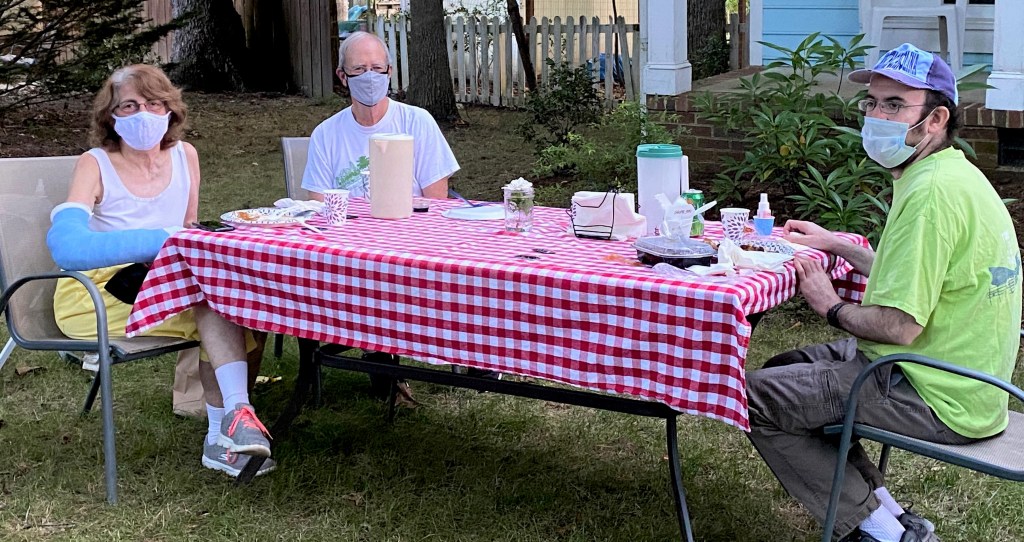
Like everyone else, we had to change a few things this year–even more than you might think because my arm is in a long cast (see photo). I’ll spare you the gory details, but I fell and broke my wrist last week. (And he couldn’t eat on one side of his mouth because he needed to have a tooth extracted this week.)

Yes, my husband, son, and I are all smiling under our masks. Photo by our delightful, socially distanced, next-door neighbor, Gina Lacava.

So, no steaks or fancy restaurants, but as you can see, none of that stopped us from celebrating–socially distanced, of course — this significant, life-changing event that trumped our current woes.

Come to think of it, kidney health is worth celebrating for everyone, every year. Don’t take yours for granted.

Don’t All Donors Deserve Donor Shield?

I’ve been emailing, calling, and visiting state legislators and members of Congress for a long time about supporting and protecting living donors. I don’t mean the feel-good kind of support that calls us “heroes” and “awesome folks” but takes no action. I’m talking about finding meaningful ways to remove hurdles that can be deal breakers for so many people who might otherwise consider donating their kidney. While Congress and legislators have been dragging their feet, a terrific model plan has been hiding in plain sight: the National Kidney Registry’s Donor Shield.

First, a little background that may be familiar to some of you: nearly 100,000 people in this country wait years for a kidney, but only about 23,000 kidney transplants were performed last year. Meanwhile, thousands die every year because they didn’t get a kidney (or other organ) in time. For the foreseeable future, our best hope of dramatically changing those appalling odds is through living donation. So, simply put, we need to make it easier for people to manage being live donors.

Photo by rawpixel.com on Pexels.com

How? For starters, by providing paid leave for all living donors for donation-related time off work–not just for federal and some state employees (not everyone has paid sick leave, and those who do shouldn’t have to use up their leave time); reimbursing for travel and lodging costs if donating far from home; and covering “incidental” expenses (which can feel anything but incidental: think childcare or eldercare).

You may already know that NKR facilitates paired donation (aka kidney swaps) through the world’s largest database of potential recipients and live donors. If you’ve never heard of Donor Shield, remember that name even if you don’t plan to be part of a paired donation. NKR automatically provides Donor Shield, which encompasses those common-sense protections and so much more, to all its living donors. But if you donate at any of the 90 U.S. transplant centers that’s affiliated with NKR– even if you’re not part of a paired donation!–you would get Donor Shield, too. I’m happy to see that the University of North Carolina Hospitals, where I donated to my son in 2006, is now affiliated with NKR.

The transplant center pays the Donor Shield premium, so there’s no charge for the donor. And there’s no cost to the recipient either. I hasten to add that, because I was shocked–and infuriated–to learn that the National Living Donor Assistance Center bases its eligibility for donor assistance on the recipient’s household income. NLDAC apparently figures that the recipient, who’s already contending with surgery and lost work time, should simply reimburse the donor for any such expenses.

In addition to the benefits and protections for living donors mentioned above, which legislators and federal agencies have been studying for years, Donor Shield also includes additional attractive features, such as providing legal support in the unlikely event that a donor is fired for taking time off to donate or encounters insurance discrimination; and in the rare event that a donor later needs surgery for a donation-related complication that isn’t covered for any reason, Donor Shield will cover it along with lost wages, and travel and lodging expenses for the donor and a companion. That’s at any point, no matter how many years after the donation. And there’s no income-based eligibility for donor or recipient.

Not only are these measures the right thing to do, they obviously save lives by making more transplants possible and taking people off the waitlists. If the moral argument doesn’t sway the powers that be, the economic argument should. Shortening the wait for a kidney, and reducing or even avoiding time on dialysis, saves hospitals and the federal government millions of dollars.

Even if the transplant center you’re donating at isn’t affiliated with NKR, it’s worth asking if they would agree to provide Donor Shield (they can obtain it). The more donors who request it, the more likely centers are to get on board. If only paired donation, NKR, and Donor Shield had been available back when I donated!

A Time to Celebrate

I think it’s only fair to warn you that this short post has absolutely nothing to do with kidneys, organ donation, or advocacy. But today is a special day, and attention must be paid. Today, amazingly, marks 50 years since my husband and I got married on a rainy Friday night in New York City. Months ago, when we were searching for special ways to celebrate this special wedding anniversary, we considered (1) throwing a party; (2) renewing our marriage vows; (3) planning a trip to Tahiti, which we’d considered for our 10th anniversary but couldn’t afford; (4) staying at New York’s Plaza Hotel, as we did on our wedding night; (5) splurging on a photographic safari to Botswana, which we actually did book for September but will almost definitely reschedule for a year later…and well, we were still dreaming up fun ways when covid turned the world—and our priorities–upside down.

So, instead, we’ll open a nice bottle of wine, maybe put on a Jacques Brel CD (we recited the lyrics to “Quand On N’a Que l’Amour—If We Only Have Love—at our wedding), and probably enjoy a special take-out meal. And we will make a toast to celebrate how incredibly fortunate we are, in the midst of all this suffering, sorrow, and shared outrage. (Thanks for indulging me.)

Hmm, maybe this topic does have something to do with kidneys, organ donation, and advocacy after all!

Does Your State Offer Paid Leave to Donors?

In the course of updating our book manuscript on living kidney donation, we were hoping to see lots of progress in job protections and financial assistance–such as paid leave laws and tax deductions/credits–for living donors. Well, the good news is that there has been some progress. More states are offering paid leave and tax benefits for donors’ unreimbursed costs for travel, lodging, lost wages, and so on. The bad news? You guessed it—not nearly enough.

Photo by Pixabay on Pexels.com

First the good news:

Job protections. Living donation is now eligible for unpaid leave and other protections under the Family and Medical Leave Act–so your job or equivalent has to be waiting for your on your return. Federal employees and most states grant such protections in the form of leave (paid or unpaid).

Paid leave: All federal employees receive at least 30 days paid leave for organ donation; most states offer paid leave of various lengths to their state employees. A few states (let’s give them a shout-out: California, Hawaii, Louisiana, and Minnesota) require private employers to provide paid leave for living donors. A few more (Arkansas, District of Columbia, and West Virginia) offer incentives to encourage private employers to do so.

Tax credits: Four states provide tax credits (that is, dollar for dollar) for unreimbursed expenses by living donors (shout-out: Idaho, Louisiana, Maryland, and Utah).

Tax deductions: About half of the states offer significant tax deductions.

The bad news: What about all the others? Why aren’t all states offering paid leave to their employees and providing incentives to private employers to offer paid leave? It’s the right thing to do and actually saves money compared with the costs of kidney patients’ staying on dialysis. Why aren’t the rest of the states with a tax code at least offering tax deductions? And why aren’t those with tax deductions offering tax credits instead?

If you’re considering donating, find out what the law is in your state before you talk to your employer. Be sure to get all relevant details, because there are frequently requirements about how many hours a week you work or how many people a company employs in order to qualify. In any case, call or email your state representatives and tell them to do the right thing. Don’t let them merely pay lip service to supporting living donation–living donors deserve every state’s concrete support.

Contact me for a state-by-state list of donor leave laws and tax regulations compiled by the National Kidney Foundation.

Preparing The Greatest Gift

My co-author, Betsy Crais, and I have been busy making revisions and updates to our book manuscript (The Greatest Gift: The Insider’s Guide to Living Kidney Donation). With the pandemic necessarily dominating the news and publishing world, this seemed like a good time to concentrate on honing our manuscript rather than sending out proposals. As we prepare the final chapters, we’re noticing some key trends since we started working on it 5+ years ago (back when we were both working full time and unable to devote much time to it):

Social media is playing a bigger and bigger role in kidney patients’ search for donors. I get requests every week to “like” a page to help someone find a donor. The National Kidney Foundation’s Big Ask/Big Give workshops, which Betsy and I have addressed in Chapel Hill and Raleigh, NC, encourage and train kidney patients and their families and friends in how to get the word out that way.

Potential donors are learning that they don’t have to be related to their recipient. Perhaps because of the social media involvement, more nonfamily members are volunteering to donate to a friend, neighbor, or colleague. Antirejection meds have come so far that, though well-matched pairs still offer the best chance of long survival, the so-called “perfect match” is far from being a requirement for a kidney transplant.

Paired donation (aka “kidney swaps”) have really taken off. Let’s say, you want to donate to Alice but you’re not a match; maybe Jane, who wanted to donate to Bill but couldn’t, can donate to Alice and you can donate to Bill. Computer formulas and kidney registeries make it all possible. In 2006, when I donated to my son, paired donation wasn’t even on our radar, and no wonder: there were only 72 such transplants in the United States that year. In 2019, there were 1,118! It doubled just in the past 5 years.

Nondirected donors are playing a bigger role. These rare individuals (a few hundred each year in the United States) make the selfless decision to donate to someone they don’t know–and may never meet. Sometimes their donation can initiate a domino chain of kidney transplants across several transplant centers.

Photo by Pixabay on Pexels.com

As we start to wrap up The Greatest Gift, I may post a few samples here from time to time.

Donation and Hollywood Endings

When we see a movie or TV show on a medical topic we know a lot about, we may roll our eyes when they take dramatic license, but we often just shrug it off. When the subject is something people are less familiar with, like organ donation and living donation, a flawed story can make a lasting and dangerous impression. Donate Life Hollywood is trying to do something about it.

Story lines that mislead and even scare people (like a macabre thriller about an organ recipient) from registering as donors can cost lives. With 112,000+ people usually waiting years for an organ from a deceased donor in this country, every time someone decides not to register as an organ donor, the wait is that much longer. Donate Life Hollywood wants to hold Hollywood accountable and offer filmmakers accurate, real-life stories from donor families, recipients, and living donors.

You can download the free app, which offers an easy, convenient way to “report-a-myth.” The app lets me know when a new movie or TV episode with a donation-related story is about to air, so donors and advocates like me can check it out and let them know if the writers got it right. The app also includes up-to-date information on organ, eye, and tissue donation, with FAQs, and resources. Check out the Activate App here.

Admittedly, some exciting aspects of medical dramas are comparatively innocuous. One of my favorite TV shows years ago was “ER.” My heart would race as my favorite docs ran out to the parking lot when an ambulance pulled up. I think I knew that wasn’t happening much if ever in real life. (That certainly wasn’t the case when we came tearing up to the hospital 30 years ago as I was giving birth to my daughter in a Subaru—but that’s another story.)

There are already plenty of harmful myths about organ donation and living donation—we can’t afford to let Hollywood perpetuate them. Let’s help educate the story makers and be part of the solution!

Did You Know? Pass It On!

Whether you’re a donor, a potential donor, or a kidney patient looking for a donor, here are a few intriguing facts everyone should know about living donors:

  1. More than a third of living kidney donors are over 50 years old (I was 58 when I donated to my son 14 years ago), and the proportion is rising.
That’s me, right before a memorable 2018 trip to “the Bean” in Chicago to help set a Guinness World Record for largest gathering of living donors.

2. Most living donors, like me, say they would do it again (often adding “in a heartbeat”).

3. Many living donors were inspired to donate to someone they didn’t know because of an eye-opening article they read or a moving Facebook post that resonated with them.

4. Nondirected donors–empathetic people who choose to donate to someone they don’t know and may never meet–now represent about 3% of living donors in the United States, but the percentage is on the rise.

5. Nondirected donors can save multiple lives by initiating a swap (aka a paired donation, as a friend did in advance for her son)–or even a chain of transplants. If Donor A isn’t a match for their intended recipient (Recipient A), but the nondirected donor is, he or she donates to Recipient A, and Donor A donates to someone else who wasn’t a match for their recipient, and so on.

6. Most living donors (in an informal survey) own rescue pets. (A shout-out to WELD San Diego for that interesting statistic!)

7. And, of course, most living donors are women (another shout-out to WELD, which, by the way, stands for WoMen Encouraging Living Donation–yes, they now include men in their growing ranks).