Living Donors Don’t Get Paid (Yet) But the Rewards Are Still Real

Maybe you’ve heard that there’s a growing movement to find a way to fairly compensate living donors as a way to address the dire kidney shortage. It’s in the form of the Coalition to Modify NOTA (the National Organ Transplant Act). Simply put, NOTA is the reason that though we can pay people to donate blood or sperm or even to carry our baby, we can’t do the same for living donors. I’ll be writing more about this in the coming weeks.

Photo by Pixabay on Pexels.com

But in the meantime, most people who have donated their kidney will tell you that the nonmonetary rewards of donation are undeniable (which by no means makes compensation any less justified). I update and dust off the blog post below every year or so because it really bears repeating.

Living donors have told me they’d nodded in agreement while reading it, and many people point out that even though these things are pretty obvious to donors, transplant centers usually don’t give them sufficient weight.

**********************************************

In previous posts, I’ve described some of the enormous benefits of a live vs. deceased-donor kidney transplant for the recipient, but did you know that there are many very real benefits to the living donor, too? For family members or couples, the benefits are nothing short of dramatic. And I’m not just talking about feel-good points.

For a family, the practical benefits can be as concrete as money in the bank. A spouse or parent whose ability to work was limited by dialysis for a long period may gradually be able to resume a full-time schedule–maybe even launch a new career. That can substantially improve the family’s ailing financial health as well.

For family caregivers, particularly, donating a kidney to the loved one you’ve been caring for can bring huge relief. The reduced stress and no doubt improved sleep can have considerable benefits in energy, mood, overall outlook, and, as a result, even job satisfaction.

Then there’s the extraordinary motivation of saving a loved one’s life or turning it around. A living donor I know who’d donated to her husband described her decision as “purely selfish. I wasn’t about to lose him,” she insisted. I know the feeling.

Seeing someone you love–in my case, my adult son–who’d been pale, weak, and listless for months or years gradually become their old self again is pretty powerful. And a donor whose partner wasn’t interested in intimacy during a long period of ill health may see a positive change in their relationship.

Want to improve your social life? Give your partner a kidney! Couples who have been uncomfortable for a long time about socializing—whether because of physical obstacles or simply due to the dialysis patient’s lack of energy or interest—may soon be able to enjoy evenings out with friends or family.

For anyone who donates a kidney—even to someone they don’t know—the benefits are nearly universal:

The feeling of personal gratification is indescribable. Knowing that you’ve helped give someone—anyone—a shot at a healthy, productive life—is an extraordinary feeling. Living donors in studies report a boost in self-esteem, and 9 out of 10 say they would do it again. Through donor-support groups I’m active in on Facebook, I’ve been struck by how life changing the experience has felt for most of us, including the few who have later had complications or whose recipient didn’t fare well for as long as expected.

A fascinating journal article inspired this post. The researchers argue that for the above reasons and more, transplant centers considering a potential donor’s relative risk might do well to acknowledge and give weight to the undeniable tangible benefits for certain donors.

“Van Pilsum Rasmussen, S. E., M. Henderson, J. Kahn, and D. Segev. “Considering Tangible Benefit for Interdependent Donors: Extending a Risk–Benefit Framework in Donor Selection.” American Journal of Transplantation 17, no. 10 (Oct. 2017): 2567-2571.

For related posts and information on my book, The Insider’s Guide to Living Kidney Donation, be sure to explore the rest of my website.

Minority Donor Awareness Month

Like most “awareness months,” this one should get more attention year ’round. Because minorities are disproportionately affected by chronic kidney disease, they are also disproportionately underrepresented when it comes to organ donation. National Minority Donor Awareness Month is a collaborative initiative of the National (Organ, Eye and Tissue Donation) Multicultural Action Group (NMAG) designed to change that.

NMAG’s objective is to bring heightened awareness to donation and transplantation in multicultural communities; the focus is on African American, Hispanic, Asian/Pacific Islander. and Native American communities.

Black or African Americans are more than 3 times as likely, and Hispanics or Latinos 1.3 times as likely, to develop kidney failure compared with white Americans, according to the National Kidney Foundation website. That’s primarily because these minorities have much higher rates of the conditions that are the major risk factors for chronic kidney disease, namely diabetes, high blood pressure, and obesity.

Earlier this year I wrote here that action finally was being taken to address critical systemic inequities in access to transplant. The formula that determines a patient’s degree of kidney function (eGFR)–and consequently their eligibility for transplant–was race based for decades until last year. The result was that fewer African Americans were deemed to be “needing” a transplant even when their creatinine (level of waste products in the blood) was the same as a white patient’s. U.S. transplant centers are now required to adjust the status of African American kidney patients who were wrongly classified based on the old formula.

That was huge news. Overall, most of the nearly 100,000 people waiting for a deceased-donor kidney in the United States wait five to ten years. Thousands die each year simply because they didn’t get one in time. Anything that unnecessarily adds to that wait is tragic.

Remember what I said in the opening about needing more minority donors? Example: In 2021 nearly 30% (28.6) of the total candidates waiting for transplants in this country were non-Hispanic blacks, but black individuals made up just 15% of organ donors in 2021.

Unfortunately, rates for living donation are even more affected. In 2021 only 18.7% of black donors were living donors versus 33.6% of white donors. Given that living donation offers shorter waits and provides better outcomes, lagging in this area further compounds the appalling disadvantages.

Taking concrete steps to reduce inequities in the system is one important way to shorten the wait for a lifesaving organ for those most in need. Raising awareness of the situation–among individuals, healthcare providers, and members of Congress (to provide increased funding for research and supports)–are others.

The NMAG collaborative has numerous print and social media messages on donation and transplantation. Spreading these messages is important this month and every month.

For related posts, resources, and information on The Insider’s Guide to Living Kidney Donation, be sure to explore the rest of my website.

My Favorite Activist: Maggie Kuhn

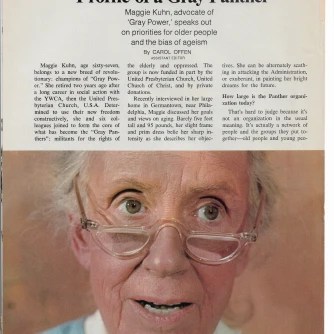
Today (August 3) is the birth date of someone you may not have heard of but who deserves to be remembered and honored: Maggie Kuhn, the engaging founder of the Gray Panthers. Maybe you saw my recent recollection on Medium of my interview with her in the 1970s or recall my blog post here You’re Never Too Old to Be an Activist.

Full disclosure: Maggie Kuhn had nothing to do with kidney donation or protections for living donors–not directly, anyway. But she was a role model for me and should be for anyone who’s ever hesitated to step outside their comfort zone to advocate for something they believe in.

“Speak your mind,” she famously said, “even if your voice shakes.” After having to take mandatory retirement at age 65, Maggie spoke hers at rallies, before boards, and congressional committees as she fought for rights of older Americans and protections for the most vulnerable in society.

I hope you’ll check out the links in this post to learn a bit about Maggie Kuhn and be inspired by her, as I was.

For related posts, resources, and information on The Insider’s Guide to Living Kidney Donation, be sure to explore the rest of my website.