
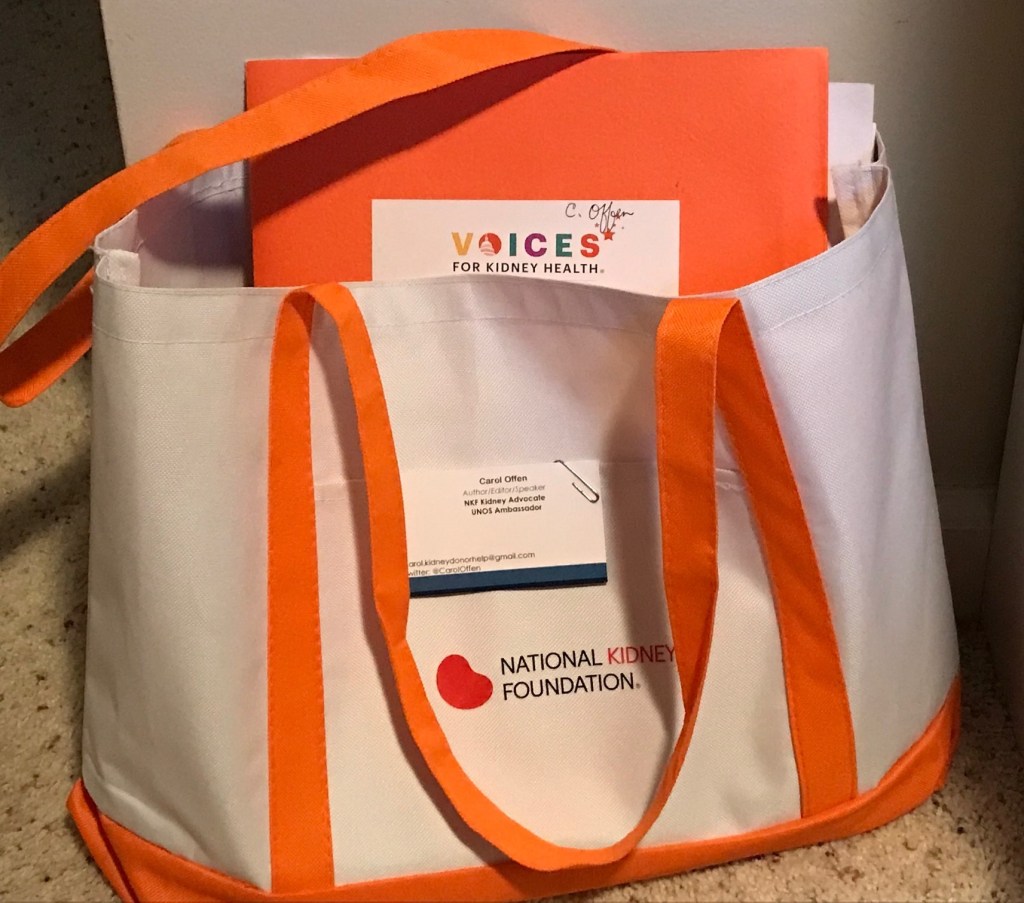
My bags are packed, and I’m ready to approach federal legislators and/or their staffers again along with other advocates from the National Kidney Foundation. As usual, we have very important asks.
If you’ve read even a few of my posts since I launched this site in 2019, you know that I’ve been lobbying for the Living Donor Protection Act–both on Capitol Hill and in my state, North Carolina–for several years. So, yes, our number-one ask is for this session of Congress to finally move ahead with this bipartisan (yes!), noncontroversial, bare-bones legislation that’s been kicking around Congress since 2014.
This bill to prohibit discrimination by insurers against living donors–through higher premiums or coverage refusal–gets reintroduced every session. There may be a new sponsor, if one of the originals is no longer in office, more cosponsors…and then it sits. It’s yet to have a committee hearing, much less a vote. This shouldn’t be so hard.
The second ask is a newer one that could benefit so many people currently on dialysis. The majority (about 85%) of dialysis patients receive hemodialysis at a center, where they go three times a week for three to four hour sessions. Not everyone lives near a center and may need to travel more than an hour by car or city bus(es) to get there. We want Congress to improve access to home dialysis for patients who choose to do it, by providing funds for training and professionals to actually go to people’s homes in the first few months to help them learn how. It could be a game changer by enabling someone to do dialysis on their own schedule and even facilitate their being able to fit sessions around their work hours.
The third ask is about modernizing and improving the national transplant system that allocates deceased organs. Nearly 100,000 people are on national waiting lists (most of them for a kidney), and most wait several years. The system is extraordinarily complex and there are appalling instances of wasted organs. Most everyone agrees it needs to be more efficient and transparent, so more people can get a transplant after a shorter wait. Congress passed an act to modernize and improve the system last year. What we need now is for lawmakers to provide the necessary $100 million funding to carry it out.
The fourth ask, and in the long run arguably the one with the most lasting potential benefit, concerns early screening for kidney disease. My symbolic “friend” in the kidney community probably isn’t even aware of being among the estimated 37 million Americans with chronic kidney disease. Yup, 90% of that population haven’t even been diagnosed yet and don’t know that their kidneys are gradually–sometimes not so gradually–losing function.
Confused? Let me clarify the difference between chronic kidney disease and kidney failure. Diseased kidneys slowly lose function over years–even decades–before they reach kidney failure, during which time there may well be no obvious symptoms. Once they fail, though, the only way to save someone’s life is with a transplant, or, in the meantime, dialysis. People with diabetes and/or high blood pressure are at the highest risk of developing kidney disease. So if doctors routinely screened these patients for kidney disease (with a simple blood test), millions of lives could be saved.
With early detection, not only can that disease progression be slowed, it can often even be reversed, through behavioral changes–exercise, healthy diet, hydration–and medication. We’re asking members of Congress to sign a letter in support of official guidelines for screening.
These are pretty straightforward noncontroversial asks. I’ll let you know how it goes.
For related posts and information on my book, The Insider’s Guide to Living Kidney Donation, be sure to explore the rest of my website.
 Could You Be a Kidney Donor? What to Expect If You Give the Greatest Gift