Belated New Year’s Resolutions, Whether You Have 1, 2, or 3 Kidneys

I know it’s a bit late for resolutions but better late than never is always my motto.

Every year before I make new ones, I look back to see how I did on last year’s. Alas, they’re almost always still relevant. I don’t think I’m unusual in that respect. I know, for example, that my Zumba classes and the workout area of my gym are more crowded these days. I used to be alarmed about it but soon saw that in a matter of weeks, the crowds invariably start to thin. By late February they’re always back to near-usual levels.

So, once again I’m dusting off my old new year’s resolution blog post with a few updates. They’re relevant for everyone–whether you’re a living donor, like me–or never plan to be–or you’re a kidney transplant recipient like my son.

If you’re already being evaluated as a living donor–yay!–or even just thinking about it, the following suggestions will benefit you and your kidneys–however many you have and wherever they happen to be.

1- Take good care of yourself (and your kidneys). That means

–Exercising regularly. My retiree friends all seem to be obsessed with pickle ball, but I’m sticking with Zumba and, slowly coming around to, regular strength training.

–Getting plenty of rest. Alas, that’s a tricky one for many if not most of us. We can at least follow the simplest rules of sleep hygiene: no screen time a couple of hours before bedtime, no late meals, and avoid caffeine and alcohol late in the day. Also be sure to factor in some quiet downtime before bed.

–Staying hydrated. This one was reinforced for me again recently when I had another scare about my kidney function.

–Eating a healthy diet. Mostly that means a balanced diet with fresh foods–no extremes on any component including protein. And avoid ultra-processed foods!

2-Getting the latest Covid booster for which you’re eligible (for your own safety and your potential future recipient’s). Many people who were vigilant about that earlier have slacked off, but Covid has not disappeared–I have a few friends who can personally attest. The boosters are still important! Also, transplant recipients, like my son, and anyone else who is immunocompromised, such as people with cancer or autoimmune diseases, can’t count on full protection from the vaccines.

It’s all the more important that the rest of us add that extra layer of protection.

3-Avoid ibuprofen and other NSAIDs. They’re hard on the kidneys for anyone. That becomes particularly important if you’re a current or potential donor or recipient.

4-Learn all you can about kidney function and get yours checked. Kidneys are amazing–read about my righty!

5-Read up on all facets of kidney donation. For example, order a copy of The Insider’s Guide to Living Kidney Donation.

I’m obviously not the first, so let me be one of the last, to wish you and your family a happy, healthy new year!

For related posts and information on my book, The Insider’s Guide to Living Kidney Donation, be sure to explore the rest of my website and my articles at Medium.com/@caroloffen.

A Cautionary Tale about the Importance of Being Hydrated

After eighteen and a half years as a living kidney donor, you’d think I’d know better.

I’ve always been justifiably proud of my “numbers”: my creatinine (level of toxins in the blood) and my eGFR (estimated kidney function). Whenever I talk to legislative staffers or podcast hosts, I boast that at 76 I’m healthy and active (Zumba classes two to three times a week!) and have normal kidney function–results that would be enviable for someone with two kidneys!

Photo by Artem Podrez on Pexels.com

Until October, that is.

That’s when I went for my annual check up and routine lab work. I was stunned at the results. For years I’ve always had normal kidney function (60 or up) and creatinine readings consistently under 1.02 (normal upper limit for women). Last year was much higher than my usual .85 but still “normal” at .94.

In October, for the first time in at least 10 years, my kidney function was a shocking 52. I conceded to my doctor that I don’t drink as much water as I should. I’m a bit embarrassed to admit I was always a little disdainful of donors who obsessively measure their fluid intake when I’d just been natural about it and always had good results. Apparently, I was getting sloppy. Last year’s .94 should have made me think twice about being so casual.

I know that creatinine readings can jump around a lot, so I was glad that my doctor suggested we retest after I came back from an upcoming trip. Let’s see if this is an anomaly, she said, adding “but be sure to be well hydrated when you test.”

We’d been back from our trip for about three weeks before I had the nerve to redo the test. I was waiting for optimal conditions. Uh-oh I wasn’t as consistent about drinking yesterday–better not test today. Uh-oh tomorrow I’m going to be out a lot and may forget to hydrate–better not test tomorrow.

I was obviously hoping for a big improvement but decided that I’d be relieved if my creatinine were down by even a little so that it would be clear the higher reading wasn’t part of an upward trend. I thought the new results could be available that evening so I watched anxiously for an email. Finally, the alert came during dinner. I raced to the computer.

Nervously, I clicked on the test results.

Drum roll please: It was .80–that’s even lower than it’s been in several years! And my eGFR? A whopping 76!

Whew. So, no, I still won’t start measuring my fluids–but will try to be mindful of always having a water bottle nearby and remembering to drink. Drink. Drink.

In addition to being reassuring, the lesson was empowering. It was a reminder that we can often still affect our health with simple daily habits. Whether you have one kidney or two (or three like my son, who has mine too), being hydrated is important for healthy kidneys.

Don’t give yourself a scare, like I did.

For related posts, resources, and information on The Insider’s Guide to Living Kidney Donation, be sure to explore the rest of my website.

ASKing Congress–for a “Friend”

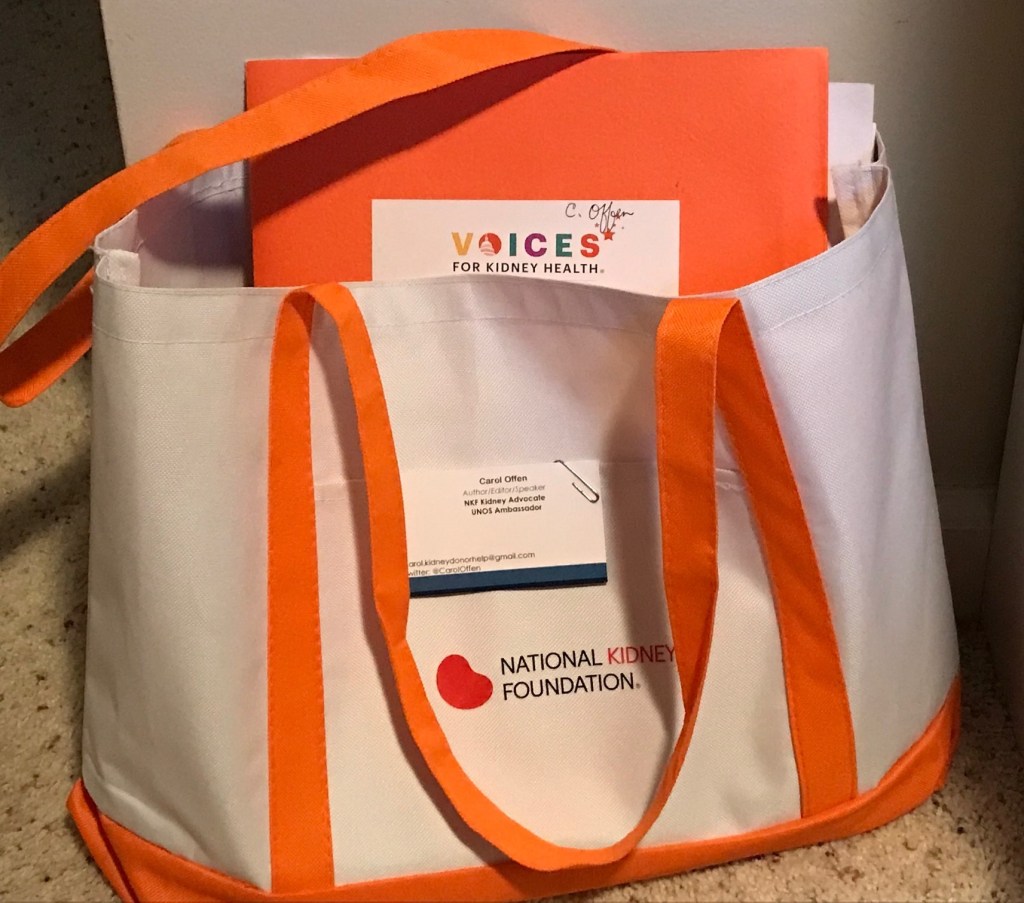
My bags are packed, and I’m ready to approach federal legislators and/or their staffers again along with other advocates from the National Kidney Foundation. As usual, we have very important asks.

If you’ve read even a few of my posts since I launched this site in 2019, you know that I’ve been lobbying for the Living Donor Protection Act–both on Capitol Hill and in my state, North Carolina–for several years. So, yes, our number-one ask is for this session of Congress to finally move ahead with this bipartisan (yes!), noncontroversial, bare-bones legislation that’s been kicking around Congress since 2014.

This bill to prohibit discrimination by insurers against living donors–through higher premiums or coverage refusal–gets reintroduced every session. There may be a new sponsor, if one of the originals is no longer in office, more cosponsors…and then it sits. It’s yet to have a committee hearing, much less a vote. This shouldn’t be so hard.

The second ask is a newer one that could benefit so many people currently on dialysis. The majority (about 85%) of dialysis patients receive hemodialysis at a center, where they go three times a week for three to four hour sessions. Not everyone lives near a center and may need to travel more than an hour by car or city bus(es) to get there. We want Congress to improve access to home dialysis for patients who choose to do it, by providing funds for training and professionals to actually go to people’s homes in the first few months to help them learn how. It could be a game changer by enabling someone to do dialysis on their own schedule and even facilitate their being able to fit sessions around their work hours.

The third ask is about modernizing and improving the national transplant system that allocates deceased organs. Nearly 100,000 people are on national waiting lists (most of them for a kidney), and most wait several years. The system is extraordinarily complex and there are appalling instances of wasted organs. Most everyone agrees it needs to be more efficient and transparent, so more people can get a transplant after a shorter wait. Congress passed an act to modernize and improve the system last year. What we need now is for lawmakers to provide the necessary $100 million funding to carry it out.

The fourth ask, and in the long run arguably the one with the most lasting potential benefit, concerns early screening for kidney disease. My symbolic “friend” in the kidney community probably isn’t even aware of being among the estimated 37 million Americans with chronic kidney disease. Yup, 90% of that population haven’t even been diagnosed yet and don’t know that their kidneys are gradually–sometimes not so gradually–losing function.

Confused? Let me clarify the difference between chronic kidney disease and kidney failure. Diseased kidneys slowly lose function over years–even decades–before they reach kidney failure, during which time there may well be no obvious symptoms. Once they fail, though, the only way to save someone’s life is with a transplant, or, in the meantime, dialysis. People with diabetes and/or high blood pressure are at the highest risk of developing kidney disease. So if doctors routinely screened these patients for kidney disease (with a simple blood test), millions of lives could be saved.

With early detection, not only can that disease progression be slowed, it can often even be reversed, through behavioral changes–exercise, healthy diet, hydration–and medication. We’re asking members of Congress to sign a letter in support of official guidelines for screening.

These are pretty straightforward noncontroversial asks. I’ll let you know how it goes.

For related posts and information on my book, The Insider’s Guide to Living Kidney Donation, be sure to explore the rest of my website.

“Ms. Smith” Goes Back to Washington

Last year at this time I excitedly announced here that I’d be going to Capitol Hill–in person!–for legislative meetings as part of the National Kidney Foundation’s Kidney Patient Summit. Because of the pandemic, the previous several summits had been virtual–important, productive, yes, but no substitute for the real thing.

I surprised myself by writing that though the logistics of getting from point A to point B, and so on, made me nervous, I realized that the actual meetings didn’t phase me. I explained that multiple trainings and meetings had driven home the message that personal stories of kidney donation and transplant are what make the biggest impression on legislators and their staff.

Last year’s team: Necole & Dre Roundtree, me, Alan Levy.

I’ve been telling mine (about donating my kidney to my adult son) for years to anyone who’ll listen.

This year I’m happy to say I’ll be going back to Capitol Hill for another in-person summit. This time I’ve been invited to also participate in a separate smaller group of advocates for a “series of deep-dive policy discussions” before the summit begins. I’m very excited to be honored with a seat at the table to consider critical issues, such as the status of the nationwide allocation system for deceased-donor organs in the wake of recent reform legislation, obstacles in furthering legislation to improve access to home dialysis, and the increased attention to addressing rare kidney diseases.

Stay tuned for more information.

For related posts and information on my book, The Insider’s Guide to Living Kidney Donation, be sure to explore the rest of my website

More New Year’s Resolutions

Every year before I make new new year’s resolutions, I try to look back to see how I did on last year’s. Alas, they’re almost always still relevant. I don’t think I’m unusual in that respect. I know that starting next week, for example, my Zumba classes and the workout area of my gym are going to be jammed. I used to be concerned but soon saw that in a matter of weeks, the crowds invariably start to thin, and by late February they’re always back to near-usual levels.

So, I thought I’d dust off my old new year’s resolution blog post and share these again. They’re relevant for everyone–if you’re a donor or never plan to be one.

Whether you’re being evaluated as a living donor already, or just thinking about it, here are a few suggestions that will benefit you and your kidneys–wherever they happen to be.

1- Take good care of yourself (and your kidneys).

–Exercise regularly.

–Get plenty of rest.

–Stay hydrated.

–Eat a healthy diet.

2-For your safety and your future recipient’s, be sure to get the latest Covid booster as soon as you’re eligible. Transplant recipients and anyone else who is immunocompromised, such as people with cancer or autoimmune diseases, can’t count on full protection from the vaccines. It’s all the more important that the rest of us add that protection.

3-Avoid ibuprofen and other NSAIDs—they’re hard on the kidneys for anyone—particularly important if you’re a donor or recipient.

4-Learn about kidney function. Kidneys are amazing!

5-Read up on all facets of kidney donation—for example, order a copy of The Insider’s Guide to Living Kidney Donation.

To all of you and your loved ones: a happy and healthy new year!

For related posts and information on my book, The Insider’s Guide to Living Kidney Donation, be sure to explore the rest of my website.