NC Will “Soon” Have a Living Donor Protection Act!

It’s so close I can taste it.

I actually wrote much of this blog post in late June thinking it was days away, then put it aside thinking I’d wait till it was official that North Carolina would join the other 35 states that currently have living donor protections.

I decided not to wait because nearly three months later, it’s still not official–though it’s closer than it’s ever been.

NC Senate Bill 101 is currently in the Rules Committee of the State Senate just to approve the changes made to the bill by the House. It shouldn’t take long but…

We–donation advocates, donors and recipients alike–have been working to prohibit discrimination against living donors by insurance companies and to provide various job protections for several years. I personally have been in the fight since 2019.

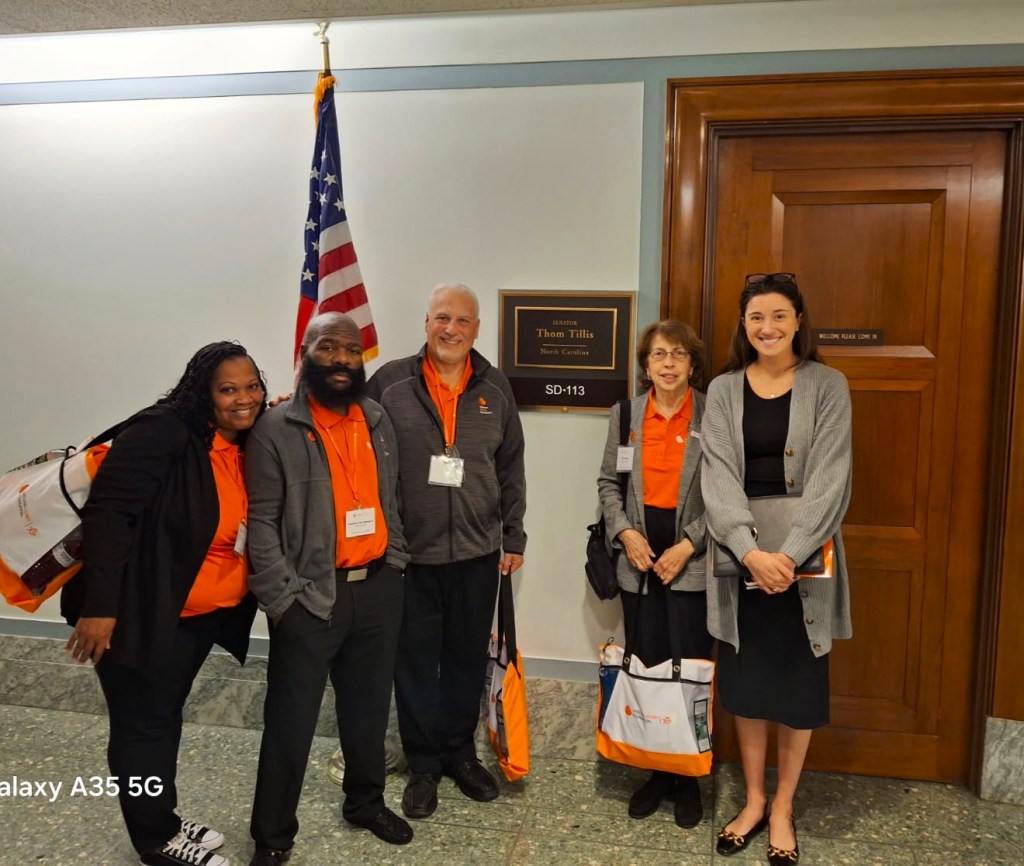
Nearly six years ago, I first met with a NC state legislator (Rep. Willingham, center of photo) and several aides for other lawmakers at the General Assembly; five years ago I had coffee in district with a state legislator; four yeas ago I gave public comment; three years ago I attended a legislative breakfast with a few state legislators to give them a personal perspective on living donation. Throughout, I’ve made countless phone calls and written several blog posts to demonstrate support.

Each legislative session, we thought this would be the one, we’d finally make it–only to miss out at the last minute and we’d need to start from scratch in the next legislative session. Last year it was because a feud between state legislators had led one of them to block the bill.

And then, in June, to my shock and delight, I learned in a meeting that the General Assembly had just passed the bill. I couldn’t find anything online about it as it went through its final formal paces.

Then about a month later I learned that it was headed to the governor’s desk, awaiting his signature.

It wasn’t.

There’s one more hurdle: the Rules Committee, which is where it’s been sitting since late June.

So this week, along with other advocates, I called the bill’s primary sponsors to urge them to try to persuade the Rules Committee to bring it to a vote.

If you’re in North Carolina, please contact your state senator and ask them to do the same. Note that this bill has been approved by both the House and the Senate.

For living donors in the state, I’m happy to report that the bill goes a little further than the national version that’s been hiccuping through Congress since 2014. The NC version gives public employees two weeks of paid leave to donate. In addition to protections for living donors, the bill protects tax-advantaged accounts such as college tuition programs and ABLE accounts for individuals with disabilities.

Here’s hoping that the next post I write on this topic will be a clear-cut triumphant one.

For related posts and information on my book, The Insider’s Guide to Living Kidney Donation, be sure to explore the rest of my website and my articles at Medium.com/@caroloffen.

An Important New Book: “Understanding Living Kidney Donation”

As a living kidney donor to my son, I can certainly attest to how rewarding, gratifying, meaningful and life changing the experience usually is. It’s also really complicated.

It would be complicated under the best of circumstances because, as we make clear in The Insider’s Guide to Living Kidney Donation, being a kidney donor is not just a medical decision. It has emotional, social, familial and financial ramifications. That’s why, in addition to information and resources, we included first-person accounts of people with different perspectives on the process.

The innate complexity of the experience is of course further complicated by the medical complexities of donor-recipient matching and the daunting intricacies of this country’s organ allocation system.

Perhaps, like me, you have a loved one who needs a kidney, or you know someone who’s donated and you know how much it meant to them, whether they gave to a family member or to a stranger. So you’re seriously considering taking this important step yourself.

Learn everything you can about it.

So–assuming you’ve already read our book!–go immediately to Glenna Frey’s excellent, extremely thorough new book. In clear, nontechnical language, she succinctly explains kidney donation, kidney disease and treatments and lays out all the stages in the donation process in detail, helpfully summarizing everything at the end of each chapter.

Glenna is a living donor herself and a well-known donation advocate. She co-founded Kidney Donor Conversations with daughter Amanda to educate people about kidneys and donation. Like my friend and co-author, Betsy, Glenna’s family has been touched by Polycystic Kidney Disease (PKD). Her husband is doing well on his second kidney transplant, and Amanda also has been diagnosed with the hereditary disease.

Glenna’s interest and expertise in the subject stems also from being a nephrology nurse for forty years, both in a transplant unit and in dialysis clinics. Given her dual personal and professional perspective, the accuracy and thoroughness of the information was not surprising. But I suspect that the refreshing clarity and accessibility of the text may also owe something to the influence of Amanda, whose career as a therapist has made her adept at making advanced concepts more accessible to lay readers.

Kidney donors need to be prepared with as much information as possible. This book belongs in any prospective donor’s library.

For related posts and information on my book, The Insider’s Guide to Living Kidney Donation, be sure to explore the rest of my website and my articles at Medium.com/@caroloffen.

A New Milestone for the Site–And Me!

A little more than six years ago, at the age of 71, I launched this website, knowing virtually nothing about launching a website. At the same time, I began writing a blog, knowing little more about writing blogs.

Photo by Tara Winstead on Pexels.com

We just hit 25,000-plus hits! And 16,000 unique visitors!

Amazing.

The odds were that it would last just a few months–a year or two at most. That’s typically the fate of similar ventures. But here we are.

I’m proud to say that for several years, the site has consistently been in the top 5 of Best Kidney Donor Blogs. When I was posting regularly, it was actually at number 2 or 3, behind two large national organizations. Ever since I began writing more frequently on Medium.com–kidney-related posts as well as personal essays and memoirs–I’ve admittedly neglected this site.

That’s why these remarkable stats took me by surprise last week:

I often say I’ve been fortunate to be having a second act as a donation advocate. Raising awareness of kidney disease and donation has been my passion for more more than a decade.

But, believe me, launching a website … writing a blog … speaking before groups never was–and still isn’t. But in pursuit of my passion, I discovered that I needed to–and could– learn to do all sorts of things I previously thought impossible.

Am I good at any of them? Good enough at most and getting better all the time.

My advice is neither profound nor original, but here goes: whatever your passion, your dream, your goal–go for it! Even if it’s outside your comfort zone–especially if it’s outside your comfort zone. The bonus just may be a few more skills that you never thought you’d accomplish.

For related posts and information on my book, The Insider’s Guide to Living Kidney Donation, be sure to explore the rest of my website and my articles at Medium.com/@caroloffen.

Kidney Advocacy 101

I just came back from Washington, DC, where I participated in in-person meetings on Capitol Hill–for the fourth time–to discuss ways that Congress can and must support the kidney community. As I type these words, I realize that the kidney community may sound like a small portion of Americans, a discrete segment of the population.

Unfortunately, that’s hardly the case.

Numbers typically don’t leave a lasting impression on most of us. Reading the oft-repeated statistic that 37 million people in this country, one in seven, are estimated to have chronic kidney disease starts to lose its shock value. Dramatic as that is, however, it’s usually followed by the shocking statement that 90% of them don’t know it.

It’s likely that you know someone who’s among the people in that estimate–maybe even a loved one.

Before my son was diagnosed with chronic kidney disease about 20 years ago, my family thought, like many, that kidney disease was something that just happened to other people. Not true, of course. And when people hear that my son’s condition was caused by a strep infection, they quickly realize that what happened to our family could happen to any family.

So our “asks” for Congress this time were threefold:

–Support the sweeping and way-overdue modernization of the antiquated and inefficient organ allocation system with funding: $67 million (the bill authorizing the modernization was passed in 2023).

–Co-sponsor the bill to expand and improve access to home dialysis (introduced in the last session of Congress but needs to be reintroduced in the new session).

–Support a brand-new and much-needed initiative to expand education and screening for kidney disease. Right now kidney patients don’t get thorough counseling until Stage 4 of chronic kidney disease–that is, just before their kidneys fail in stage 5. Early screening and detection for everyone is vital in catching declining kidney function in the early stages, when it’s still treatable.

So whatever the particular legislative “asks” at a given time–and whether I go to Capitol Hill as part of a delegation from the National Kidney Foundation, as I did last week, or the American Kidney Fund, as I did last May–my advocacy has a very simple goal.

To keep this vital topic on Congress’s radar. Because it’s in virtually everyone’s interest.

For related posts and information on my book, The Insider’s Guide to Living Kidney Donation, be sure to explore the rest of my website and my articles at Medium.com/@caroloffen.

Why You Should Know More About Your Kidneys Than You Do

The following article, which I wrote, appeared originally in Wise & Well, a Medium.com publication, on Feb. 13, 2025.

If you saw recent headlines about clinical trials for transplanting modified pig kidneys into humans, you may have wondered why scientists would even think about doing such a thing.

The simple reason is that there aren’t nearly enough human kidneys available, living or deceased, to meet the growing need. About 800,000 people in the United States have kidney failure. About 37 million people — one in seven — in this country have chronic kidney disease, meaning that they’re slowly losing kidney function. The real tragedy is that 90% of them don’t know it.

Photo by Pixabay on Pexels.com

Simply knowing the level of your kidney function–that is, how effectively your kidneys are working–could save your life.

Chronic kidney disease is usually asymptomatic until it’s progressed to kidney failure and sometimes not even then. Often it’s discovered when someone gets a screening at a Kidney Walk event to raise awareness of kidney disease. Or someone may go to the emergency room for a possibly unrelated problem.

If the kidneys are failing, that person immediately is put on dialysis, a process that removes toxins and excess fluid if the kidneys can’t do the job. The patient will need dialysis — but, ideally, a new kidney — to stay alive.

If kidney disease is caught in the early stages, however, the condition can frequently be reversed through healthful eating, exercise and possibly medication. In any case, disease progression typically can be slowed with proper treatment. Once the disease reaches kidney failure, though, it‘s too late to turn it around.

Contrary to popular notions, kidney disease can strike anyone, not only older people or those with diabetes or poor eating habits.

When my family got the news

My son was diagnosed with kidney disease when he was in college, and the news came out of left field for us. We did not have a family history of kidney disease, and he had none of the usual risk factors (diabetes, hypertension, obesity). His condition, discovered in lab work, was the unexpected and devastating result of a strep infection.

We were told that because he was young and otherwise healthy, the disease might never progress to kidney failure; in any case it could take many years. His condition was monitored for a few years, and then, inexplicably, his kidneys failed just months after his college graduation.

He spent 20 long months clinically depressed as he underwent in-center dialysis, until I could donate my left kidney to him. Eighteen years later, the one I gave him is still going strong. My right one still gives me normal kidney function–that is, a GFR, or glomerular filtration rate, of 60 or higher; mine is 76. At nearly age 77, I have an active, healthy life, as do most living donors.

Before my son’s initial diagnosis I knew nothing about kidneys and kidney disease. I was not alone in my lack of awareness. As an active kidney donation advocate for almost a decade since then, I’ve met dozens of fellow living donors and even more transplant recipients. Interestingly, almost all of them say that they too knew nothing about this all-important organ until the disease affected their own family.

Don’t wait till you have a personal connection to learn about your kidneys and kidney transplantation.

A Quiz

How well are your kidneys functioning?

Chances are good that you don’t know this extremely important piece of health information. If that’s the case, ask your doctor to check ASAP so you can start taking control of your health care. All that’s needed is a simple blood test.

Now test your knowledge of some basic kidney-related facts. True or false?…

1. More than 100,000 people in the United States are waiting for an organ (most of them for a kidney) from a deceased donor.

True.

The number currently waiting for a kidney is about 90,000. Not every patient is a candidate for a transplant, depending on their condition and comorbidities. About 27,000 kidney transplants — from both living and deceased donors — were performed last year. That obviously leaves a huge gap.

Most of the people with kidney failure are on dialysis.

2. For patients with kidney failure, dialysis is a simple, comfortable treatment that can replace all or most of normal kidney function.

False.

Dialysis is not a substitute for a new kidney; it provides only about 20% of normal kidney function. The process also exacts a heavy toll on the body: although many kidney patients live on dialysis indefinitely, the average survival rate after five years is less than 50%.

For most people on dialysis, the quality of life is very difficult. Patients are tethered to a machine for hours at a time at least three days a week. After each session they typically feel fatigued for hours. Depression is common.

Some people adjust better to dialysis than others, particularly if they can do home dialysis relatively comfortably. That usually entails overnight treatments that may enable them to have a normal work schedule.

3. Most people in kidney failure have to wait several weeks to get a lifesaving kidney.

False.

Most wait several years for a call that an appropriate deceased-donor kidney has become available, depending on where they live, their blood type, their condition, and other factors. It’s not uncommon to wait 10 years in some states. More than a dozen people die every day because they didn’t get one in time — or they are removed from the list because they became too sick for a transplant to be feasible.

If a person finds a living donor, however, the wait can be dramatically shortened to a matter of months, the transplant can be performed at an optimal time for both donor and recipient, and the recipient can be removed from the long national waitlist, making the wait that much shorter for everyone else on the list.

An added bonus: Live-donor kidneys typically have a better outcome and last twice as long on average as one from a deceased donor.

4. If I’m registered to be an organ donor after I die, I know that my organs will save someone’s life.

False.

Currently, about 58% of Americans are registered as organ donors even though more than 95% are said to favor organ donation. Signing up is extremely important, and we need to increase that percentage (sign up here). Even so, however, less than 1% of people die in such a way that their organs can be donated (typically in a hospital on a ventilator, once someone is brain dead, to keep the heart pumping blood).

5. We have two kidneys and we need both for good health.

False.

Most of us have two kidneys, but many people are born with just one kidney and usually live healthy productive lives. Sometimes they don’t even know they have only one. That’s why living kidney donors, like me, gradually regain normal kidney function as the remaining kidney takes on much of the work of its former mate.

6. Living donors must be a biological relative of the person to whom they want to donate their kidney.

False.

That has historically been the case (I am), but it’s less so in recent years. Increasingly, spouses, partners, friends and neighbors — even strangers — are choosing to donate. Thanks to improved antirejection medications, you don’t need to be a so-called “perfect match” at all. However, you do need to be the same blood type for starters.

Even that criterion is no longer a deal breaker when there’s an otherwise eligible healthy donor. Thanks to the practice of paired donation, an incompatible donor and recipient can “swap” with another mismatched pair to find a good match. The National Kidney Registry, for example, has a huge computer database to help potential recipients find the best possible match among potential donors.

7. You have to be young to be a living kidney donor.

False.

I was 58 when I donated, and I know people who donated in their mid-70s. What’s most important is the health of the donated kidney and the potential donor’s overall health, to ensure that donation will not jeopardize the donor’s own health and quality of life.

8. Donors need to take kidney-related medication and restrict activity for the rest of their lives. And they can’t drink alcohol.

False.

Donors should simply eat a healthy diet, stay hydrated and exercise regularly. Because alcohol is processed through the liver, not the kidneys, there are no kidney-specific cautions concerning alcohol. Most living donors have an active lifestyle. Many even run marathons and some have climbed mountains. (I’ve never been athletic but I do Zumba twice a week — and it’s not Zumba Gold!)

9. Living donors can get paid for donating their kidney.

False.

The recipient’s insurance pays for the donor surgery and evaluation, and several organizations will now reimburse donors for related expenses such as lost wages, childcare and eldercare, transportation and lodging if applicable. However, direct payment for donating an organ is illegal in the United States.

In an effort to dramatically increase the number of living donations, which has remained static for many years, there is a growing movement to change the law. The End Kidney Deaths Act, which would provide nonrefundable federal tax credits for nondirected donors–that is, donors who do not have a specific recipient in mind–was introduced in the last session of Congress.

10. If a celebrity or millionaire needs a kidney, he or she can go to the top of the waitlist for a deceased donor.

False.

No one can break into the line. The waitlist doesn’t work that way anyway. It’s managed by the Organ Procurement & Transplantation Network, or OPTN, a public-private partnership that links donation professionals in the United States. Deceased-donor kidneys are allocated based on a highly complex system that considers blood and tissue match, how long someone has been on dialysis, the kidney patient’s condition, geographic location and myriad other factors.

I hope this has piqued your interest in kidneys and organ donation. Start by finding out your own kidney function number. If you want to learn more about these important topics, here are a few respected websites:

For related posts and information on my book, The Insider’s Guide to Living Kidney Donation, be sure to explore the rest of my website and my other articles on Medium.


New Year’s Resolutions No Matter How Many Kidneys You Have

Every year before I make new new year’s resolutions, I look back to see how I did on last year’s. Alas, they’re almost always still relevant. I don’t think I’m unusual in that respect. I know that in a few weeks, for example, my Zumba classes and the workout area of my gym are going to be jammed. I used to be alarmed about overcrowding but soon saw that in a matter of weeks, the crowds invariably start to thin, and by late February they’re always back to near-usual levels.

So, once again I’m dusting off my old new year’s resolution blog post with a few updates. They’re relevant for everyone–if you’re a donor or never plan to be one.

Whether you’re already being evaluated as a living donor, or just thinking about it, here are a few suggestions that will benefit you and your kidneys–wherever they happen to be.

1- Take good care of yourself (and your kidneys). That means

–Exercising regularly. My friends all seem to like pickle ball, but I’m sticking with Zumba and strength training.

–Getting plenty of rest. Alas that’s a hard one for many of us. We can at least follow the simplest rules: no screen time a couple of hours before bedtime, no late meals, and avoid caffeine and alcohol late in the day. Also be sure to factor in some quiet downtime before bed.

–Staying hydrated. This one was reinforced for me just recently when I had a scare about my kidney function.

–Eating a healthy diet. Mostly that means a balanced diet with fresh foods–no extremes on any component. And avoid ultra-processed foods!

2-For your safety and your future recipient’s, be sure to get the latest Covid booster. Many people who were vigilant about that earlier have slacked off, but Covid is still around. The boosters are still important! Also, transplant recipients and anyone else who is immunocompromised, such as people with cancer or autoimmune diseases, can’t count on full protection from the vaccines. It’s all the more important that the rest of us add that extra layer of protection.

3-Avoid ibuprofen and other NSAIDs. They’re hard on the kidneys for anyone—particularly important if you’re a donor or recipient.

4-Learn about kidney function and get yours checked. Kidneys are amazing!

5-Read up on all facets of kidney donation. For example, order a copy of The Insider’s Guide to Living Kidney Donation.

To all of you and your loved ones: a happy and healthy new year!

For related posts and information on my book, The Insider’s Guide to Living Kidney Donation, be sure to explore the rest of my website.

A Cautionary Tale about the Importance of Being Hydrated

After eighteen and a half years as a living kidney donor, you’d think I’d know better.

I’ve always been justifiably proud of my “numbers”: my creatinine (level of toxins in the blood) and my eGFR (estimated kidney function). Whenever I talk to legislative staffers or podcast hosts, I boast that at 76 I’m healthy and active (Zumba classes two to three times a week!) and have normal kidney function–results that would be enviable for someone with two kidneys!

Photo by Artem Podrez on Pexels.com

Until October, that is.

That’s when I went for my annual check up and routine lab work. I was stunned at the results. For years I’ve always had normal kidney function (60 or up) and creatinine readings consistently under 1.02 (normal upper limit for women). Last year was much higher than my usual .85 but still “normal” at .94.

In October, for the first time in at least 10 years, my kidney function was a shocking 52. I conceded to my doctor that I don’t drink as much water as I should. I’m a bit embarrassed to admit I was always a little disdainful of donors who obsessively measure their fluid intake when I’d just been natural about it and always had good results. Apparently, I was getting sloppy. Last year’s .94 should have made me think twice about being so casual.

I know that creatinine readings can jump around a lot, so I was glad that my doctor suggested we retest after I came back from an upcoming trip. Let’s see if this is an anomaly, she said, adding “but be sure to be well hydrated when you test.”

We’d been back from our trip for about three weeks before I had the nerve to redo the test. I was waiting for optimal conditions. Uh-oh I wasn’t as consistent about drinking yesterday–better not test today. Uh-oh tomorrow I’m going to be out a lot and may forget to hydrate–better not test tomorrow.

I was obviously hoping for a big improvement but decided that I’d be relieved if my creatinine were down by even a little so that it would be clear the higher reading wasn’t part of an upward trend. I thought the new results could be available that evening so I watched anxiously for an email. Finally, the alert came during dinner. I raced to the computer.

Nervously, I clicked on the test results.

Drum roll please: It was .80–that’s even lower than it’s been in several years! And my eGFR? A whopping 76!

Whew. So, no, I still won’t start measuring my fluids–but will try to be mindful of always having a water bottle nearby and remembering to drink. Drink. Drink.

In addition to being reassuring, the lesson was empowering. It was a reminder that we can often still affect our health with simple daily habits. Whether you have one kidney or two (or three like my son, who has mine too), being hydrated is important for healthy kidneys.

Don’t give yourself a scare, like I did.

For related posts, resources, and information on The Insider’s Guide to Living Kidney Donation, be sure to explore the rest of my website.

Kidney for Life? “Eplets” Is the Key Word

One of the biggest myths about a kidney transplant is that it’s a cure for kidney failure. A new, healthy kidney–problem solved, right? Alas, that’s hardly the case even though transplant is the gold standard for the “treatment” of kidney failure (far better than dialysis). The better the match, the better the person’s overall health, and the patient’s diligence in safeguarding that kidney, the longer the new kidney will last.

Statistically, that’s an average of 10 to 15 years for a deceased-donor kidney and 15 to 20 for a living-donor kidney. Statistics and averages never give the whole picture, so, fortunately, many kidney recipients have been able to keep their transplant for 25, even 35 years or more.

Photo by Pixabay on Pexels.com

The National Kidney Registry has a mission not only to increase the number of kidney transplants and improve the matches, but to work toward a long-lasting transplant. Last year I attended a fascinating symposium on important research and developments in donor-recipient matching, sponsored by the National Kidney Donation Organization, or NKDO. Invariably one or two strong takeaways emerge from any important presentation. This time it was a single word and dramatic new concept for me: eplets.

They’re the key to what NKR calls the “Kidney for Life Initiative.”

After the symposium last year I wrote a blog post on this game-changing concept of low-eplet mismatch. The rest of this post is mostly excerpted from that one.

It turns out that compatibility is way more nuanced than I ever imagined. You may have heard about HLA antigens (you know, the 6-out-of-6 match being the so-called “perfect match”?) . Well, apparently, “matching” antigens may look the same, but they differ by their eplet pattern (think of them as “immunologic hot spots”).

Fair warning: I am not a transplant surgeon, a scientist, or a medical writer, so please do not quote me on this. Rather, use the occasion to go ask someone who is–or, better yet, google Kidney for Life.

Dr. Dorry Segev, NYU Langone transplant surgeon (photo by Carol Offen)

I’d seen the word eplet on charts and even heard it referenced at the NKR Gala presentations the night before. I got the basic gist from the context, but it wasn’t until Dorry Segev, transplant surgeon at NYU Langone, explained it so well at the symposium that I “got it.” From what I understand, it’s time that potential donors and transplant recipients started using the term, as in “Do you test for eplets?”

Yup, Dr. Segev says “everyone should ask” that before a donation/transplant, so if you’re a donor candidate be sure to add it to your list of questions. Not all transplant centers do the necessary “high-resolution typing” that can see how many eplets are in the antigens. The number of eplet mismatches can make the difference between a kidney transplant that starts to deteriorate months later, and leads to rejection, and one that can conceivably last “for life,” requiring a lower level of immunosuppressants.

Wow–what a potential game changer! Though “eplets” are new to me, and probably to you, they’re hardly new to transplant professionals, who have been studying this “latest generation in DNA sequencing technology” (per the NKR website) for years. Dr. Segev thinks that within about five years, we’ll all be talking about eplets. I know I will and I hope you will too.

If you’re sufficiently intrigued now and wonder if waiting for that “low eplet mismatch” is really worth the wait, here’s Dr. Robert Montgomery, director of NYU Langone’s Transplant Center, explaining why it is worth waiting a little longer for an ideal match.

For related posts, resources, and information on The Insider’s Guide to Living Kidney Donation, be sure to explore the rest of my website.

A Very Productive Day on Capitol Hill

I just figured out that I’ve now participated in more than thirty advocacy (aka lobbying) meetings for the kidney community, mostly at the federal level. My recent meetings in DC for the National Kidney Foundation’s Kidney Patient Summit definitely stand out. I thought I’d share some observations.

At their worst–perish the thought!–such meetings risk being dry, one-sided recitations of our “asks” (often cosponsoring legislation, signing on to a letter, voting to increase research funding) while a well-meaning but harried staffer listens quietly, taking notes, followed by our rushed awkward efforts to “tell our stories” before the staffer, obviously distracted by more pressing obligations, moves to end the meeting early.

Fortunately, the only ones I’ve ever had that were close to that scenario occurred years ago on Zoom, because of COVID, often without video. (I kept hoping that the disembodied voice was more engaged than it sounded and wishing desperately for a little eye contact to have a better idea if our message was “getting through.”)

At their best, though, such as one our North Carolina team had recently with a seasoned Senate staffer, Garrett Daniel (Senator Thom Tillis’s legislative assistant), they can be exhilarating. Here are a few illustrations.

Instead of being one sided, they’re natural interactive conversations that happily go off script. I’d been in several excellent Zoom meetings with Garrett since 2020, but this was our first in-person meeting. He’s always engaged, well informed, and often alludes to other ideas in the senator’s pipeline–such as a plan for a framework for paid leave for caregivers–that dovetail with our efforts.

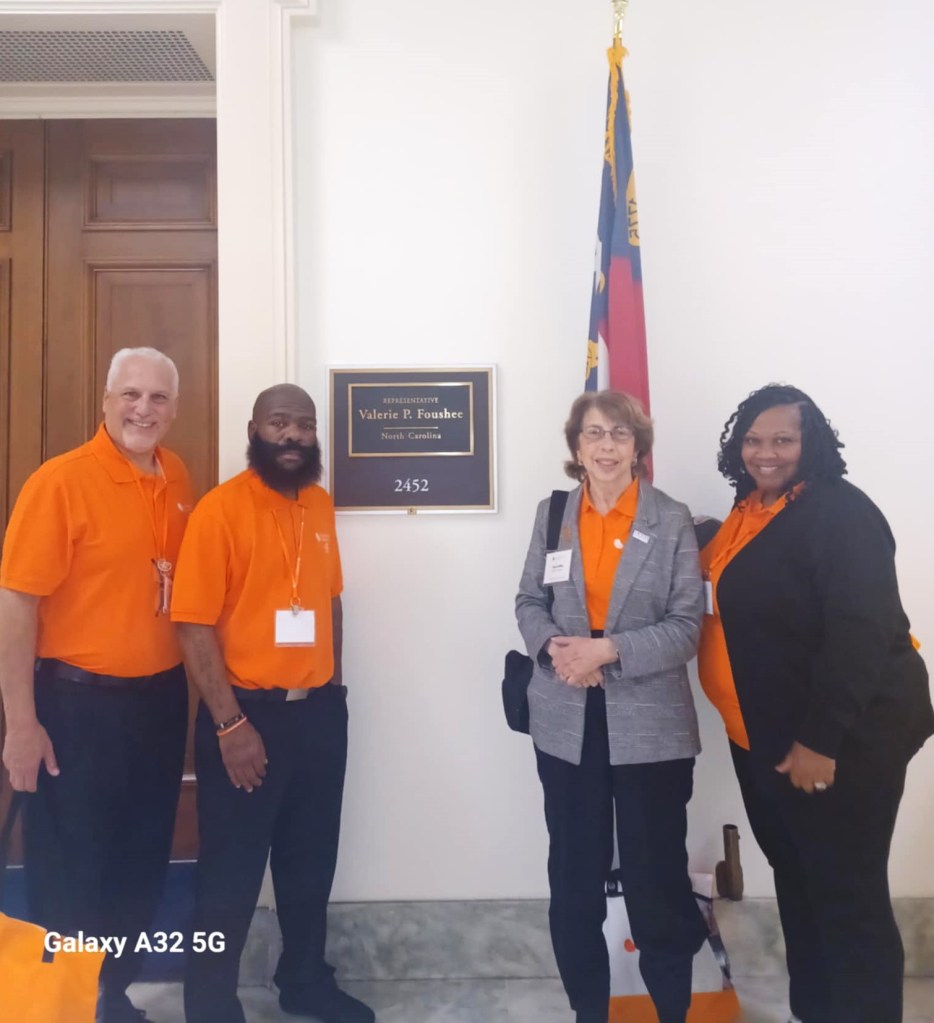
LA Garrett Daniel, standing next to name plaque, with our NC team this year (left to right: Alan Levy, me, Wendy Glod, Dre Roundtree, kneeling, and his wife, Necole Roundtree.

We all participated in the lively discussion, often, in response to his questions, mentioning additional aspects of our asks that we hadn’t touched on in our elevator pitch. After hearing comments from a kidney transplant recipient’s wife, Garrett was the one to raise the subject of the burden on the caregiver not just in the home but in terms of job issues.

He listened to our personal stories and then often gently asked questions to get a clearer picture of what our experiences entailed. In fact, when he prompted one of our team members to elaborate on her long journey to get a kidney transplant, she shared important and wrenching details that the rest of us hadn’t heard.

Because her insurance company would only cover her numerous appointments for essential tests if she went to a center three hours each way from her home in Charlotte–instead of one just fifteen minutes away–she had to wait more than two years before she could move ahead with the transplant she desperately needed. Then, after she went through all her testing and was just one test away from being listed for a transplant, she got a peritonitis infection–so the transplant was further delayed.

At the end of the meeting, in addition to concern, Garrett also offered critical pragmatic support. For example, Senator Tillis is already a cosponsor of the Living Donor Protection Act, so our ask in his case was to help us get a committee hearing for the bill. Garrett’s boss is not on one of the committees in question, so Garrett offered to reach out to his counterparts in the office of NC Senator Budd (who is) to bolster our efforts. He planned to do the same with other offices regarding another bill the kidney community is supporting, to help expand access to home dialysis.

It was late afternoon when we left the office, and in between meetings we’d been walking up and down long, imposing corridors and all over Capitol Hill for hours. Our feet hurt. But after meetings like this, everyone on our team left feeling energized.

For related posts and information on my book, The Insider’s Guide to Living Kidney Donation, be sure to explore the rest of my website.

ASKing Congress–for a “Friend”

My bags are packed, and I’m ready to approach federal legislators and/or their staffers again along with other advocates from the National Kidney Foundation. As usual, we have very important asks.

If you’ve read even a few of my posts since I launched this site in 2019, you know that I’ve been lobbying for the Living Donor Protection Act–both on Capitol Hill and in my state, North Carolina–for several years. So, yes, our number-one ask is for this session of Congress to finally move ahead with this bipartisan (yes!), noncontroversial, bare-bones legislation that’s been kicking around Congress since 2014.

This bill to prohibit discrimination by insurers against living donors–through higher premiums or coverage refusal–gets reintroduced every session. There may be a new sponsor, if one of the originals is no longer in office, more cosponsors…and then it sits. It’s yet to have a committee hearing, much less a vote. This shouldn’t be so hard.

The second ask is a newer one that could benefit so many people currently on dialysis. The majority (about 85%) of dialysis patients receive hemodialysis at a center, where they go three times a week for three to four hour sessions. Not everyone lives near a center and may need to travel more than an hour by car or city bus(es) to get there. We want Congress to improve access to home dialysis for patients who choose to do it, by providing funds for training and professionals to actually go to people’s homes in the first few months to help them learn how. It could be a game changer by enabling someone to do dialysis on their own schedule and even facilitate their being able to fit sessions around their work hours.

The third ask is about modernizing and improving the national transplant system that allocates deceased organs. Nearly 100,000 people are on national waiting lists (most of them for a kidney), and most wait several years. The system is extraordinarily complex and there are appalling instances of wasted organs. Most everyone agrees it needs to be more efficient and transparent, so more people can get a transplant after a shorter wait. Congress passed an act to modernize and improve the system last year. What we need now is for lawmakers to provide the necessary $100 million funding to carry it out.

The fourth ask, and in the long run arguably the one with the most lasting potential benefit, concerns early screening for kidney disease. My symbolic “friend” in the kidney community probably isn’t even aware of being among the estimated 37 million Americans with chronic kidney disease. Yup, 90% of that population haven’t even been diagnosed yet and don’t know that their kidneys are gradually–sometimes not so gradually–losing function.

Confused? Let me clarify the difference between chronic kidney disease and kidney failure. Diseased kidneys slowly lose function over years–even decades–before they reach kidney failure, during which time there may well be no obvious symptoms. Once they fail, though, the only way to save someone’s life is with a transplant, or, in the meantime, dialysis. People with diabetes and/or high blood pressure are at the highest risk of developing kidney disease. So if doctors routinely screened these patients for kidney disease (with a simple blood test), millions of lives could be saved.

With early detection, not only can that disease progression be slowed, it can often even be reversed, through behavioral changes–exercise, healthy diet, hydration–and medication. We’re asking members of Congress to sign a letter in support of official guidelines for screening.

These are pretty straightforward noncontroversial asks. I’ll let you know how it goes.

For related posts and information on my book, The Insider’s Guide to Living Kidney Donation, be sure to explore the rest of my website.