Holiday Gifts about the Greatest Gift

If you’re still looking for ideas for a holiday–or any kind of–gift, consider a batch of my personal favorites on my favorite subject. A couple of years ago,I described several here, and they’re still books I regularly recommend. I also have a few to add:

Ascending America, by Matt Harmody, just came out in November. Before I read this beautiful book about living-donor mountain climbers and world records, I didn’t know a thing about mountain climbing and had no particular interest in it. But as a living kidney donor/advocate, I, of course had to check it out. I’m very glad I did.

I wrote about the author here a while back when I did a post about living kidney donors climbing Mt. Kilimanjaro in 2022. This time Matt was part of a team of living donors who broke a Guinness world record by climbing 50 state summits in 43 days! The riveting text explains just enough about the technical parts of climbing to grasp the exciting situations but not enough to bore the layperson.

And readers who are more interested in the climbing will also learn about kidney donation–as much or as little as they’d like, because the short, specific, and very accessible chapters are designed for easy reference. A retired emergency physician, Matt knows how to explain medical information to make it understandable to the rest of us. For readers who want to delve further, the chapters have extensive footnotes.

The donor team’s message is that even living donors who were ultra-athletes before donating needn’t fear that donating will necessarily alter their active lifestyle. My only caveat in writing about these amazing advocates is the need to continually remind readers that you don’t need to be a mountain climber-type to be a living donor. Living donors aren’t a breed apart–most of us are simply very healthy, caring individuals who were touched by someone’s need and were in a position to do something about it.
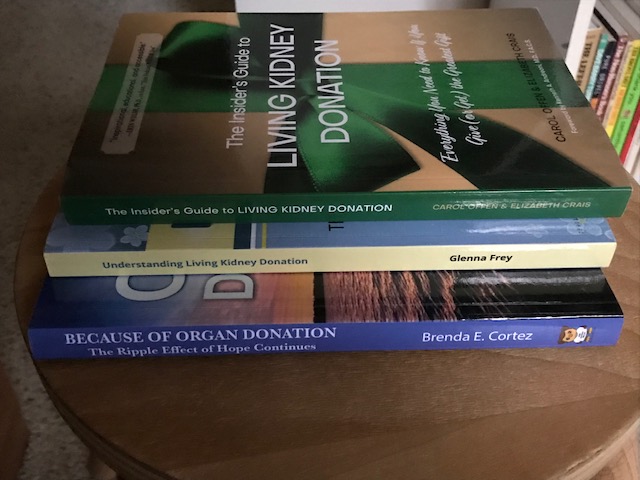
Because of Organ Donation: The Ripple Effect of Hope Continues, by Brenda E. Cortez. I’ve written about Brenda before, with her HOWL the Owl children’s series on donation and the first Because of Organ Donation.

The latest edition first came to my attention because of my interest in one of the contributors, Stormi Murtie. I wrote about Stormi’s tireless efforts to donate her kidney to her firefighter stepson in another state. His rare, life-threatening disease had drastically reduced his chances of finding a match. Her chapter evocatively details the anguish and frustrating delays they experienced, which were exacerbated by the terrible timing: the early phases of COVID.

Ultimately, Stormi’s stepson received a deceased donor transplant [which, sadly, failed after two years, so he is once again in need of a donor]. By then Stormi was determined to donate anyway and did it through a donor exchange program. The book’s companion chapter was written by her grateful recipient’s wife, who was also a living donor in an exchange. The families have become close.

The warm bond and resulting close relationships between donor and recipient families is a familiar theme in these stories and in those of so many donation advocates I’ve met.

One particularly memorable chapter is by a woman whose family lost their adult son in a tragic ski accident. She describes the remarkable and unexpected relationship that resulted when their son’s liver matched with a young man who lived nearby. When his wife gave birth to twins, they warmly accepted the older couple as their children’s adopted grandparents. The couple continues to be actively involved in the growing children’s lives, one of whom was named after the donor.

As in the first book, the contributors bring a wide variety of perspectives and write movingly about their donation/transplant experiences. I’m reminded that despite the similarities, no two donor-recipient stories are the same, and I always learn something from them. I’m also invariably inspired by people who have repeatedly experienced life-threatening episodes and choose to devote much time and energy to advocating for donation.

I previously reviewed here Understanding Living Kidney Donation, by Glenna Frey, a nephrology nurse who is also a living donor; it’s an excellent and comprehensive book on kidney disease and donation; and Gifted, by Robert Horsey, which, unlike the other books, is a poignant novel. It’s inspired by the author ‘s professional experience and commitment to donation as an organ procurement coordinator.

And if you’d like to gift my book, The Insider’s Guide to Living Kidney Donation, you can take advantage of the current 25% off on the paperback by using promo code HOLIDAY at checkout at this link.
Did You Know? Pass It On!

Whether you’re a donor, a potential donor, or a kidney patient looking for a donor, here are a few intriguing facts everyone should know about living donors:

  1. More than a third of living kidney donors are over 50 years old (I was 58 when I donated to my son 14 years ago), and the proportion is rising.
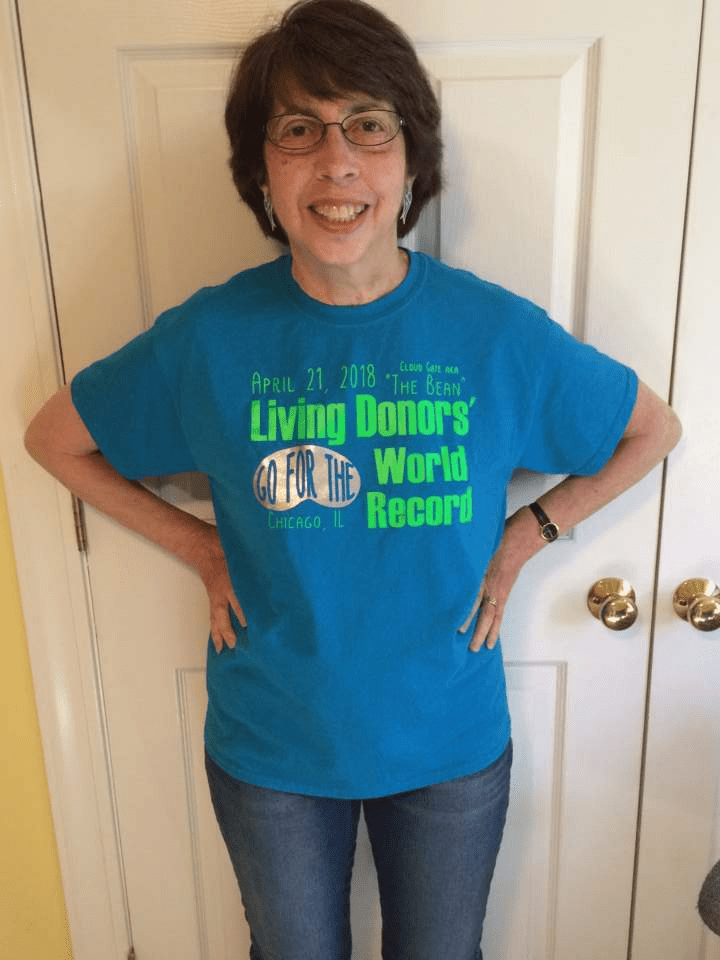
That’s me, right before a memorable 2018 trip to “the Bean” in Chicago to help set a Guinness World Record for largest gathering of living donors.

2. Most living donors, like me, say they would do it again (often adding “in a heartbeat”).

3. Many living donors were inspired to donate to someone they didn’t know because of an eye-opening article they read or a moving Facebook post that resonated with them.

4. Nondirected donors–empathetic people who choose to donate to someone they don’t know and may never meet–now represent about 3% of living donors in the United States, but the percentage is on the rise.

5. Nondirected donors can save multiple lives by initiating a swap (aka a paired donation, as a friend did in advance for her son)–or even a chain of transplants. If Donor A isn’t a match for their intended recipient (Recipient A), but the nondirected donor is, he or she donates to Recipient A, and Donor A donates to someone else who wasn’t a match for their recipient, and so on.

6. Most living donors (in an informal survey) own rescue pets. (A shout-out to WELD San Diego for that interesting statistic!)

7. And, of course, most living donors are women (another shout-out to WELD, which, by the way, stands for WoMen Encouraging Living Donation–yes, they now include men in their growing ranks).

Happy World Kidney Day–with a shout-out to women!

March 12 is World Kidney Day, and it seems fitting to continue our theme of women and kidneys (two of my favorite subjects). In a recent post, I pointed out that neither gets the respect and attention they/we deserve. It’s mostly because most people just don’t know a whole lot about what they do: in the case of women, we hold up half the sky, as the African proverb says. And kidneys do much the same for the body, quietly keeping it functioning as it should, balancing nutrients, eliminating dangerous toxins, regulating fluids and salt content, promoting bone health. I could go on.

Now how do I tie this back to women, you ask? Let’s consider living kidney donors. Not surprisingly, most are women. When I participated in setting the Guinness World Record for largest gathering of living donors in April 2018, it was clear that the vast majority of us donors there were women. Now, it’s tempting to say that’s all due to our natural empathy and nurturing instincts. I do believe that’s partly responsible, but I know it’s more complicated than that.

For one thing, donating a kidney, like any major surgery, usually entails taking off work for at least a couple of weeks, if you have a sedentary job as I did (editor/writer). If you’re a laborer, however, because of a restriction on lifting anything over 10 pounds for about the first 6 weeks after surgery, that obviously could mean a lot longer interruption.

Donors who are lucky enough to have sufficient paid sick leave (or any at all) don’t have to worry about lost pay. But for anyone who doesn’t, that’s a major road block to being a live donor. The reality is that, in a lot of families, it’s still harder to get by without the man’s earnings. The National Living Donor Assistance Center has been offering much-needed financial help with travel and lodging costs for some donors who need to travel to their recipient’s transplant center. It’s a wonderful program, but it hasn’t covered lost pay and other uncovered expenses. Now there’s a plan to significantly expand that assistance to cover a donor’s lost pay and major “incidental” expenses like child care and elder care. But it needs a major boost in funding from the House Appropriations Committee. Please contact your representative and tell him or her to get behind this important effort. Helping living donors helps to save lives.

The Greatest Gift

Carol Offen

Between us, my son and I have four kidneys—not very remarkable, except that he has three of them. I gave him one of mine about twelve years ago. The reason was simple: after spending nearly two years on dialysis, he clearly needed the kidney and I didn’t. I still had another that worked just fine so it was a perfect opportunity to share resources within the family. Today even unrelated people in different parts of the country can do the same, thanks to sophisticated computer algorithms. But this was more than twelve years ago.

My son, Paul, had the extraordinarily bad luck to develop chronic kidney disease—which can gradually lead to kidney failure—when he was in college. He was otherwise healthy, we had no family history of it, and he didn’t have diabetes or hypertension. Plus he was skinny.

What he had was a lingering strep infection.

Keep reading!

This post is excerpted from an article I wrote for the Fall 2018 issue of South Writ Large, a quarterly online magazine published since 2007. The theme of the issue was sharing resources, so living kidney donation was a natural fit.

Living Donor Rally

You’ve already heard (and seen pix) about the living donor rally I attended this weekend in Chicago. But I’ve been eager to share some observations while they’re still fresh because it was truly the most encouraging, life-affirming experience I’ve had in years.

For 3 wonderful days I was surrounded by hundreds of people–on Saturday more than 1200–I’d never met before, but with whom I felt an incredible bond. We were from all different parts of the country (a few from Canada and one family from India), backgrounds, ethnicities, ages (many 20-30 yrs younger than me), genders, and political views. I’m guessing about the last one because politics NEVER came up. Yup, for 3 days politics did not come up–I don’t mean I avoided it, I mean it just didn’t come up, it was irrelevant.

We laughed together, teared up a lot (for both sad and happy reasons), and connected on the most basic human level. We shared our stories and nodded knowingly on hearing others’ experiences (often if we hadn’t lived it, we had worried or wondered about such things): a young woman who’d donated to her father a few yrs ago was grieving for the kidney he had lost a month before, a mother from Texas donated to her son who was on dialysis when the power was out for days during a hurricane and she lived in terror of the generator going out. There were happy tears on hearing of people who’d donated to someone from their church whom they’d barely known and now get invited to every graduation, wedding, and baby shower–a warm acknowledgment that if it wasn’t for the donors, the recipients might not have been around for these special family events. I met altruistic donors (who donate to an unknown recipient)–many were thrilled to meet their recipient and were welcomed as part of the family, some had never met even years later, one wished they hadn’t met–but all continued to be tireless champions of living donation.

I heard it repeatedly: we felt like we were among family or old friends. A sense of community that transcends demographics, politics, religion, sexual orientation–if you thought it was no longer possible in 2018, I’m happy to report that it was very much alive and well in Chicago this weekend. True, it was a very special gathering, but now I know that it is indeed possible. May you all experience it sometime soon. It’s a helluva feeling!

This post appeared on my Facebook page, April 27, 2018.


Living Donors Rally, April 21, 2018, in Chicago–we set a Guinness World Record for largest gathering of living donors! Can you see me?
Photo by John Martin Photography, Detroit.