The Greatest Gift: What’s Inside?

In my last post, I shared how the idea for our book came about and promised some information on what’s inside and why.

Photo by Pixabay on Pexels.com

Our ultimate goal in writing The Greatest Gift: The Insider’s Guide to Living Kidney Donation, of course, is to highlight the desperate need for living donors and to encourage people who might not have considered donating to think about whether they could be a donor. 

Overwhelming statistics—like 100,000 people on years-long wait lists for a kidney and fewer than 20,000 transplants performed each year—become more understandable and meaningful when they are presented in terms of individuals’ firsthand experiences. Besides sharing our own stories and lessons learned, we decided to include other perspectives, with first-person accounts of people personally or professionally involved in the donation or transplant process: donors and recipients, of course, but also family members, a caregiver, a family therapist, a volunteer advocate, a transplant nurse coordinator.

From the beginning, we were on the same page in wanting to provide thorough but accessible, nontechnical and multifaceted information for both donors and recipients. We were mindful that families, friends, and acquaintances of kidney patients are the best source of potential living donors and are certainly the backbone of the patients’ support system.  In assisting donors, we reasoned, we would clearly be helping patients, too. We also wanted to reach both readers who already planned to donate or to be a recipient as well as those just exploring the idea. We initially drew mostly on our own experiences in raising issues to be considered at all stages of a donation or transplant. In recent years, as we became immersed in the burgeoning kidney-support and living-donor communities, we were able to learn what “real-world” questions others were raising in workshops, Facebook groups, and online forums.

Within these parameters, we each had our own personal motivation and goals for the book. Betsy was particularly interested in addressing emotional and family issues, how a transplant might affect you personally and the impact it can have on your loved ones; as a self-described wimp who feared the donor’s medical evaluation phase as much as the surgery itself, I wanted to provide details on tests and interviews to support and motivate others who might be similarly hesitant.

Although our experiences overlap, the reality is that potential living donors and transplant recipients have inherently different journeys. Living donation, by definition by a healthy individual, is of course a choice; transplant, on the other hand, though technically a choice, is usually a critically needed and wished-for prospect for someone with end stage renal disease. Dialysis helps patients maintain some of their kidney function while awaiting transplant, but it cannot offer the same quality of life and long-term outcomes as a new kidney. The decision to seek a transplant and the steps in the process are determined by a patient’s individual medical needs and circumstances. The medical issues naturally dominate, so frequently family and emotional considerations are given short shrift.

That’s why we have a detailed chapter on thinking through the decision to donate and the step-by-step process: what to expect and ask along the way. For recipients, we focus on the often-overlooked nonmedical aspects of having a transplant and on the emotional consequences of neglecting these important issues.

 Because we fully recognize the enormity of a decision to donate or have a transplant, we encourage everyone to consider the myriad factors that go into such a decision. We hope that having all the information contained in our book will empower readers to be informed consumers because information is power—never more so than in matters of health.

How “The Greatest Gift: The Insider’s Guide” Idea Originated

As you may know, some of the information for this site comes from the book The Greatest Gift: The Insider’s Guide to Living Kidney Donation, which I am writing with Betsy Crais, a live-donor kidney recipient. As we come into the final lap of the book’s marathon preparation, I thought it was time to share its origins with you.

Betsy and I met nearly two decades ago when our daughters were in the same Girl Scout troop (we bonded when we shared a pup tent during a camping trip). Some years later we discovered that we also shared a passion for encouraging living organ donation, which has resulted in this book.

the 2 authors, women, sitting in front of a sign that says "Ask the Expert"
Elizabeth (“Betsy”) Crais, left, and me at the University of North Carolina’s Live Donor Champion program, Chapel Hill, NC, on March 24, 2019.

How did we go from tent-mates to co-authors? I’m glad you asked. Read on.

When Betsy first faced declining kidney function and had to consider dialysis and ultimately a transplant about 15 years ago, the only books she found to inform her were renal-focused cookbooks or medical texts about kidney diseases, with short chapters about her condition (polycystic kidney disease, or PKD). There was little available on what to expect before and after dialysis or transplant, and certainly nothing that delved into topics related to emotions or family relationships.

Fortunately for Betsy, she at least could talk about her disease with her mother and two of her siblings, who also had PKD. Through them, she could at least get some of her personal questions answered. Later her sisters also came to help her when she had her surgeries. Although her siblings’ care was a great blessing, the best part was having someone there who had been through the experience and could guide her expectations. 

In contrast, when I faced the opposite situation a couple of years later—contemplating being a living donor for my 25-year-old son, Paul—I knew no one who had donated a kidney. I had dozens of questions and could ask the professionals some of them but had no one to advise me who’d been through the experience. For Paul’s questions, fortunately our family could call on Betsy, who talked to Paul to help allay his and the rest of the family’s concerns. Most important, Betsy shared some encouraging examples of how her quality of life had improved post transplant compared with her time on dialysis.

Not long after Betsy’s transplant and recovery, she began thinking about her difficult experiences and the silver lining of having family members with PKD who could be her own invaluable support group. The awareness that most people, like me, do not have that critical support prompted us both to want to write a book that could help others be more informed about what to expect in the donation and transplantation processes. Both of us had been surprised and frustrated to find so little practical, nontechnical information and support in those pre-Google days.

Early on Betsy drafted an outline and started thinking of people who might contribute various chapters, and Carol wrote an occasional op-ed piece on being a living donor. But because of day-to-day obligations it would be several more years before Carol reached out to Betsy to talk concretely about an idea for this book. 

Neither of us knew that the other had already been thinking along the same lines.

Next time I’ll provide some specifics about The Greatest Gift: The Insider’s Guide to Living Kidney Donation and share with you our goals for the book.

Expanding Aid to Living Donors: Dear Committee Members

May 20 was a big day. The committee that advises the federal agency with the power to expand financial aid to living donors held a meeting and heard a dramatic plan from the National Living Donor Assistance Center (NLDAC). The plan would not only markedly expand eligibility but would extend coverage for significant living donor costs like lost wages and childcare and eldercare expenses. Those essential expenses so often stand in the way of would-be donors’ acting on their desire to donate (and save a life).

Photo by rawpixel.com on Pexels.com

The Advisory Committee on Transplantation accepted public comments in advance of the meeting and dedicated some meeting time to hearing from people supporting expanded benefits for live donation. I prepared my comments and sent them to the committee last week. During the online meeting, I listened excitedly to the impressive NLDAC presentation and patiently waited to speak. Alas, because of technical difficulties and the committee’s being behind schedule, most of us never got to deliver our remarks live. This is what I was going to say:

Dear Committee Members:

I’m a living donor in North Carolina. Thirteen years ago I donated my kidney to my 26-year-old son. We were fortunate to live close to one another and near the UNC transplant center. I had a smooth recovery and could have gone back to work in 2 or 3 weeks if it were just a matter of my own health. But like so many other living donors, my recipient was a family member, so I was also a caregiver; we were all devastated when our son needed emergency surgery a week after his transplant. His recovery was slow, and he lived with us for about 2 months. I missed work for much of that time.

My husband and I shared family responsibilities that included our other child–a teenager with her own needs–and my elderly father, whom we had moved down to our town. We both maxed out our paid leave time. With my job, again I was fortunate: I had a supportive supervisor, short-term disability leave, and an employer with a shared-leave policy that enabled colleagues to donate their leave time. I cobbled together partial coverage. My husband did not have the benefit of shared leave donations. Not many potential living donors have such luxuries. In fact, many of the people on the transplant lists have low incomes, and many of their families and friends have little ability to ride out periods of missed pay. So they languish on the wait lists still longer.

NLDAC’s coverage of travel and lodging expenses for donors has saved lives by enabling people to donate who would not have been able to otherwise. The prospect of lost pay affects—that is, discourages—even more potential donors than travel issues do. My son was so lucky to have a live donor. If I hadn’t been able to donate to him after he’d spent nearly 2 years on dialysis, he could have faced another 5 years tethered to a machine 3 times a week, draining his energy, his time, and his spirit. Incidentally, the 5-year survival rate on dialysis is only a little more than a third.

 At an extremely difficult time for our family, we at least had everything going for us: our location, adequate resources, and a supportive employer. I implore you to help someone else’s son avoid that long, dangerous wait for a donor by raising the income cap and extending benefits to cover lost wages and related costs. Thank you.

I’ll have more details on the NLDAC recommendations when we learn how HRSA (Health Resources and Services Administration, part of Health and Human Services) decides to proceed.

WELD-What Do Living Donors and Transplant Folks Talk About?

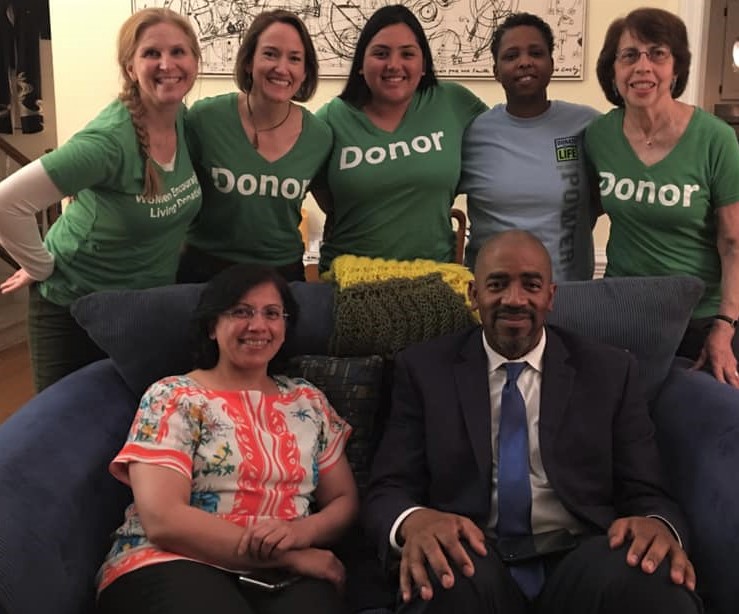
When living donors (women) and transplant professionals (men and women) get together, what do they talk about? Well, if a recent meeting of a local WELD (Women Encouraging Living Donation) chapter at my house is any indication, assorted animated discussions could cover the following:

Transplant surgeons Dr. Aparna Rege, bottom left, and Dr. Bradley Collins of Duke Transplant Center, Durham, NC, with a few local WELD members.
  • Spreading the word of the urgent need for living donors to reduce the 5+ year wait for a kidney for those on the transplant wait lists
  • Transplanting pigs’ kidneys to humans: logistics and ethics
  • Using drones to transport a deceased-donor kidney
  • A live kidney being put with the plane’s cargo but a heart going in the cockpit with the pilot
  • Hamilton, the musical
  • Managing kidney donors’ pain effectively with a combination of meds to reduce or even eliminate use of opioids
  • Taking part in The Big Ask, the National Kidney Foundation’s program to help kidney patients’ family and friends help the patients find a living donor
  • Some African Americans being wary of organ donation, specifically, but sometimes the health care system, generally
  • A transplant center’s setting up a paired donation program, which enables donors and recipients who are not a good match to swap with another pair so as to find a successful match for each pair
  • Solo camping with your dog
  • Comparing current and brand-new rules on allocation of livers from deceased donors
  • New approaches to preventing post-donation constipation in donors
  • Signing up as an organ donor whether or not you choose to have a little heart on your driver’s license
  • A grieving family arguing about whether to honor a young person’s wishes to be an organ donor
  • A young donor concerned about pregnancy, wanting to participate in a study to help provide the answers that elude her now
  • Comparing two surgeons’ hand sizes
  • Camping with the Girl Scouts

It was getting late for a weekday evening, and everyone else had a drive home, but I’ve no doubt we could have found lots more to talk about.

Donate Life Month Quiz: 5 True or False about Dialysis

True or false?

1-People with kidney failure have dialysis every few weeks.

False—For hemodialysis at a dialysis center, the standard is 3 times a week; patients who have some form of dialysis at home may do it 4 to 7 times a week.

2-Dialysis sessions usually last 3 to 4 hours at a time.

True—The average session at a dialysis center is 4 hours on the machine. (That’s not counting the weigh-ins and pre- and post-blood pressure readings. ) Again, people who do it at home may vary the amount of time, including an option of doing it overnight while they sleep.

3-Dialysis can approximate about half of kidney function.

False—As advanced as it is, dialysis accomplishes only about 20% of normal kidney function.

4-People on dialysis can skip a few sessions if they’re busy or go on vacation.

False—Skipping a session very occasionally is not usually a problem, but skipping several sessions is extremely dangerous and can be fatal as toxins build up in the blood. Patients who go out of town can try to arrange in advance to have sessions at a dialysis center at their destination.

5-Dialysis is an equally effective alternative to transplant for someone with kidney failure.

False—When possible, a kidney transplant is by far the better option. After one year of treatment, patients on dialysis have a 20-25% mortality rate, with a 5-year survival rate of 35%. People who receive transplants have a 3% mortality rate after 5 years.*

*University of California at San Francisco. The Kidney Project, https://pharm.ucsf.edu/kidney/need/statistics

Donate Life Month Quiz: 5 True or False

Here are a few important “facts” about organ donation. Test yourself—and let me know how you did! (Not to worry–I’ll grade on a curve.)

1-Most of the 113,000+ people on the national waiting lists for an organ from a deceased donor are waiting for a heart.

False. More than 80% of them are waiting for a kidney.

2-In the United States, the wait for a kidney from a deceased donor is a matter of months.

False. In many areas of the country, it’s 5 to 10 years.

3-Every year a few hundred people die because they didn’t receive a lifesaving organ in time.

False. About 6,500 people on the lists die while waiting for a kidney each year.

4-A large percentage of people in the United States can be organ donors when they die.

False. Only about 3 in 1,000 people die in such a way that they can be organ donors: generally, in a hospital following a trauma such as a car accident. That’s just 0.3% (yes, I had to look it up).

5-Most living donors are men.

False. Nearly 2/3 of living donors are women.

So, if you’re not already a registered organ donor, you needn’t wait till you renew your driver’s license. You can do it online right now at registerme.org. (There you’ll also find more facts about donation.) And if you’d ever wondered why the wait for a deceased-donor organ is so long, and why donation advocates hope that more people will consider being live donors, now you know the bottom line. There simply aren’t enough organs available.

Donate Life Month Fun

As part of National Donate Life Month events, I joined Donate Life NC exec director Deanna Mitchell Sunday at Rush Cycle in Morrisville, NC. In keeping with the month’s theme of Life Is a Beautiful Ride, Rush was offering free cycling classes and gave us a prominent spot to talk about organ donation and share our story of being living donors. I was delighted at the enthusiastic reception and animated conversations with the cyclers (I’d wondered if they’d just ignore us, frankly). See the back of our tee shirts–we’re also proud WELD members: that’s Women Encouraging Living Donation. And check out the photo from our WELD meeting in Durham Tuesday https://tinyurl.com/y2fvbe8x! One of the members had just donated a couple of weeks before!

That’s Deanna above on the right. Besides info, we gave out goodies: protein bites, oranges, dates, sunglasses, trail mix.

World Kidney Day!

I’m wearing orange today to spread awareness of kidneys: the body’s unsung heroes! They regulate fluid levels, balance nutrients, produce urine, eliminate toxins, make red blood cells, promote bone health, regulate blood pressure, and so much more. Now do you see why I say they don’t get the attention they deserve? If you don’t already know your kidney function, PLEASE make an appointment to have your kidneys checked–it’s just a simple blood test. Thirty million Americans have chronic kidney disease, and most of them have no idea. [In the picture with me is my friend “the Comeback Kidney.” That’s what we named the kidney I donated to my son, which enabled HIS comeback 12 and a half years ago.]