Covering Anti-Rejection Meds Should Be a No-Brainer

Ever hear of the Immunosuppressive Drug Coverage for Kidney Transplant Patients Act? I didn’t think so, but we need to make sure that members of Congress hear about it.

You already may know that virtually all (yes, I know of one exception) kidney transplant patients, unless they got the new kidney from their identical twin, have to take anti-rejection meds for the rest of their lives. That’s so their body’s immune system doesn’t see the organ as a foreign body and pounce on it the way it’s designed to do.

You may also know that Medicare provides health coverage for patients of any age with kidney failure—ESRD, or end stage renal disease (a name, incidentally, that scared the hell out of me when we were first told that was my son’s condition). That’s a good thing, right? Of course, though, there are a few catches, like needing to accumulate enough work quarters or credits, as my son described in a post here recently.

But here’s the real, global problem. For some unfathomable reason, the coverage ends 36 months after the transplant.

That might make sense by some logic if most patients needed to take those anti-rejection meds for a maximum of 3 years. No way–see second paragraph of this post, which points out that virtually all patients have to take them “for the rest of their lives.”

Photo by rawpixel.com on Pexels.com

Now, you may be thinking, well, these drugs are probably available for a nominal charge given that these are life-and-death medications. Think again: they run into the thousands of dollars per month for direct pay. So, depending on what kind of health insurance you have—and if indeed you have any at all—you may very well not be able to afford them. You know what happens when people skip doses or stop taking these essential medications completely? Their bodies reject the transplanted kidney and they’re back on dialysis—or they die.

The campaign to push for extending immunosuppressive drug coverage is called “Honor the Gift”–that is, honor the gift of life by protecting that precious kidney–and it’s supported by virtually every major kidney and organ donation organization in the country. Clearly, it makes no sense either medically or morally to stop this life-sustaining drug coverage at an arbitrary point, when it’s so obviously still needed.

Medical and moral justifications should be reason enough, but there’s a strong economic one, too: in the long run, an organ transplant costs the federal government far less than years of dialysis for those patients. In fact, an analysis by ASPE, a federal agency within the US Department of Health and Human Services, concluded in May 2019 that extending the Medicare drug coverage beyond the 3 years “would result in ten-year accumulated savings of approximately $73 million.”

Bipartisan coalitions in both the House and the Senate have been poised to introduce legislation to extend the Medicare drug coverage. The bill has been introduced more than a dozen times in the past 15 years. Tell your senator and member of Congress that supporting this legislation is a no-brainer for families–like mine–struggling with a loved one’s kidney failure and for society in general.

Kidney Vouchers Are Even Cooler Than You Thought

My last post, “Kidney Swaps and Vouchers and Chains, Oh My!” got a very positive reaction. It was a real feel-good story about a living donor I know who made a new kidney possible for her son even though she couldn’t donate to him directly, thanks to a voucher system. Several people outside the kidney community were blown away by the idea of vouchers, which is part of the National Kidney Registry’s advanced donation program. Not surprising—it is pretty cool. I realized though that I hadn’t explained some of the amazing ramifications of a voucher system.

I’ve heard many living donors who’ve given to a friend or acquaintance–or even someone they didn’t know–report that their families were very upset with them. Can you imagine how shaken these donors were to encounter not just concern but sometimes outright anger as they contemplated the most selfless act of their lives? What if your mother or I need one? What if one of your kids ever needs a kidney (often asked of childless couples and unattached individuals)?

The donor’s answer usually was that they felt compelled to respond to someone’s very real need now and couldn’t refuse to help that person because of a what-if that might never occur. Many of these donors say they felt confident that an equally generous person would step up at such a time of need. One African American woman I was on a panel with recently said because live donation is still uncommon in the black community, her mother was particularly uncomfortable with the idea of her donating to someone she didn’t know. She stopped her mother’s protests once and for all, though, by asking simply, “If I were the one who needed a kidney and had no family donor, wouldn’t you want someone to come to my aid?”

The young man I wrote about in my last post was fortunate to get his live-donor kidney soon after he needed it, just a few months after his mother’s donation. Vouchers can be redeemed years, or even decades, after the donation if they’re not needed right then.

I remember reading about a healthy man in his 60s whose granddaughter had kidney disease and would probably need a kidney transplant in a few years. He feared that he might not be healthy enough to donate by then. With a voucher system, he was able to donate soon to improve the child’s chances of getting a live kidney if and when she needs it. There are no guarantees that a good match will be available at that point, of course, but having the voucher would definitely make her wait much shorter.

Photo by u041fu0430u0432u0435u043b u0421u043eu0440u043eu043au0438u043d on Pexels.com

So potential living donors who encounter their families’–or their own–troubling “what if” questions, actually have a practical response. NKR vouchers are increasing the number of people willing to donate a kidney—and saving more lives.

Kidney Swaps and Vouchers and Chains, Oh My!

I was delighted to hear from fellow WELD (Women Encouraging Living Donation) member, Michele Hughes, that her son Dan had just had a successful kidney transplant, at New York-Presbyterian/Weill Cornell Medical Center. Like me, Michele had wanted to donate her kidney to her 20-something son with kidney disease. In their case, though, it wasn’t possible. But this is 2019. So, a few months ago, Michele donated her kidney at Vidant Medical Center in Greenville, North Carolina, to a stranger on Dan’s behalf. In return, they received a prized voucher through the National Kidney Registry for a compatible kidney for her son.

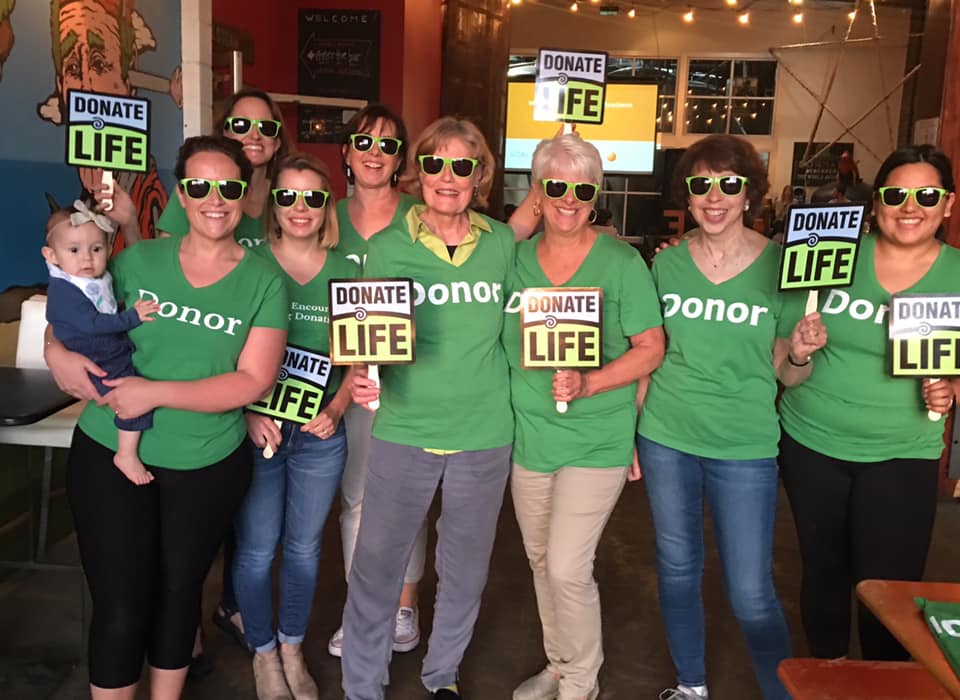
A picture of WELD members wearing DONOR tee shirts and holding signs that say "Donate Life." The caption tells where Michele is standing.
Michele is in the front row, third from the left (not counting our littlest WELD member). That’s me, second from the right.

NKR has a huge living-donor pool in the United States; it tries to find the best match for a potential recipient so that if the intended donor isn’t a match for them, they can do a “swap” or even form a kidney chain.

Yes, these amazing options make everything so much easier than it used to be. But anyone whose loved one has had a life-threatening condition knows how stressful and overwhelming navigating the system can be. Fortunately, Michele’s family was closely supported by a knowledgeable friend who’s a living donor himself, Ned Brooks.  I recently heard Brooks’s fascinating TED talk, “What Makes a Person Decide to Donate His Kidney to a Stranger?

In 2015 Brooks, a retired businessman, decided to donate his “spare” kidney to a stranger to set off a chain of three transplants. Like many of us, he found the living-donation experience so uplifting and life changing that he was determined to spread the word. He went so far as to found a nonprofit, Donor to Donor, to publicize the kidney crisis and to encourage and facilitate living kidney donation. In addition to sharing valuable information and donation stories, the organization matches potential kidney recipients with previous kidney donors/advocates who volunteer to help them find a donor.

Congratulations to Michele and her son. Wishing Dan a smooth recovery.

Donor to Donor will sponsor a (free) one-day Volunteer Kidney Donor Advocates Conference April 24, 2020, in New York City. Details to come.

New Record: 84-year-old Living Kidney Donor

I hope everyone knows that no one is too old in principle to be an organ donor when they die. And that’s becoming truer of living donors, too. When I donated my kidney to my son 13 years ago I was 58, which is hardly ancient (actually, it seems downright young to me now!) but seemed “old” at the time. Now, more than a third of donors are over 50. Donors in their 60s are increasingly common, and I’ve known of many people who donated in their 70s. The common wisdom has always been, it’s not the donor’s age that matters but the kidney’s health and the donor’s overall health. So I’m happy to say that the record for oldest living kidney donor was set recently when an 84-year-old man in Texas kindly donated his kidney to his neighbor. Admittedly, it wouldn’t have been a great option for most 30-year-olds, but it was a perfect gift for his grateful 72-year-old recipient with lupus. Read more in this very touching and informative story.

Howl the Owl and Brenda Cortez Help Kids Grasp Organ Donation

I first met Brenda online a couple of years ago through a Facebook living donor support group. We were both so moved by having donated that we became strong advocates for donation awareness and went a step further in deciding to write books about donation (hers for young children, mine for adults). I was excited to meet the warm, energetic Wisconsinite in person last year in Chicago during that memorable weekend when we helped set the Guinness World Record for Living Donors. We’ve followed and cheered on each other’s donation advocacy activities ever since.

My book with Betsy Crais, “The Greatest Gift: The Insider’s Guide to Living Kidney Donation”—in its final stages as we look for a publisher—was conceived to help potential donors and recipients navigate the donation/transplant process and the emotional challenges. If you think we adults have trouble grasping and dealing with donation, transplant, and dialysis in the family, just imagine how bewildering the topic is for little kids. So, I’m delighted to see that Brenda’s children’s series on donation has really taken off. The books, most of which star an adorable little owl named Howl (which stands for Help Others With Love), help kids make some sense of these frightening situations, whether they’re experiencing the condition themselves or, more commonly, a parent or grandparent is.

Brenda’s first book, “My Mom Is Having Surgery,” was prompted by her daughter’s college application essay that told how inspired she was by her mother’s donating her kidney a few years earlier to another mom she’d known only casually. Not long after the first book, Brenda created Howl to help spread her message of kindness and awareness of organ donation. Among the titles, which are delightfully illustrated, are “Howl Gets a Heart” (yup, the little guy is a transplant recipient!) and “Howl Learns About Kidneys and Dialysis”; her latest is “Howl Goes to the Races,” where he gets to meet race car driver and organ donation advocate Joey Gase on the occasion of Organ Donation Awareness Day.

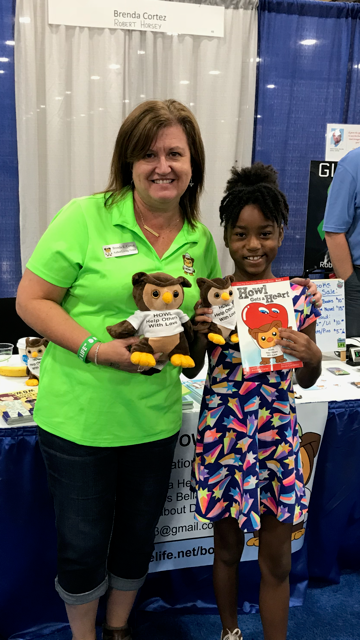
Brenda and Howl pose with a visitor to her table at an event. Howl has helped kids of all ages make sense of organ donation.

Part of the proceeds from sales of all of Brenda’s donation books, and the popular plush Howls, go to support Donate Life America https://www.donatelife.net/books/. Brenda has taken Howl and his message several steps further: the plush Howl goes along with her to blood donations, reassuring visits to kids in the hospital, educational school fairs, elementary school classroom readings, the biannual Transplant Games, donation walks… he gets around.

In fact, a Howl mascot has become a popular figure at community events in Wisconsin and on Brenda’s travels. She’s incredibly industrious: she ordered a mascot costume online and then had it transformed into Howl. Brenda would love to be able to send it off when events request his presence, but the shipping costs are prohibitive. That’s why she’s looking for a sponsor whose name could be displayed on the back of Howl’s tee shirt, to defray the costs. If you or your organization might be interested in promoting this charming donation mascot and/or helping to get the books into hospitals and transplant centers, you can reach her at Brenda@howltheowl.com

In recent months, Howl has even become a world traveler. Fellow donor (and one of the organizers of the Living Donor Rally) Kate Griggs has helped coordinate sending a little plush Howl on overseas trips with living donors, along with Howl’s very own business cards (much cuter than mine, by the way), and banners promoting living donation.

Thank you, little Howl, for spreading the word about organ donation and helping to make the world a kinder place. Can’t wait to meet you in person!

White House Kidney Health Initiative—Wow!

It’s hard to overstate what a big deal this is.

I hesitated to post anything on it till I’d had a chance to digest it and try to learn if it’s as great as it seems. Frankly, even if it’s less than it appears—some of it rests on the continuation of the Affordable Care Act, need I say more?—and takes longer to go into effect than we think, it’s still a big deal. Given that it’s one of the biggest sets of changes in kidney health care in five decades, attention must be paid. As my friends at WELD (Women Encouraging Living Donation) put it, “Regardless of your feelings about the messenger, the message here is breaking the logjam…” (the “logjam” being the often 5-to-10-year wait for the roughly 100,000 people waiting for a kidney in the United States).

The whole system is in need of repair, so not surprisingly, the executive order/kidney health initiative has a few pieces to it:

1. Helping living donors. The exciting decision to cover a donor’s lost wages, child care, and other family expenses (and expand the pool of those eligible) alone can be a game changer for so many potential donors. This is the proposal that I provided public comment for in May when the federal Health Resources and Services Administration’s (HRSA’s) advisory committee was considering it [see post]. Waitlist Zero founder/director Josh Morrison (a living kidney donor himself) whose organization was behind the effort, estimates conservatively that the revised policy could increase the number of living donors by 25%. Simply put, helping living donors helps kidney patients. Getting a kidney from a living donor not only shortens that recipient’s wait, it removes one person from the waitlist for a deceased organ and generally offers a better outcome.

2. Early Detection and Research. The new Medicare fee structure will provide incentives for physicians to take the time to discuss and screen kidneys at an earlier point. For example, people with diabetes or high blood pressure, particularly African Americans with those conditions, are at higher risk for chronic kidney disease, which is a gradual loss of kidney function.  For most people, unless they have a family history, it’s not on their radar. I’ve heard several young people say that they didn’t learn their kidneys were failing until they had a screening at a health fair or went to the ER for something else.  That’s why it’s called a “silent killer”—it often has no noticeable symptoms until it reaches the point of kidney failure and sometimes not even then. The initiative also calls for increased funding for research.

3. In-Home Dialysis. The initiative aims to enable most dialysis patients to do it at home (currently only 12% do so by a variety of options, including while they sleep). It plans to improve support to make it more feasible financially and logistically. Life on dialysis is an enormous burden, sapping one’s energy, strength, and time. For the majority of patients, who receive it at a center, it means traveling three days a week to the facility, which might be more than an hour’s drive from home, and being connected to a machine, currently 4 hours at a time. My son, who was on dialysis for 20 months before his transplant in 2006, recalls being on dialysis as “the worst experience of my life” [see post]. Doing dialysis at home, which, admittedly would still not be everyone’s preference, would make it easier for more dialysis patients to continue working.

4. Overhauling allocation of deceased organs. The initiative aims to make thousands more kidneys available by reducing the number discarded for a variety of reasons, due to waste and for medical factors. The system is very complicated, so I won’t even try to analyze these changes. The trend in recent years already has been to consider the benefits of using “high-risk” donor organs; organ transplants that were once almost unthinkable—say, between HIV-positive donors and recipients—have been successful. By the way, the oft-cited “national waiting list” is actually a network of myriad regional lists. When a deceased organ becomes available, they look for the best match, usually in the same region so it can be transplanted ASAP, which can lead to geographic disparities. “Matching” a donor and recipient isn’t just a question of blood type—it’s also based on age, how long someone’s been on the list, and other factors. Also, to be clear, the waitlist isn’t like a numbered list, where you might move from number 2,000 to number 1,999 and so on.

Some of these steps will take years, but some are expected to begin as soon as January 2020. But kidney patients and their families and friends should certainly rejoice at this news. I know I do.

Betsy’s Need for a Donor Makes Local TV News

So glad that ABC News (WTVD) did a piece on Betsy Crais’s need for a second transplant (see the video), as I described in a post about my book’s co-author last month.

Betsy initially thought she had four possible kidney donors in her immediate family. A few weeks ago she received a call from the transplant center saying that one by one, all of them had been eliminated. Potential donors have to be in excellent health and can be disqualified not only if they have a condition that could potentially harm the recipient–but also if donating might jeopardize their own health.

Fortunately, Betsy has never been one to be discouraged for long. She took a deep breath and sat down to send off an email to friends, family, and colleagues, letting them know about her kidney failure after 15 years of a successful transplant. Within minutes of hitting SEND, Betsy was heartened to receive not only messages of concern and support but even several inquiries about how to be tested to be a donor.

Because the transplant center will consider and test only one candidate at a time, Betsy and her family now have to wait impatiently for word from the transplant coordinators. Although Betsy is on the waiting list for a deceased donor, that wait is often several years long. A transplant from a live donor might be just months away, typically has a better chance of success, and can last up to twice as long. Naturally, Betsy is fervently hoping for a live donor.

In the meantime, she had an access port surgically created in her arm in readiness for dialysis. Betsy’s condition is stable, so there’s a chance she may never need it–if a donor is approved in time, she could have a preemptive kidney transplant (that is, before she needs dialysis).

Transplant Anniversary: Notes from My Son (My Recipient)

Thirteen years ago this week, my son and I went into UNC transplant center with four kidneys between us. When we left a few days later, we still had four, but he had most of them. He still does. I’ve written here and elsewhere about “our” story, so this is his chance to share his perspective on this momentous experience, which had begun 2 years earlier.

Thirteen years ago I received a kidney transplant from my mother. I appreciate this kind act, but knew she would not disappoint. I also am glad to know that she has benefited from this act, and has become an activist for living kidney donation.

Here’s some background: when I was in college, I was diagnosed with IgA nephropathy. It was discovered in lab work after I had gotten sick with strep. Years later I learned that that was often a trigger for my type of kidney condition. I had no symptoms, though, and was otherwise healthy—I didn’t have diabetes or high blood pressure, which are common causes of kidney failure—and I was thin, with no family history, so the nephrologist said it was something to monitor and take seriously, but wasn’t expected to get much worse, at least not in the foreseeable future. I had regular lab work throughout college.

At my first post-college appointment, the blood test results showed that my kidneys were failing; I learned I would soon need dialysis and then would have to be on it until I could receive a kidney transplant. The doctor first told me I might have to start dialysis in a year, but it ended up being only 3 months. I had just graduated college, and I was nervous but hopeful about the future. Before that appointment I had no idea I had kidney failure, let alone that I’d be on dialysis in 3 months.

Dialysis was the worst experience of my life. It began with two painful insertions of needles into my arm, followed by being connected to a dialysis machine 3 hours at a time 3 days a week. With prep time and post-time, plus another hour for transportation, it was more than half a day. When I got home I just didn’t feel like doing much of anything. I didn’t feel like myself and couldn’t relax. I had time for little else.  I felt like my life was under a microscope.

My parents began the process of applying to be donors. My dad was eliminated for having had a kidney stone and my sister was too young at the time. My mom made it through the first round, but the hospital wouldn’t allow her to begin the actual testing because I did not have health insurance that would cover the donor, which is usually part of the recipient’s insurance. Because I was no longer a full-time student, I wasn’t covered by my parents’ health insurance. Had the Affordable Care Act been in effect then, since I was under 26 I could have remained on my parents’ plan. Medicare has an ESRD category for kidney failure patients, but it required a certain amount of “work quarters” to qualify. This was particularly upsetting because having just been in college and now with my health suddenly failing, I didn’t yet qualify. I then had to earn work quarters while on dialysis, which limited how much I could work.

I felt horrible about the awful luck that put me in this situation. I was angry at a health care system that puts such policies in place. I believe I have a right to health care. Had insurance not been an issue, I could have spent 1 year less on dialysis and gotten my transplant a year earlier. And if, instead, my kidneys had failed a year later, this policy might have been moot because I probably would have earned enough work quarters by then.

Meanwhile, for more than a year my family made countless phone calls and wrote pleading letters to the hospital and anywhere we could, hoping I could somehow get a transplant soon. After a lot of advocacy, the hospital finally agreed to take on the costs and allowed my mom to begin the testing. It even agreed to pay for the donation surgery itself if Medicare did not come through, but I accumulated enough work quarters by then.

Paul and my husband, Neil, with me at the 2016 Triangle Kidney Walk in Durham, NC.

I knew that if my mom couldn’t donate to me, there were no other potential donors at the time. So I was really crossing my fingers after each of her tests, knowing that she could be disqualified at any point.

I checked into the hospital the day before the transplant and had dialysis there. When I prepped that night I was mistakenly told I could use the special soap for my hair, and it got in my eyes. They were still stinging the next morning, which naturally increased my nervousness about the transplant.

Transplant day finally came after 1 year and 8 months of dialysis. I vaguely remember being wheeled into intensive care after the surgery. From what I could tell, the doctors thought it had gone successfully. When my dad and sister came in to see me and asked me how I was, my response was “could be worse.”

I recovered at my parents’ house for more than a month. I still had several things attached to my body. I had frequent doctor’s appointments and usually would have something removed/disconnected each time: a stent one day, a catheter another. Slowly, I began to regain my life and at a point feel like I did before the transplant and then, eventually, feel better than I had on dialysis.

By no means is being a transplant recipient easy—there are a lot of things to keep track of, like medicines, appointments, protection from getting sick. There will always be potential hazards, and I’ll always need to take extra precautions. I check expiration dates a lot more closely than before and cancel get-togethers with family and friends if one of them is sick even with a cold. My immune system will always be suppressed to keep it from rejecting my mom’s kidney.

But life as a transplant patient is so much better than the traumatic experience I went through as a dialysis patient. –Paul Offen, Chapel Hill, NC


For related posts and information on my book, The Insider’s Guide to Living Kidney Donation, be sure to explore the rest of my website.


15 Years Is Not Long Enough!

I really hoped I would never need to write this post.

If you’ve checked out my story or many of my blog posts, you know that Betsy Crais, the co-author of my book in progress* and a dear friend, is a kidney recipient from a live donor. Betsy had her transplant 15 years ago and had been doing really well until the last several months.

Elizabeth (“Betsy”) Crais

I am so sad to say that Betsy’s kidney function has declined to the point that she now needs another transplant. I’ve always said that Betsy was the poster child for living a full and productive life with a kidney transplant: not only does she work full time as a university professor and researcher, shunning retirement, but she’s active on grant review panels, committees, and national organizations–on top of being a devoted wife and mother and a lovely person (not to mention a co-author and a donation advocate, of course).

Because Betsy, like her mother and two of her sisters, has polycystic kidney disease (PKD), her two adult children are at risk of developing it themselves. They can’t be considered as donors until they’re well into their thirties, when the disease typically manifests itself. Betsy had fervently hoped to avoid dialysis, but in the absence of a living donor for now, she is having an access port put in soon and expects to start dialysis this summer.

If you know anyone who has ever remotely considered donating their kidney (or maybe the idea of doing it yourself is what brought you to this site), please contact me (carol.kidneydonorhelp@gmail.com). I’ll provide the contact info for the donor nurse coordinator at UNC Hospitals. Betsy is blood type A, but as you may already know, these days it’s not essential to have a matching blood type (see the FAQs). There are lots of options now.

Thanks for anything you can do to help spread the word!

*The Greatest Gift: The Insider’s Guide to Living Kidney Donation.

The Big Ask, The Big Give

After a terrific workshop for kidney patients and their families and friends on Sunday, I was initially inspired and encouraged at all the valuable resources and options available for finding a donor: paired donation (aka “kidney swaps”), social media vehicles for spreading the word, financial assistance for travel and lodging, and sophisticated fundraising plans. These exciting options were unthinkable back when we learned that my son Paul’s kidneys were failing. Yes, I was ultimately able to donate to him in 2006, and so glad I did, but we had no back-up plan if I hadn’t been able to donate. I was relieved to know that someday when Paul needs another transplant, that these options now exist.

Betsy, my co-author,* and I had been invited to be on a panel to tell our story and take questions at the National Kidney Foundation’s Big Ask, Big Give program at the University of North Carolina’s Rex Hospital in Raleigh, NC. It’s understandably hard for most people to go public about such a personal need (brother, can you spare a kidney?), and it’s easier for loved ones to spread the word. The program provided useful resources and concrete advice, with step-by-step plans on telling “your story” or your loved one’s. The cautiously hopeful attendees sounded resourceful and impassioned.

But when I couldn’t fall asleep that night, something was nagging at me, and my excitement turned to righteous indignation. Damnit, people facing kidney failure and their families shouldn’t need to think about fundraising or how to word the biggest ask of their lives. They have enough things on their plate. Soon my righteous indignation turned into outright anger when I recalled at least two attendees’ mentioning that their family member on dialysis had lost their job because of needing to miss so much work. What kind of a system allows these shameful situations to happen?

My inclination was to condemn the companies that had pulled the rug out from under these vulnerable employees, but then I realized that it’s not that simple, of course. Big companies can better afford to be supportive and accommodating in the face of frequent or long absences and the need to hold a job open. What about smaller companies or mom-and-pop establishments that are themselves just getting by? That’s why it’s the system that needs fixing. Sure, not all big companies go the extra mile anyway, so absolutely, let’s give a shout-out to those that do: in my case, RTI International. I benefited from a shared-leave program through which generous, anonymous colleagues donated leave time when I’d exhausted mine.

Humane and compassionate employment support at such a time ought to be a right, not a perk.

Living donors are now protected under the Family and Medical Leave Act (FMLA), but the FMLA applies only to government employers and to private employers with at least 50 employees. (And remember, that’s unpaid leave!) Incidentally, even the Americans with Disabilities Act (ADA), which mandates reasonable accommodations for people with disabilities, applies only to companies with at least 15 employees. I’m not an economist, but it seems like a no-brainer that we need to be providing subsidies or tax breaks to enable small firms to provide paid leave and job protections for donors and recipients.

For example, if federal laws (it shouldn’t matter what state you live in) ensured that no one could lose income (much less their job) to be a living donor, more lives could be saved. Sure, money isn’t the only consideration in someone’s decision to donate, but it’s very often a deal breaker to anyone without sick leave.

The recipient’s health plan covers the donor’s medical expenses, but few insurers, like United Healthcare, include any necessary travel and lodging costs for donors who need to travel far to the recipient’s transplant center. Our tax system should allow credits, not deductions, for kidney patients’ own medical expenses and for reimbursing their donors’ nonmedical expenses.

 In a recent post, I described the National Living Donor Assistance Center’s (NLDAC)’s proposal to expand its coverage to include lost wages and related childcare or eldercare expenses. NLDAC currently covers travel and lodging expenses, which is great, but lost wages and additional out-of-pocket expenses affect far more potential living donors than the need to travel. Some living donors spend thousands of dollars to offset their uncovered costs; at the same time, each one saves the healthcare system an estimated $145,000.

No one’s suggesting paying donors for parting with their kidneys–only that it shouldn’t cost anyone money to do so. Expanding donor assistance would go a long way toward making living donation financially neutral. It’s not only the cost-effective thing to do, it’s the right thing to do.

*on our book in progress: “The Greatest Gift: The Insider’s Guide to Living Kidney Donation.”