Happy National Kidney Month and National Women’s Month!

NASA

Yes, March is National Kidney Month and National Women’s History Month. What do kidneys and women have in common, you ask? For starters, both are underappreciated. We can hope that someday we will get to a point where we don’t need to introduce people to integral aspects of our culture and our history (like Black History Month). For now, though, we clearly do need these reminders. Certainly the recent death of the brilliant NASA mathematician Katherine Johnson (remember “Hidden Figures”?) highlighted the ongoing need for both black and women’s history month.

Similarly, this month we highlight the critically important role that kidneys play in our bodies. Do you know what your kidney function is? You may think you know what women contribute to daily life, but do you know what kidneys do? It would be crucial enough if they just removed dangerous toxins from the blood, but they also regulate the amount of fluids in our body, maintain the salt content of those fluids, balance minerals, produce urine, promote bone health, and so much more.

I’ve had a healthy respect for kidneys ever since my son was in dialysis. For nearly 2 years, dialysis machines, doctors, nurses, and technicians did a masterful job of trying to approximate what healthy kidneys manage to do every day. Yet even with doing their damndest to get this juggling act all right, dialysis can achieve only about 20% of normal kidney function. One-fifth.

Like women, kidneys pull off much of their heroic daily work quietly, often without calling attention to themselves. That’s why when kidneys are starting to fail, we usually don’t notice. More than 30 million Americans have chronic kidney disease—meaning they’re gradually losing kidney function—and most of them don’t know it. It’s called “the silent killer” because people usually don’t feel sick (and often look fine) until it’s dangerously far along. I know of people who just had a routine screening at a health fair, or went to the ER for a broken arm, or just didn’t feel right—only to learn, to their shock, that their kidneys were failing significantly and they needed to start dialysis ASAP.

My son knew he had kidney disease ever since it was diagnosed following a strep infection when he was in college. He was otherwise healthy and was told to monitor the condition with routine blood tests, which he did, never showing or feeling any symptoms. It was only at a routine checkup soon after his college graduation that the tests showed a precipitous decline in his kidney function. Within a month he was having surgery to put in an access point for dialysis, in 3 months he was undergoing dialysis 3 days a week, and close to 2 years later, he was welcoming my left kidney into its new home. It’s lived there happily since 2006, by the way. (My right kidney is managing just fine without it.)

So, this month, please make an appointment to have your kidney function checked with a simple blood test. (And be sure to thank a woman every day!)


Happy National Donors Day!

Happy Valentine’s Day AND National Donors Day! You don’t need to be a living donor like me to be able to someday save a life–or several, in fact. If you don’t have that little heart on your driver’s license and haven’t already registered as an organ donor, please don’t wait to renew your license: go to organdonor.gov, among other sites.

More than 113,000 people in the United States are waiting for a lifesaving organ (most of them for a kidney). Only about 3 in 1,000 people die in such a way that organ donation is possible–for example, in a hospital following a car accident–so the pool is very small. That’s why it’s critical that everyone register. But those that can be organ donors can donate up to eight organs: two kidneys, two lungs, a pancreas, a liver, a heart, and intestines. Plus eyes and tissue–even hands and face.

Photo by Pixabay on Pexels.com

Registering as a donor is important, but sharing your wishes with your family is just as important. When in doubt, at a very difficult time, a family in grief may choose not to donate the person’s organs. Many grieving families take lasting comfort in knowing that their loved one’s organs will help save someone’s life and bring relief and joy to another family. Most families will want to honor your wishes, if they just know what they are.

Donors, Your New-Normal Numbers Don’t = Kidney Disease!

I always tell potential kidney donors to keep an open mind but to do their homework and be as well informed about living donation as they can be. Turns out that that advice even applies years later.

Through social media donor support groups, I recently was stunned and outraged to learn that some donors have been told that they have stage 3 chronic kidney disease. One donor said she cried all night. Before you conclude that their “disease” is a result of kidney donation, I hasten to add that these were people with normal kidney function. In other words, as researchers have demonstrated, those living donors DO NOT HAVE CHRONIC KIDNEY DISEASE! Their slightly low readings are perfectly normal for them.

Photo by rawpixel.com on Pexels.com

Apparently, their primary care providers—and, unbelievably, sometimes even nephrologists—were referring to the eGFR (estimated glomerular filtration rate) scale based on people with two kidneys and/or real kidney disease. Donors lose 25 to 35% of their pre-donation kidney function, but that’s still sufficient to lead a healthy normal life. It’s meaningless and patently wrong to look at the numbers in a vacuum and say that these people have chronic kidney disease.

As we get older, no matter how many kidneys we have, our kidney function declines. It’s especially common for people over 70, like me, to have a slightly low eGFR. At my last check-up, though, 13 years after donating my kidney to my son, my eGFR was 69 (normal is over 60).

So, if you are a kidney donor, don’t be alarmed at news of a slightly high eGFR. Ask questions (how long has it been in that range? what’s your creatinine?), and always remind your provider that you have one kidney. You may well be relieved to know that your new normal is just fine!

Protecting Living Donors from Discrimination

This week I met with North Carolina Rep. Verla Insko, my state legislator, and Katey Cipriani, the National Kidney Foundation’s regional community outreach director. The topic was living donation, of course. We were seeking Rep. Insko’s support for a Living Donor Protection Act in our state, as we had with other legislators just a few months ago at the legislature. The General Assembly is between sessions now, so this meeting was more informal, a pleasant chat in a quiet local coffee house in Chapel Hill. I was there to share my story of donating to my son and offer some personal insights into why we need to protect living donors from discrimination.

Katey (far right) and I (far left) with fellow donor Dolores McGrath and Young Bae, Rep. Insko’s legislative assistant, who set up our meeting with Rep. Insko.

So why might donors ever be discriminated against for saving a life? Let me give you an example. To be approved as a living donor, I had to pass numerous tests that looked at my heart, lung, kidney, general fitness, myriad blood tests… Thirteen and a half years post donation, my kidney function is fine and I’m still in excellent health at 71. I’m active, enjoy Zumba a few times a week, and walk regularly. Nothing remarkable there, but I have donor friends in their 50s and 60s who run marathons. And yet…

If we apply for a life insurance policy tomorrow, there’s a chance an insurer could either deny coverage or up the premiums. Some cap coverage much lower than requested. Doesn’t make sense, does it–not to mention that it’s morally indefensible? It doesn’t happen often, but a study found that about one in four living donors had experienced some type of insurance discrimination–mainly due to misinformation about the negligible impact of living with one kidney. Did you know that many healthy people were born with one kidney? Donors do lose some kidney function, but the other kidney gets plumper and takes on part of the job of the “missing” one. As a result, donors have sufficient function to live normal productive lives.

Among other things, a state Living Donor Protection Act would prohibit insurance companies from denying or limiting coverage–or charging higher premiums–for life, disability, or long-term care insurance for living donors. The proposed federal LDPA, which has been reintroduced in Congress and has dozens of sponsors, would also address job protections and a few other issues that can be disincentives to donation. With nearly 100,000 people waiting for a kidney from a deceased donor, removing those disincentives is critical.

Most people don’t realize how widespread chronic kidney disease is–it’s more common than breast cancer or prostate cancer. As I told Rep. Insko, I really think most people are no more than two degrees of separation from someone who’s had or needs a kidney transplant: a friend of a friend, a neighbor’s cousin, a PTA member’s spouse…

Rep. Insko listened attentively and asked how other states have approached the task of protecting living donors: How many have relevant laws (11, but several more are in process)? Which one do we want to model North Carolina’s on? Did those states encounter any pushback? What concessions did they have to make to get it passed?

She also had several helpful suggestions of people in the General Assembly to approach, including those who had some ties to health care. She promised to take a close look at the related materials Katey had brought and was interested in learning more. As it turns out, we have time–most new legislation can’t be introduced until the 2021 session of the General Assembly.

I’m learning that advancing legislation is a slow, stop ‘n start process. But we’re making progress, gathering support, and picking up some tips along the way.

Health Information Is Power!

Before my son was diagnosed with chronic kidney disease in 2004, I knew as much as most people about the subject—which is to say, almost nothing. Not sure if I even knew you can live a normal life with one kidney. Before he developed kidney failure, and I started the evaluation process for donating my kidney to him, I knew almost nothing about living donation. Now, fortunately or unfortunately, I know more than most people about these things and have made it my mission to help people learn before a crisis hits—in the hope, ideally, of preventing more such crises.

So now I find myself in a similar situation concerning liver disease and liver donation. No, thankfully, it’s not my own family this time, and I’m not considering being a living donor again in my 70s, but as always, it’s because of someone I care about. You may have read here that my friend and co-author, Betsy, needs another kidney transplant after 15 years. That was bad enough. For a while though, a few months later, there was good news when she’d found a living donor and was scheduled to have the transplant in December. Unfortunately, the good news gradually became more tentative as her health began to deteriorate and the transplant was postponed.

And now the biggest shock of all came last week when she/we learned that she also needs a liver transplant. After being stunned and saddened, I began my new education about livers and liver donation. All I knew was that, since the majority of people on the deceased-donor waiting lists need a kidney, the wait for a liver is much shorter: about a year versus 3 to 5 years (often 5-10). As for living liver donation, I knew you can donate part of your liver because it grows back but that it’s a bigger deal than donating a kidney–it’s a more serious surgery, with a longer recovery.

However, by reaching out to the Facebook donation/transplant community, reading articles, and searching online, I’ve already learned some very encouraging information. Did you know that you can donate two-thirds of your liver and it regenerates so much that within a few months, both you and your recipient have a healthy-sized liver?

Photo by Vidal Balielo Jr. on Pexels.com

I also learned that the donation surgery is easier than it used to be and that some centers have started to use minimally invasive laparoscopic surgery as is done for kidney donors. That means a much smaller incision, far less pain and blood loss—and a quicker recovery. That should make it a little easier to think about asking people to consider donating.

That’s all good news, not just for Betsy and her friends and family, but for all patients and their families and friends. Betsy certainly has a lot to deal with and is facing many difficult decisions and waiting periods. But she’s an amazingly positive person and is learning all she can and asking questions so she’ll be as informed as possible. As we always say, information is power—never more so than in matters of health.

Getting Closer to Extending Drug Coverage for Transplant Patients

A while back I wrote here about the insanity of cutting off lifesaving drug reimbursement for kidney patients. I’m happy to report some real progress on that front. At long last, a bill to extend Medicare coverage for kidney transplant patients–and Honor the Gift of life–is ready for a committee hearing this week! HR5534 is scheduled for a hearing in the House Subcommittee on Health. Please contact your members of Congress and urge them to support this crucial and common-sense bill. And sign the pledge to spread the word: https://honorthegift.org/act/

It’s got a long multi-syllabic name–Comprehensive Immunosuppressive Drug Coverage for Kidney Transplant Patients Act–but it’s really pretty simple. It safeguards patients’ access to critical lifelong medications–that is, long after the 36 months currently allowed for patients who don’t otherwise qualify for Medicare. Oh, and this is hardly a measure that will break the bank. On the contrary, it will save Medicare an estimated $70 million over 10 years [per a later report from the Congressional Budget Office]!

Photo by JESHOOTS.com on Pexels.com

How? Because antirejection meds for transplant patients keep people healthy and productive. Patients who don’t have other drug coverage and can’t afford their expensive medications (full cost is roughly $3,000 per month) often try to do without or cut back. The tragic result is death or the need for dialysis, which costs the government about $90,000 per year. Not only is dialysis far more expensive than drug reimbursement, it comes with a much worse prognosis. People on dialysis have a 5-year survival rate of 35% (contrast that with a transplant patient’s 97% survival rate 5 years out). Those lucky enough to get off dialysis and have a transplant [see my son’s candid story about life with a transplant vs. being on dialysis] naturally desperately try to protect that gift.

About 113,000 people in this country are on waiting lists for a lifesaving organ–nearly 100,000 of them are waiting for a kidney. As a society, we too need to do all we can to protect that precious gift.

Voices of Other Donors on the Web: One man’s decision to donate to his father

I came across this man’s story again recently and believe it deserves more attention.

Carol Offen's avatarCould You Be a Kidney Donor? What to Expect If You Give the Greatest Gift

Have you seen this excellent, candid article about the issues a young family man grappled with before making the decision to donate? It’s a very honest, clear-headed portrayal of what it means to be a living donor.

View original post

Bonding with State Legislators

The idea of meeting with state legislators to push for protections for living donors sounded a bit intimidating at first. I’d often emailed legislators and committee members, of course, and called my members of Congress about a national Living Donor Protection Act, but in-person meetings were a whole new ballgame. That’s what advocates do, though, right? So I took a deep breath and started calling representatives to whom I’d emailed information about a Living Donor Protection Act for North Carolina.

I called. And I called again. And then, amazingly, one by one, I started connecting with their warm and helpful legislative assistants, one of whom thought I was “awesome” for donating my kidney to my son 13 years ago. Little by little, I managed to set up meetings. I’d be joined by Dolores McGrath, a fellow living donor/NKF Kidney Advocacy Committee member, and Katey Cipriani of NKF Carolinas. It was starting to feel like a semi-official delegation.

For my first effort, I’m happy to report a reasonable success. The people we met were so pleasant and receptive to our “pitch” that the experience reminded me a bit of selling Girl Scout cookies when my daughter was a kid. Hardly a tough sell. Not really surprisingly, nearly everyone we spoke to had some direct or indirect connection to the topic.

After meeting with Rep. Willingham, we posed for a group photo. Left to right: Joe and Dolores McGrath, Rep. Willingham, me (dwarfed by everyone else!), and Katey Cipriani from NKF.

My representative, Verla Insko, wasn’t in town but we met her legislative assistant, whose brother is a nephrologist; he’s long been hearing stories of the critical need for public education about kidney disease. Another shared that the tragic death of a young woman she knew had saved several lives. Both she and her boss are ardent supporters of organ donation in general. Another has a mother with kidney disease–we compared notes about a beloved nephrologist my son saw years ago.

Rep. Shelly Willingham, who was at the legislature this week and was kind enough to give us a half-hour out of his busy day, said diabetes runs in his family. Fortunately, his diabetes is well controlled now, without needing to take insulin shots, because he “did everything the doctors told me to do.” Most people probably don’t know that that’s possible (I know I didn’t!). Diabetes and high blood pressure together account for three-quarters of the cases of chronic kidney disease, so when people with diabetes follow doctor’s orders, they’re also helping to prevent kidney disease.

We were joined by Dolores’s husband, her recipient, who also has diabetes. His kidney disease went undiagnosed for a long time, and by the time it was discovered, his kidneys were failing and he had to start dialysis. They both shared what a toll his years on dialysis had taken.

Although Rep. Verla Insko wasn’t in Raleigh, we met with Young Bae, her legislative assistant.
We were also glad to meet Margaret Martin, Rep. Michael Wray’s research assistant, and Pam Pate (not shown), Rep. Phillip Shepard’s legislative assistant.

Exchanging personal stories of health struggles and triumphs not only helps to raise awareness, it also creates bonds. We left feeling that we had made a true connection and sincerely believe we have the representative’s support. He plans to reach out to another legislator in a bipartisan bid to protect living donors in our state. We’ll be going back to the General Assembly when it reconvenes in January and are optimistic that we can make some real progress. (Still, I’d love to have a bite of Thin Mints now…)

A Cold But Successful Kidney Walk

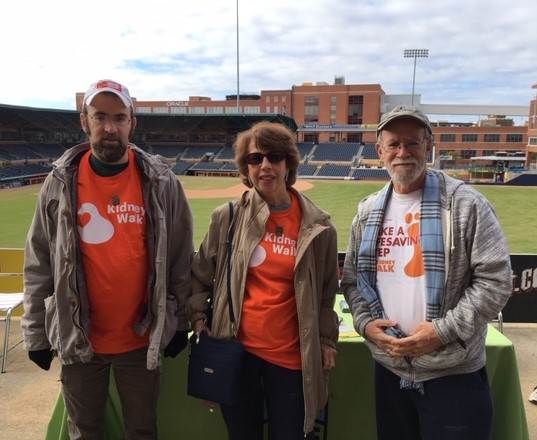
This weekend my husband (Neil), son (Paul, my recipient), and I participated in our umpteenth National Kidney Foundation Triangle Kidney Walk [see my post on our long history of kidney walks], in Durham, NC. We were thrilled to learn that it set a record for donations: more than $97,000, with money still coming in. I think it broke another record, too–this may have been the coldest one (I know it’s the only time I’ve ever worn a winter coat over my Kidney Walk tee shirt).

Because of the damp chilly weather, the Walk organizers decided to shorten the route. What was supposed to be a 2.4-mile loop was reduced to just 1 mile total. True, my fingers were numb even before it was over, but we were still a bit disappointed.

It was long enough though to fall into conversation with a woman doing her first Walk. She’d driven all the way from the Pinehurst area because her mother had died recently from kidney failure, and she felt she had to do something. Like so many of us, she’d known very little about kidney disease before her mother started dialysis 4 years before. A few family members had planned to come along, she said with a little annoyance, but one by one they’d backed out. To her credit she came alone.

We talked about how little is known about kidney disease and how important it is to focus more attention on education in addition to research. We learned a startling statistic before the walk started: the U.S. National Institutes of Health, which is the main source of health-related research in this country, spends $568 per patient/year on cancer research. Kidney disease research accounts for…$29 per patient/year! I thought I’d heard it wrong and had to double-check before finalizing this post. And yet chronic kidney disease affects more than 30 million Americans. It’s yet another reminder of how important that new public awareness campaign is [see my previous post].

We saw lots of familiar smiling faces at the walk, many peering out from under wool hats. Friends from Donate Life NC/WELD (Women Encouraging Living Donation) were working a table this year. One of them, Dolores McGrath, a fellow NKF Kidney Advocacy Committee member, would be joining me for my first “official” visit to the state legislature this week. (More on that in my next post!)

That’s Dolores McGrath, center; and Deanna Kerrigan, Donate Life NC/WELD director, right.

Powerful Push to Promote Public Awareness of Kidney Disease

I’ve long been amazed and frustrated that most people know little about kidney disease and are unaware of the public health crisis: nearly 100,000 people in this country are waiting for a kidney from a deceased donor, and most will wait several years. For many, that’s too long, and thousands die every year because they didn’t receive a kidney in time.

That lack of information is widespread and includes educated, otherwise knowledgeable, well-informed people. Most of the 30 million-plus people in this country with chronic kidney disease don’t even know it yet, so if people paid more attention to their kidneys, and healthcare providers focused on early detection, kidney disease could be treated before it reached life-threatening kidney failure. Just think of the thousands—maybe millions—of lives that could be saved!

That’s why I was very excited to learn that the public awareness part of that amazing kidney health initiative just got some real teeth. The National Kidney Foundation (NKF) is forming an important partnership with the Department of Health and Human Services (HHS) and American Society of Nephrologists (ASN) to promote the Public Awareness Initiative portion of what’s officially called Advancing American Kidney Health initiative. 

Did you know that one-third of Americans are at risk for developing kidney disease, not only because of diabetes and high blood pressure, but also cardiovascular disease, obesity, and family history of kidney disease? For certain groups, particularly African Americans and Hispanics, the risks are especially high: African Americans are three times as likely as whites, and Hispanics nearly 1.5 times as likely as non-Hispanics, to develop end stage kidney failure.

Even for people who are not at increased risk, my family knows well that our kidney health should never be taken for granted. If you read my son’s post on this site on the anniversary of his transplant, you may recall that he developed his kidney disease from a lingering strep infection. He was young and otherwise healthy, but 5 years later he was on dialysis, and 2 years after that, I gave him my kidney.     

The collaboration by HHS, NKF, and ASN will provide education about the risks of kidney disease and promote the early detection and management of kidney disease to improve patients’ results.

 For more information on the partnership, the Initiative, and kidney disease in general, read the complete announcement here.