(If a wimp like me could donate a kidney, you probably can, too!)
Author: Carol Offen
I'm a living kidney donor--I donated to my son in 2006--who happens to be a wimp (I faint at flu shots). I'm passionate about encouraging living donation, and I figure that if I can donate a kidney, you probably can, too. I'm also a professional writer and editor. I recently co-authored a book, with a kidney recipient, titled The Insider's Guide to Living Kidney Donation: Everything You Need to Know If You Give (or Get) the Greatest Gift.
I’m wearing orange today to spread awareness of kidneys: the body’s unsung heroes! They regulate fluid levels, balance nutrients, produce urine, eliminate toxins, make red blood cells, promote bone health, regulate blood pressure, and so much more. Now do you see why I say they don’t get the attention they deserve? If you don’t already know your kidney function, PLEASE make an appointment to have your kidneys checked–it’s just a simple blood test. Thirty million Americans have chronic kidney disease, and most of them have no idea. [In the picture with me is my friend “the Comeback Kidney.” That’s what we named the kidney I donated to my son, which enabled HIS comeback 12 and a half years ago.]
Have you seen this excellent, candid article about the issues a young family man grappled with before making the decision to donate? It’s a very honest, clear-headed portrayal of what it means to be a living donor.
March 8 is International Women’s Day, so it seems fitting to continue our theme of women and kidneys (two of my favorite subjects). In my last post, I pointed out that neither gets the respect and attention they/we deserve. It’s mostly because most people just don’t know a whole lot about what they do: in the case of women, we hold up half the sky, as the African proverb says. And kidneys do much the same for the body, quietly keeping it functioning as it should, balancing nutrients, eliminating dangerous toxins, regulating fluids and salt content, promoting bone health. I could go on.
Now how do I tie this back to women, you ask? Let’s consider living kidney donors. Not surprisingly, most are women. When I participated in setting the Guinness World Record for largest gathering of living donors last April, it was clear that the vast majority of us donors there were women. Now, it’s tempting to say that’s all due to our natural empathy and nurturing instincts. I do believe that’s partly responsible, but I know it’s more complicated than that. (For one thing, in the case of the Guinness event in Chicago, many of us needed to be able to afford a trip halfway across the country.) More important, donating a kidney, like any major surgery, usually entails taking off work for at least a couple of weeks, if you have a sedentary job as I did (editor/writer). If you’re a laborer, however, because of a restriction on lifting anything over 10 pounds for about the first 6 weeks after surgery, that obviously could mean a lot longer interruption.
Donors who are lucky enough to have sufficient paid sick leave (or any at all) don’t have to worry about lost pay. But for anyone who doesn’t, that’s a major disincentive to be a live donor. The reality is that, in a lot of families, it’s still harder to get by without the man’s earnings. The National Living Donor Assistance Center has been offering much-needed financial help with travel and lodging costs for donors who need to travel to their recipient’s transplant center. It’s a wonderful program, but it doesn’t cover lost pay. Now there’s a growing movement in Congress, spearheaded by Reps. Jaime Herrera-Beutler and Matthew Cartwright, to expand that assistance to cover lost pay. Contact your representative and tell him or her to get behind this important effort!
* *
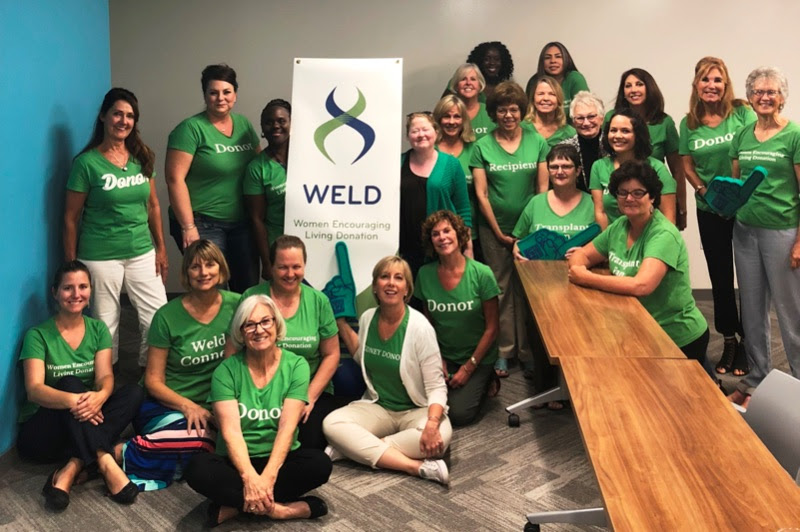
Have you ever heard of WELD (spoiler: it has nothing to do with welding)? It stands for Women Encouraging Living Donation. I’m guessing you’re going to start hearing more about it as this terrific organization grows. I recently went to my first meeting of its fledgling NC site. It was a kick, as always, to meet other women who’ve donated, are in the process of donating, or touched by donation and transplant in some way, whether personally or professionally.
The main WELD group started in 2015 in San Diego. It’s composed of dedicated living kidney donors, transplant recipients, transplant surgeons, nephrologists, nurse coordinators, transplant social workers, volunteer advocates—all women. WELD started as an offshoot of the John Brockington Foundation, founded by John and Diane Brockington. Diane donated her kidney to John, an ex-football star, in 2001, and they later married. Today the Foundation provides financial assistance and education resources to donors and recipients in the San Diego area. Meanwhile, WELD, led by Diane, actively encourages living donation through in-home presentations, one-on-one mentoring, billboards, and support of public events.
I heard about the San Diego organization more than a year ago and was excited to learn that they were exploring branching out. They’ve teamed up with Donate Life, which promotes organ donation (after death). Deceased donation alone can’t meet the need for organs—nearly 100,000 Americans are on waiting lists for a kidney, for example, and only about 20,000 transplants are performed each year. So, WELD—and other groups promoting living donation—hope to bridge that gap. I’m so happy to be a part of their efforts.
Yes, March is National Kidney Month and National Women’s Month. What do kidneys and women have in common, you ask? Both groups are underappreciated! We can hope that someday we will get to a point where we don’t need to introduce people to integral aspects of our culture and our history (like Black History Month). For now, though, we obviously do. And this month we highlight the critically important role women play in our society. Similarly, we highlight the critically important role the kidneys play in our body.
Do you know what your kidney function is? You may think you know what women contribute to daily life, but do you know what kidneys do? For starters, they remove dangerous toxins from the blood, regulate the amount of fluids in our body, maintain the salt content of those fluids, balance minerals, produce urine, promote bone health, and so much more.
I’ve had a healthy
respect for kidneys ever since my son was in dialysis. For nearly 2 years, dialysis
machines, doctors, nurses, and technicians did a masterful job of trying to
approximate what healthy kidneys manage to do every day.
Yet even with doing their damndest to get this juggling act all right, dialysis could produce only about 20% of normal kidney function. One-fifth.
Like women, kidneys pull off much of their heroic daily work quietly, often without calling attention to themselves. That’s why when kidneys are starting to fail, we usually don’t notice. About 30 million Americans have chronic kidney disease—meaning they’re gradually losing kidney function—and most of them don’t know it. It’s called “the silent killer” because people usually don’t feel sick (and often look fine) until it’s dangerously far along. I know of people who just had a routine screening at a health fair, or went to the ER for a broken arm, or just didn’t feel right—only to learn, to their shock, that their kidneys were failing significantly and they needed to start dialysis ASAP.
My son knew he had kidney disease ever since it was diagnosed following a strep infection when he was in college. He was otherwise healthy and was told to monitor the condition with routine blood tests, which he did, never showing or feeling any symptoms. It was only at a routine checkup soon after his college graduation that the tests showed a precipitous decline in his kidney function. Within a month he was having surgery to put in an access point for dialysis, in 3 months he was undergoing dialysis 3 days a week, and close to 2 years later, he was welcoming my left kidney into its new home. It’s lived there happily since 2006, by the way. (My right kidney is managing fine without it.)
So, this month, please make an appointment to have your kidney function checked with a simple blood test. (And be sure to thank a woman every day!)
Besides the gamut of medical tests, the donor evaluation entails interviews with a psychologist, a social worker, a financial counselor, a surgeon, and a transplant nephrologist. Coordinating it all and providing lots of support, is a transplant nurse coordinator. This team of professionals was assigned to me. My recipient–my son–had his own. The idea was to avoid any conflict of interest and to ensure that the donor not feel pressured in any way. These providers had my interests at heart, and every one of them had been forewarned that I was a wimp. They were cool with that. They never made me feel foolish or ashamed for thinking about queasiness or dizziness at such a critical time for my son (I did that myself).
The social worker wanted to be sure I’d thought this through. We had a teenage daughter who was dealing with her own adolescent struggles. Also, we’d recently moved my elderly father down from New York, and though he didn’t live with us, I was his primary caregiver. “You’re the glue that’s holding this all together,” the social worker pointed out. “What’s going to happen when you need care yourself?” The question prompted lots of soul searching and discussions. My husband was very supportive of my decision (he’d also wanted to donate but was eliminated) and was already shouldering more than his share, so I knew we’d manage somehow. My main concern was the added stress on him.
Throughout the donor testing—the umpteen blood draws, X-rays, a stress cardiogram, CT angiography, lung function test, and more—my nurse coordinator was just a phone call away. Knowing my wimp background, she always offered gentle encouragement; accommodations like arranging to draw as much blood at a time as possible to avoid sticking me extra times; useful tips, such as lidocaine to numb my arm for the blood draws; and, thankfully, a warm sense of humor.
After each test I’d call her nervously to see if I’d passed. I knew that even after months of successful test results, I could still be eliminated. (I know someone who was actually eliminated the night before the scheduled surgery. She was devastated.) Hmmn, how would I really feel if I were disqualified? Would I secretly be relieved (after all, I’d tried)? Much to my surprise, I realized I’d be crushed. I’d gone through many stages of adjustment in my decision to be a donor: initial determination, wavering, a new resolve, cautious optimism, and solidly back to determination. So when the psychologist later asked if I was still sure I wanted to do this, I had to laugh. “Ohhh yeah,” I said without hesitation.
There are still many myths about what’s involved in donating a kidney, and here are a few. I first included these in an article in 2017 and have already needed to update a couple of them because many aspects of the process have gotten easier. How many of the questions can you answer correctly?
True or False: The surgeon removes a rib to get to the donor’s kidney.
False: Thanks to minimally invasive laparoscopic surgery (the standard of care), I had two tiny slits and a three-inch bikini incision.
True or False: Donors must be young.
False: More than a third of living kidney donors are over 50. It’s the health of the kidney–plus the donor’s overall health–that counts. I was 58 when I donated mine.
True or False: Donors stay in the hospital for a few weeks.
False: A typical stay is now 1 or 2 days.
True or False: Donors need to miss work for 3 to 6 months.
False: I could have gone back to my sedentary job as an editor in 2 or 3 weeks. A laborer might need a couple of months.
True or False: There’s no turning back.
False: You can change your mind at any point. My transplant nurse coordinator, social worker, psychologist, nephrologist, and transplant surgeon all assured me that I could. My son would be told only that I had been eliminated.
I just discovered an embarrassing glitch (aka technological error) in this brief post, so I’ve corrected it and reposted. It’s drawn (and updated) from an earlier, longer post I wrote forWELD’s blog.The original 2017 article appeared on the National Kidney Foundation website.
….I’ve always been a wimp: I faint at flu shots, IVs, blood tests. And yet, in June 2006, I donated a kidney to my son, Paul. The reason is simple: his kidneys were failing and I was the only willing one who could. Wimp or not, of course, I’d do it.
He was in his early 20s when he developed ESRD [end stage renal disease]. He’d been diagnosed with IgA nephropathy when he was in college, following a lingering strep infection—not uncommon. Yeah, no hereditary disease, no diabetes or high blood pressure. He wasn’t obese. He just had rotten luck. So, in other words, what happened to Paul—and to our family—could happen to anyone.
Between us, my son and I have four kidneys—not very remarkable, except that he has three of them. I gave him one of mine about twelve years ago. The reason was simple: after spending nearly two years on dialysis, he clearly needed the kidney and I didn’t. I still had another that worked just fine so it was a perfect opportunity to share resources within the family. Today even unrelated people in different parts of the country can do the same, thanks to sophisticated computer algorithms. But this was more than twelve years ago.
My son, Paul, had the extraordinarily bad luck to develop chronic
kidney disease—which can gradually lead to kidney failure—when he was in
college. He was otherwise healthy, we had no family history of it, and
he didn’t have diabetes or hypertension. Plus he was skinny.
This post is excerpted from an article I wrote for the Fall 2018 issue of South Writ Large, a quarterly online magazine published since 2007. The theme of the issue was sharing resources, so living kidney donation was a natural fit.
You’ve already heard (and seen pix) about the living donor rally I attended this weekend in Chicago. But I’ve been eager to share some observations while they’re still fresh because it was truly the most encouraging, life-affirming experience I’ve had in years.
For 3 wonderful days I was surrounded by hundreds of people–on Saturday more than 1200–I’d never met before, but with whom I felt an incredible bond. We were from all different parts of the country (a few from Canada and one family from India), backgrounds, ethnicities, ages (many 20-30 yrs younger than me), genders, and political views. I’m guessing about the last one because politics NEVER came up. Yup, for 3 days politics did not come up–I don’t mean I avoided it, I mean it just didn’t come up, it was irrelevant.
We laughed together, teared up a lot (for both sad and happy reasons), and connected on the most basic human level. We shared our stories and nodded knowingly on hearing others’ experiences (often if we hadn’t lived it, we had worried or wondered about such things): a young woman who’d donated to her father a few yrs ago was grieving for the kidney he had lost a month before, a mother from Texas donated to her son who was on dialysis when the power was out for days during a hurricane and she lived in terror of the generator going out. There were happy tears on hearing of people who’d donated to someone from their church whom they’d barely known and now get invited to every graduation, wedding, and baby shower–a warm acknowledgment that if it wasn’t for the donors, the recipients might not have been around for these special family events. I met altruistic donors (who donate to an unknown recipient)–many were thrilled to meet their recipient and were welcomed as part of the family, some had never met even years later, one wished they hadn’t met–but all continued to be tireless champions of living donation.
I heard it repeatedly: we felt like we were among family or old friends. A sense of community that transcends demographics, politics, religion, sexual orientation–if you thought it was no longer possible in 2018, I’m happy to report that it was very much alive and well in Chicago this weekend. True, it was a very special gathering, but now I know that it is indeed possible. May you all experience it sometime soon. It’s a helluva feeling!
This post appeared on my Facebook page, April 27, 2018.
Living Donors Rally, April 21, 2018, in Chicago–we set a Guinness World Record for largest gathering of living donors! Can you see me? Photo by John Martin Photography, Detroit.
This is from my original 2017 post on the National Kidney Foundation website.
…Throughout the donor testing—blood draws, X-rays, a stress cardiogram, CT angiography, lung function test, and more—the nurse coordinator was just a phone call away. She offered gentle encouragement, useful tips (like lidocaine to numb my arm for blood draws), and, thankfully, a sense of humor.
After each test I’d call her nervously to see if I’d passed. How would I really feel if I were disqualified? Would I secretly be relieved? To my surprise, I realized I’d be crushed.
So when the psychologist asked if I was sure I wanted to do this, I laughed. “Trust me,” I said. “You can skip to the next question.”






 Could You Be a Kidney Donor? What to Expect If You Give the Greatest Gift