Powerful Push to Promote Public Awareness of Kidney Disease

I’ve long been amazed and frustrated that most people know little about kidney disease and are unaware of the public health crisis: nearly 100,000 people in this country are waiting for a kidney from a deceased donor, and most will wait several years. For many, that’s too long, and thousands die every year because they didn’t receive a kidney in time.

That lack of information is widespread and includes educated, otherwise knowledgeable, well-informed people. Most of the 30 million-plus people in this country with chronic kidney disease don’t even know it yet, so if people paid more attention to their kidneys, and healthcare providers focused on early detection, kidney disease could be treated before it reached life-threatening kidney failure. Just think of the thousands—maybe millions—of lives that could be saved!

That’s why I was very excited to learn that the public awareness part of that amazing kidney health initiative just got some real teeth. The National Kidney Foundation (NKF) is forming an important partnership with the Department of Health and Human Services (HHS) and American Society of Nephrologists (ASN) to promote the Public Awareness Initiative portion of what’s officially called Advancing American Kidney Health initiative. 

Did you know that one-third of Americans are at risk for developing kidney disease, not only because of diabetes and high blood pressure, but also cardiovascular disease, obesity, and family history of kidney disease? For certain groups, particularly African Americans and Hispanics, the risks are especially high: African Americans are three times as likely as whites, and Hispanics nearly 1.5 times as likely as non-Hispanics, to develop end stage kidney failure.

Even for people who are not at increased risk, my family knows well that our kidney health should never be taken for granted. If you read my son’s post on this site on the anniversary of his transplant, you may recall that he developed his kidney disease from a lingering strep infection. He was young and otherwise healthy, but 5 years later he was on dialysis, and 2 years after that, I gave him my kidney.     

The collaboration by HHS, NKF, and ASN will provide education about the risks of kidney disease and promote the early detection and management of kidney disease to improve patients’ results.

 For more information on the partnership, the Initiative, and kidney disease in general, read the complete announcement here.

The Top Kidney Donor Blogs

A short while ago I came across “The Top 30 Kidney Donor Blogs and Websites to Follow in 2019.” It lists individual personal blogs from donors and recipients, plus from major organizations (nearly half of the websites listed, in fact) like the National Kidney Foundation and the National Foundation for Transplants. Last week I noticed that there was a way to submit a blog, and I did. So, guess who’s #10 on the Top 30 list now?

Sure, the Top 30 is a marketing vehicle, but it’s also a convenient way to find interesting donor-related blogs; you can click to see their latest posts. Each listing also tells how frequent the blog posts are (mine average four a month), the number of Twitter followers (I have a modest but growing 280), and such.

This blog went live just several months ago, in March 2019. I’ve been delighted to see how well it’s been received. I didn’t know what to expect in terms of number of views and visitors, but I’m pretty pleased to have surpassed the 3,000-views mark (and more than 1,700 visitors).

 I’ve enjoyed sharing my living-donor experiences and recipient-family insights with you; helping to encourage living donation–not by proselytizing but by offering candid, clear, practical information; and fighting to protect the rights of kidney patients and donors (for example, check out these blog posts). I’m very glad that more people may find their way here.

Photo by rawpixel.com on Pexels.com

Still Walking after All These Years

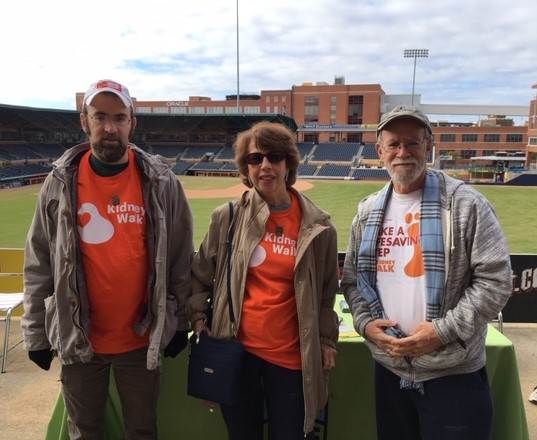
Another Triangle Kidney Walk date is approaching: Sunday, November 17, in nearby Durham, NC. My husband, son, and I (our daughter’s up in Brooklyn) will be there as usual. We’ve walked in more of them than I can count: three or four recent National Kidney Foundation walks starting at the present Durham Bulls Ballpark location; maybe another four or five NKF walks in Research Triangle Park, which wove through the campus of my long-time employer, RTI International, often a sponsor; plus a few Kidney Kare run/walks in Carrboro, NC, sponsored by the University of North Carolina Transplant Center.

Just a small sample of my collection of tee shirts from many years of Kidney Walks in North Carolina.

We’ve walked in blistering heat, when the water bottles the helpful volunteers were distributing were downright hot; in chilling cold, with our hoods up and gloved hands clutching thermoses; stepping gingerly over deep puddles, dripping wet as we shunned umbrellas (so far never in snow). Still, the events are usually fun and always inspiring. In the midst of the upbeat music, entertainment, and snacks, there are of course speeches, information, organizations with handouts (so excited that NC WELD–Women Encouraging Living Donation–will have a table this year!), and health screening booths.

I remember the middle-aged man who spoke to the gathered walkers before the start of the walk a couple of years ago. He described being at one such walk a few years before and deciding to do the screening. There he’d discovered to his shock that he had stage 4 kidney failure. That Kidney Walk saved his life: he began dialysis within a few months and was able to have a transplant a couple of years later.

It bears repeating: chronic kidney disease is a silent killer. Most of the more than 30 million people in this country who have it don’t know it because they don’t have symptoms yet—and may not until it’s too late. The transplant center and NKF have mobile units that do screenings around the state throughout the year. Education, screenings, and research all cost money.

That’s why we walk. Proudly wearing bibs that say DONOR (me), RECIPIENT (my son), or DONOR FAMILY (my husband), we chat with other walkers. We’ve met hopeful families of kidney patients desperately in need of a kidney, transplant recipients happily walking with a bounce in their step for the first time in years, patients who’ve been on dialysis for more than a decade and can never have a transplant because they have too many other serious health conditions–some are not strong enough for the walk but come out to volunteer and help raise funds for awareness, education, and research.

Please consider donating whatever you can or just share this post on social media or email it to your families and friends. Our team is called the Comeback Kidney, named after our nickname for the kidney I donated to my son more than 13 years ago. But whether or not you donate to our team, to the Kidney Walk in general, or to any kidney disease organization, please spread the word about the importance of kidney heath—and be sure to get your kidneys checked.