To be a living kidney donor, you have to be (a) young, (b) a family member of the recipient, (c) brave, (d) all of the above, or (e) none of the above?
(a) Wrong. I was 58. In fact, more than a third of living donors are over 50.
(b) Wrong. Though the largest group of donors are indeed family members, unrelated donors are an increasingly large portion of living donors.
(c) Wrong. “Brave” is certainly not a word ever used to describe me! As a self-described wimp, I relied heavily on my supportive and caring transplant team, who did all they could to accommodate my needs and concerns. The experience proved to be much easier than I expected (certainly easier than childbirth!).
Whether you’re a living kidney donor (like me) or a registered organ donor with a little heart on your driver’s license (also like me), thank you for giving someone a chance at a healthy life! As you may know, more than 100,000 people in this country are on years-long waiting lists for an organ (most of them in need of a kidney). Registering to be an organ donor is easy and quick: just go to http://organdonor.gov, and then be sure to tell your family of your wishes. National Donate Life Month shines a spotlight on organ donation in the hopes of shortening the long wait for a life-saving organ.
So many people can be saved from just one registered donor with two kidneys, a liver, two lungs, a heart, a pancreas, and intestines–and, since 2014, even hands and faces. However, even if everyone registered, there just aren’t enough deceased-donor organs to go around. Did you know that less than 1% of people die in such a way that their organs can be used (typically in a hospital following an accident), though, fortunately, corneas, tissues, blood stem cells, and bone marrow can still be used? That’s why it’s so important to have as large a pool of potential donors as possible.
See my little heart on the right? You can have one, too.
It’s also one of the many reasons that live donation is so important. (We’ll talk more about the benefits of live donation in another post.) Every time someone on the list gets a live donor–and can be removed from the wait list–it shortens the wait for the others on the list. Please help save a life by registering to be an organ donor.
I spoke to my first group of prospective kidney recipients and their “champions” last weekend at the University of North Carolina’s transplant center in Chapel Hill. I was delighted to see how many people had brought along their spouse, siblings, and/or children to learn how to tell their story and spread the word about the person’s urgent need for a kidney.
This is a terrific program, and I only wish it had existed when we were
contemplating my son’s transplant. Asking someone–even a relative–to
part with a bodily organ does not come naturally to most people. So
the idea of teaching one’s support team about how kidneys work (or
fail) and live donation, and how to spread the word, is an inspired and
effective approach.
You may have seen newspaper photos of people publicizing a need for a kidney (for themselves or a loved one) on a billboard or banner or tee shirt, complete with blood type and telephone number. But for every one of these novel attention grabbers, tens of thousands wait silently for someone to come forward.
My son was one of the lucky ones (he got a kidney from me). So was Betsy, my co-author (The Greatest Gift: The Insider’s Guide to Living Kidney Donation). She got hers from a colleague at UNC, where she teaches. We shared our stories with the attendees and answered questions. (That’s me on the right.)
I told about donating to my son 12 and a half years ago. I hope my story resonated with these “champions,” because they’re also potential living donors, of course. I told them a secret: living donors aren’t necessarily brave. I certainly wasn’t. In fact, as I told them, I’m a wimp. It’s not just that I don’t like needles–who does?–I don’t like thinking about or picturing medical procedures. My sister once made the mistake of asking me to come along for moral support when she had oral surgery. I waited in the hallway so I wouldn’t risk glimpsing anything, but I could still hear what was going on. When my sister asked the surgeon to explain what he was about to do, I started feeling faint as I listened. The nurse had to run out of the room to pick me up off the floor. My sister was not amused.
Betsy told about her transplant, which happened 15 years ago. The prospective recipients could certainly relate to her decades-long experience with chronic kidney disease, which runs in her family. Like her mother and two of her siblings, Betsy has polycystic kidney disease, PKD.
The attendees had come from all over the state for this 2-hour program. One couple told me they’d had a 5-hour drive. One gentleman who’d brought his sister and brother with him said that they both were being tested as donors. A sibling offers a great match. He was concerned that his sister had been told to lose a lot of weight before she could be approved to donate. I told him that transplant centers typically will work with such prospective donors and usually have them meet with a nutritionist.
Many of the
attendees had lots of questions and left with answers, I hope, but no
doubt with more questions. Maybe some of them found their way to this
site and are starting to get those answers. In any case, I wish them all
well.
Betsy and I look forward to participating in another program in June.
What are living donor champions? They are friends and family members of someone who needs a transplant who learn how to effectively spread the word to potential donors. Let’s say you know someone who needs a kidney, but they’re uncomfortable for any number of reasons about coming out and asking someone they know–much less someone they don’t know–to donate one of their kidneys.
Back in 2004 when we first learned that my son would need a transplant, the idea of asking someone if they would donate their kidney was beyond awkward. (People who have trouble asking for a ride to the airport don’t even know where to begin to ask for a bodily organ!) Though social media existed then, it was mostly a social thing for teens and 20-somethings–hardly a vehicle for something like life-saving/life-changing requests. Fast forward to 2019: Facebook, Twitter, and other platforms have changed the whole donation landscape, which dovetails perfectly with living donor champion efforts.
Betsy Crais, my co-author (The Greatest Gift: The Insider’s Guide to Living Kidney Donation), and I are going to speak at a few such programs over the coming months. We’ll start with one this weekend at the University of North Carolina’s kidney transplant center. That’s only fitting, because it’s where I donated a kidney to my son, and where Betsy received hers from a UNC colleague. We’re going to tell our stories and take questions from attendees.
I’m so looking forward to it. Watch for a post on the event!
March 8 is International Women’s Day, so it seems fitting to continue our theme of women and kidneys (two of my favorite subjects). In my last post, I pointed out that neither gets the respect and attention they/we deserve. It’s mostly because most people just don’t know a whole lot about what they do: in the case of women, we hold up half the sky, as the African proverb says. And kidneys do much the same for the body, quietly keeping it functioning as it should, balancing nutrients, eliminating dangerous toxins, regulating fluids and salt content, promoting bone health. I could go on.
Now how do I tie this back to women, you ask? Let’s consider living kidney donors. Not surprisingly, most are women. When I participated in setting the Guinness World Record for largest gathering of living donors last April, it was clear that the vast majority of us donors there were women. Now, it’s tempting to say that’s all due to our natural empathy and nurturing instincts. I do believe that’s partly responsible, but I know it’s more complicated than that. (For one thing, in the case of the Guinness event in Chicago, many of us needed to be able to afford a trip halfway across the country.) More important, donating a kidney, like any major surgery, usually entails taking off work for at least a couple of weeks, if you have a sedentary job as I did (editor/writer). If you’re a laborer, however, because of a restriction on lifting anything over 10 pounds for about the first 6 weeks after surgery, that obviously could mean a lot longer interruption.
Donors who are lucky enough to have sufficient paid sick leave (or any at all) don’t have to worry about lost pay. But for anyone who doesn’t, that’s a major disincentive to be a live donor. The reality is that, in a lot of families, it’s still harder to get by without the man’s earnings. The National Living Donor Assistance Center has been offering much-needed financial help with travel and lodging costs for donors who need to travel to their recipient’s transplant center. It’s a wonderful program, but it doesn’t cover lost pay. Now there’s a growing movement in Congress, spearheaded by Reps. Jaime Herrera-Beutler and Matthew Cartwright, to expand that assistance to cover lost pay. Contact your representative and tell him or her to get behind this important effort!
* *
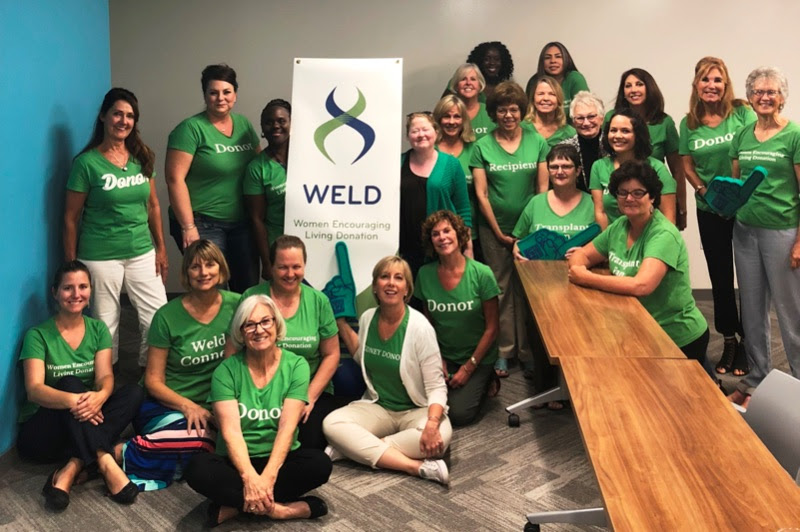
Have you ever heard of WELD (spoiler: it has nothing to do with welding)? It stands for Women Encouraging Living Donation. I’m guessing you’re going to start hearing more about it as this terrific organization grows. I recently went to my first meeting of its fledgling NC site. It was a kick, as always, to meet other women who’ve donated, are in the process of donating, or touched by donation and transplant in some way, whether personally or professionally.
The main WELD group started in 2015 in San Diego. It’s composed of dedicated living kidney donors, transplant recipients, transplant surgeons, nephrologists, nurse coordinators, transplant social workers, volunteer advocates—all women. WELD started as an offshoot of the John Brockington Foundation, founded by John and Diane Brockington. Diane donated her kidney to John, an ex-football star, in 2001, and they later married. Today the Foundation provides financial assistance and education resources to donors and recipients in the San Diego area. Meanwhile, WELD, led by Diane, actively encourages living donation through in-home presentations, one-on-one mentoring, billboards, and support of public events.
I heard about the San Diego organization more than a year ago and was excited to learn that they were exploring branching out. They’ve teamed up with Donate Life, which promotes organ donation (after death). Deceased donation alone can’t meet the need for organs—nearly 100,000 Americans are on waiting lists for a kidney, for example, and only about 20,000 transplants are performed each year. So, WELD—and other groups promoting living donation—hope to bridge that gap. I’m so happy to be a part of their efforts.
This is from my original 2017 post on the National Kidney Foundation website.
…Throughout the donor testing—blood draws, X-rays, a stress cardiogram, CT angiography, lung function test, and more—the nurse coordinator was just a phone call away. She offered gentle encouragement, useful tips (like lidocaine to numb my arm for blood draws), and, thankfully, a sense of humor.
After each test I’d call her nervously to see if I’d passed. How would I really feel if I were disqualified? Would I secretly be relieved? To my surprise, I realized I’d be crushed.
So when the psychologist asked if I was sure I wanted to do this, I laughed. “Trust me,” I said. “You can skip to the next question.”



 Could You Be a Kidney Donor? What to Expect If You Give the Greatest Gift