In my last post I wrote about celebrities who’ve been given a shot at a fuller, healthier life because of a living kidney donor. If you thought they mostly led quiet restricted lives, along comes David Ayres, the emergency goalie who won the game for the Carolina Hurricanes hockey team against the Toronto Maple Leafs!
Ayres received a kidney from his mother (like my son did!) 15 years ago. Since then the 42-year-old kidney transplant recipient has been happy to be a practice goalie, Toronto arena operations manager, and sometime-Zamboni driver. He never dreamed he’d get his turn in an NHL game, an always-physical and sometimes brutal sport. But on February 22, when a string of injuries left the Canes without a goalie, he was called to the ice with 28:41 to go in the game. He stopped eight shots and helped earn the team a dramatic 6-3 victory in his NHL debut.
The Canes are selling No. 90 Ayres tee shirts, for which he will receive royalties. A portion of the proceeds will go to a kidney foundation in his honor. The Canes are working with him to determine which foundation. There were a lot of winners that night in Toronto. The donation and the increased awareness of kidney transplants means that there will be even more.
They’re athletes, actors, and musicians of different ages, races, and ethnicities. So, what do the celebrities listed below have in common? They’re all healthier, and very likely happier, because a living kidney donor gave them a shot at a better quality of life. The best way to shorten someone’s wait for an organ–rich or poor, famous or not–is to find a living donor. Sometimes it’s a biological family member who steps up–sometimes it’s a future or former partner. And sometimes it’s a Good Samaritan, who chooses to donate to an unknown person in need.
Fortunately, some of these famous live-kidney transplant recipients have become spokespersons for National Kidney Foundation campaigns, and some, like former NBA star Alonzo Mourning, comic George Lopez, and former NFL star John Brockington have gone so far as to launch their own kidney disease awareness foundations. (Did you know that my dear WELD [Women Encouraging Living Donation] started as an offshoot of the John Brockington Foundation before joining forces with Donate Life?)
Other celebrities have individually turned to the media to share their personal transplant experiences. Singer Selena Gomez and her donor, actress Francia Raisa, gave several helpful major interviews in 2019 about Gomez’s transplant, shedding light on the donation process and the aftermath. And actress Sarah Hyland candidly shared details of her two kidney transplants, first from her father and most recently from her brother, and of her struggles with depression.
Even though chronic kidney disease is more common than breast cancer or prostate cancer, the general public knows very little about it. If more celebrities who’ve been touched by kidney disease and transplant would openly talk about their life-changing stories, it could encourage more people to have their kidneys checked, register as organ donors, and even consider being living donors. All those actions would go a long way toward reducing the years-long wait for a kidney and ultimately saving more lives. By the way, celebrity status and money offer no privileges on the national waiting lists for a deceased donor.
How many of these celebrities did you know had had kidney transplants (the year of their transplant is next to each name)?
I always tell potential kidney donors to keep an open mind but to do their homework and be as well informed about living donation as they can be. Turns out that that advice even applies years later.
Through social media donor support groups, I recently was stunned and outraged to learn that some donors have been told that they have stage 3 chronic kidney disease. One donor said she cried all night. Before you conclude that their “disease” is a result of kidney donation, I hasten to add that these were people with normal kidney function. In other words, as researchers have demonstrated, those living donors DO NOT HAVE CHRONIC KIDNEY DISEASE! Their slightly low readings are perfectly normal for them.
Apparently, their primary care providers—and, unbelievably, sometimes even nephrologists—were referring to the eGFR (estimated glomerular filtration rate) scale based on people with two kidneys and/or real kidney disease. Donors lose 25 to 35% of their pre-donation kidney function, but that’s still sufficient to lead a healthy normal life. It’s meaningless and patently wrong to look at the numbers in a vacuum and say that these people have chronic kidney disease.
As we get older, no matter how many kidneys we have, our kidney function declines. It’s especially common for people over 70, like me, to have a slightly low eGFR. At my last check-up, though, 13 years after donating my kidney to my son, my eGFR was 69 (normal is over 60).
So, if you are a kidney donor, don’t be alarmed at news of a slightly high eGFR. Ask questions (how long has it been in that range? what’s your creatinine?), and always remind your provider that you have one kidney. You may well be relieved to know that your new normal is just fine!
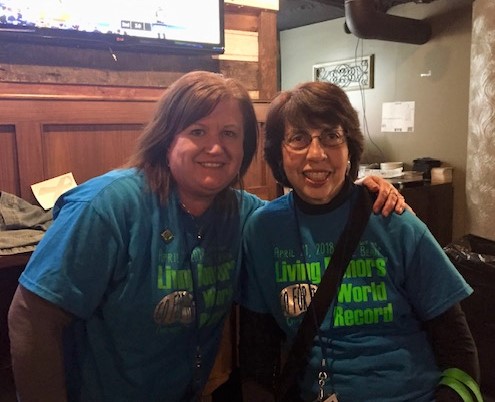
I first met Brenda online a couple of years ago through a Facebook living donor support group. We were both so moved by having donated that we became strong advocates for donation awareness and went a step further in deciding to write books about donation (hers for young children, mine for adults). I was excited to meet the warm, energetic Wisconsinite in person last year in Chicago during that memorable weekend when we helped set the Guinness World Record for Living Donors. We’ve followed and cheered on each other’s donation advocacy activities ever since.
My book with Betsy Crais, “The Greatest Gift: The Insider’s Guide to Living Kidney Donation”—in its final stages as we look for a publisher—was conceived to help potential donors and recipients navigate the donation/transplant process and the emotional challenges. If you think we adults have trouble grasping and dealing with donation, transplant, and dialysis in the family, just imagine how bewildering the topic is for little kids. So, I’m delighted to see that Brenda’s children’s series on donation has really taken off. The books, most of which star an adorable little owl named Howl (which stands for Help Others With Love), help kids make some sense of these frightening situations, whether they’re experiencing the condition themselves or, more commonly, a parent or grandparent is.
Brenda’s first book, “My Mom Is
Having Surgery,” was prompted by her daughter’s college application essay
that told how inspired she was by her mother’s donating her kidney a few years
earlier to another mom she’d known only casually. Not long after the first
book, Brenda created Howl to help spread her message of kindness and awareness
of organ donation. Among the titles, which are delightfully illustrated, are “Howl
Gets a Heart” (yup, the little guy is a transplant recipient!) and “Howl Learns
About Kidneys and Dialysis”; her latest is “Howl Goes to the Races,” where he
gets to meet race car driver and organ donation advocate Joey Gase on the
occasion of Organ Donation Awareness Day.
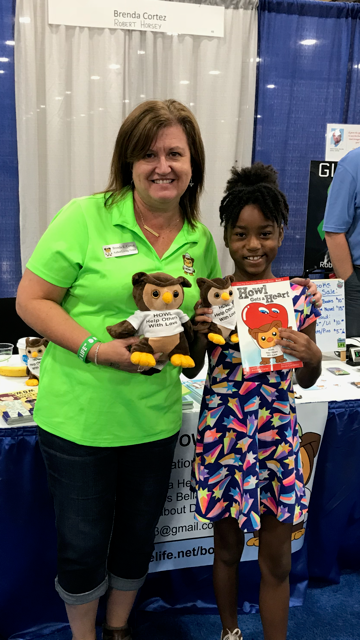
Brenda and Howl pose with a visitor to her table at an event. Howl has helped kids of all ages make sense of organ donation.
Part of the proceeds from sales of all of Brenda’s donation books, and the popular plush Howls, go to support Donate Life America https://www.donatelife.net/books/. Brenda has taken Howl and his message several steps further: the plush Howl goes along with her to blood donations, reassuring visits to kids in the hospital, educational school fairs, elementary school classroom readings, the biannual Transplant Games, donation walks… he gets around.
In fact, a Howl mascot has become a popular figure at community events in Wisconsin and on Brenda’s travels. She’s incredibly industrious: she ordered a mascot costume online and then had it transformed into Howl. Brenda would love to be able to send it off when events request his presence, but the shipping costs are prohibitive. That’s why she’s looking for a sponsor whose name could be displayed on the back of Howl’s tee shirt, to defray the costs. If you or your organization might be interested in promoting this charming donation mascot and/or helping to get the books into hospitals and transplant centers, you can reach her at Brenda@howltheowl.com
In recent months, Howl has even become a world traveler. Fellow donor (and one of the organizers of the Living Donor Rally) Kate Griggs has helped coordinate sending a little plush Howl on overseas trips with living donors, along with Howl’s very own business cards (much cuter than mine, by the way), and banners promoting living donation.
Thank you, little Howl, for
spreading the word about organ donation and helping to make the world a kinder
place. Can’t wait to meet you in person!
Though the idea was uncharted territory for him, this proud husband describes in a moving article how he came to see his wife’s selfless decision as natural and logical.
Now
that April is over, so is Donate Life Month. No more special themed
events, signs, and PSAs. But the need for organ donors is hardly over:
about 114,000 people are still spending years on national waiting lists
for a lifesaving organ. Even though it’s at an all-time high, organ
donation still falls way behind the need. About 6,500 people on those
lists die each year simply because they didn’t get the organ they needed
in time. About 16 people die each day because they didn’t get a kidney
in time. Sixteen people.
What can we do about it? First step, of course, is to sign up to be an organ donor after we die. If you’re not already registered, no need to wait for your driver’s license renewal. Just go to registerme.org or organdonor.gov. You can even do it on your iPhone’s health app.
Second step is to tell your family you did. People unfortunately often neglect to make their wishes known to family members, who must confirm the decision and, if there is any ambiguity, at a time of grief, can sometimes overrule the registration.
Third step is to spread the word. Donate Life Month or not, tell everyone you know about the need. I’m always surprised at how little the general public is aware of the crisis.
Fourth step is obviously the hardest, but it’s on the rise and holds the key to shortening the wait for thousands of patients: consider becoming a living donor. A healthy person can donate a kidney (by far the most common living donation), as I did, or a part of their lung, liver, intestines, blood, or bone marrow. I’m not suggesting such a decision be made lightly. Just take a small step and educate yourself on the subject–check out the Resources on this site–and see where it goes.
I just bet you’ll find a number of surprises, so then share what you learn with everyone you can. Maybe you’ll prompt someone else to donate.
Woohoo! Got my commemorative living donors rally tee shirt in the mail, and it has my name on it with the other Guinness record holders! If you zoom in, you just may be able to find my name in the upper left quadrant–alphabetized under “C.”
What a memorable weekend that was! Several living donors gathered at the Bean again this year for an informal reunion. On one hand, I was sorry to miss it–I would have loved to see so many people I met last year. On the other hand, though, I’d kind of like to keep that warm memory special. A reunion couldn’t possibly capture the excitement and the emotion, which I tried to describe in a Facebook post soon after it.
In my post last week, I explained some of the enormous benefits of a live vs. deceased-donor kidney for the recipient, but did you know that there are real benefits to the donor, too?
For family members or couples, they are nothing short of dramatic:
1-To see a loved one who’s been pale, weak, and often listless for many months or years gradually become their old self again is pretty powerful. And a partner who wasn’t interested in intimacy during the period when he or she was on dialysis may now discover a new bond.
2- A spouse or parent whose ability to work was limited for a long period may soon resume a full-time schedule–or even launch a new career–to substantially improve the family’s finances.
3-Couples that have been uncomfortable for a long time about socializing—whether because of specific obstacles or simply due to the patient’s lack of energy or interest—will soon be able to enjoy evenings out with friends or family.
4- If the donor has been the caregiver, the reduced stress and no doubt improved sleep can have considerable benefits in mood, overall outlook, and even job satisfaction.
For family members or anyone who donates a kidney—even to a stranger–the benefits are universal:
5- The feeling of personal gratification is indescribable. Knowing that you’ve helped give someone—anyone—a chance at a healthy, productive life—is an extraordinary feeling. Donors in studies report a boost in self-esteem, and 9 out of 10 say they would do it again. Through donor-support groups I’m active in on Facebook, I’ve been struck by how life changing the experience has felt for nearly all of us, including the few who have later had complications or whose recipient didn’t fare well for as long as expected.
A fascinating journal article inspired this post. The researchers argue that for the above reasons and more, transplant centers considering a potential donor’s risk might do well to acknowledge the undeniable benefits for certain donors as well.
“Van Pilsum Rasmussen, S. E., M. Henderson, J. Kahn, and D. Segev. “Considering Tangible Benefit for Interdependent Donors: Extending a Risk–Benefit Framework in Donor Selection.” American Journal of Transplantation 17, no. 10 (Oct. 2017): 2567-2571.
As part of National Donate Life Month events, I joined Donate Life NC exec director Deanna Mitchell Sunday at Rush Cycle in Morrisville, NC. In keeping with the month’s theme of Life Is a Beautiful Ride, Rush was offering free cycling classes and gave us a prominent spot to talk about organ donation and share our story of being living donors. I was delighted at the enthusiastic reception and animated conversations with the cyclers (I’d wondered if they’d just ignore us, frankly). See the back of our tee shirts–we’re also proud WELD members: that’s Women Encouraging Living Donation. And check out the photo from our WELD meeting in Durham Tuesday https://tinyurl.com/y2fvbe8x! One of the members had just donated a couple of weeks before!
That’s Deanna above on the right. Besides info, we gave out goodies: protein bites, oranges, dates, sunglasses, trail mix.
If you have a loved one or acquaintance who needs a kidney, you might be wondering why there’s such an emphasis on finding a live donor. Aside from the inescapable reality that there simply aren’t enough deceased-donor organs available (more than 100,000 Americans are waiting for one), live donation offers very real advantages. Here are just five big ones:
1-The wait is much shorter. Kidney patients in the United States may spend 5 to 10 years on the wait list. About 16 patients die every day because they haven’t received the life-saving organ in time. Having a live donor translates to a wait of months instead of years.
2-Because the live donation/transplant can be
scheduled—as opposed to waiting for “the call” that a potential kidney match has
become available—it can be done under optimal conditions: at the donor’s
convenience but also when the patient is at his or her strongest. If one or the
other is even mildly sick when the transplant is scheduled, it can be postponed
for a few weeks till conditions are just right.
3-The two surgeries are typically done at the same
time and often on the same corridor. The shorter time that the kidney is
removed from the blood supply—a matter of minutes in such a case—the sooner it
will “wake up” and start to function in the recipient’s body.
4-Because the kidney starts to work immediately, the patient often begins to “pink up” and feel better the same day. With a deceased-donor kidney, there’s usually a delay of a few weeks, during which the patient would generally need to be on dialysis.
5-For all of these reasons and more, a live-donor kidney typically lasts significantly longer than one from a deceased-donor: an average of 15 to 20 years versus 10 to 15 with a deceased donor. Those are just averages, though. I know of many recipients of live kidneys who have had theirs for more than 30 years—the record is about 50 years! Deceased-donor kidneys only rarely last more than 30 years.
If
you think the benefits of live donation are only for the recipient, watch for my
upcoming post on the benefits of live donation for the donor!






 Could You Be a Kidney Donor? What to Expect If You Give the Greatest Gift