International Women’s Day…and Kidneys, of course

March 8 is International Women’s Day, so it seems fitting to continue our theme of women and kidneys (two of my favorite subjects). In my last post, I pointed out that neither gets the respect and attention they/we deserve. It’s mostly because most people just don’t know a whole lot about what they do: in the case of women, we hold up half the sky, as the African proverb says. And kidneys do much the same for the body, quietly keeping it functioning as it should, balancing nutrients, eliminating dangerous toxins, regulating fluids and salt content, promoting bone health. I could go on.

Now how do I tie this back to women, you ask? Let’s consider living kidney donors. Not surprisingly, most are women. When I participated in setting the Guinness World Record for largest gathering of living donors last April, it was clear that the vast majority of us donors there were women. Now, it’s tempting to say that’s all due to our natural empathy and nurturing instincts. I do believe that’s partly responsible, but I know it’s more complicated than that. (For one thing, in the case of the Guinness event in Chicago, many of us needed to be able to afford a trip halfway across the country.) More important, donating a kidney, like any major surgery, usually entails taking off work for at least a couple of weeks, if you have a sedentary job as I did (editor/writer). If you’re a laborer, however, because of a restriction on lifting anything over 10 pounds for about the first 6 weeks after surgery, that obviously could mean a lot longer interruption.

Donors who are lucky enough to have sufficient paid sick leave (or any at all) don’t have to worry about lost pay. But for anyone who doesn’t, that’s a major disincentive to be a live donor. The reality is that, in a lot of families, it’s still harder to get by without the man’s earnings. The National Living Donor Assistance Center has been offering much-needed financial help with travel and lodging costs for donors who need to travel to their recipient’s transplant center. It’s a wonderful program, but it doesn’t cover lost pay. Now there’s a growing movement in Congress, spearheaded by Reps. Jaime Herrera-Beutler and Matthew Cartwright, to expand that assistance to cover lost pay. Contact your representative and tell him or her to get behind this important effort!

                                       *                                                     *                                          

Have you ever heard of WELD (spoiler: it has nothing to do with welding)? It stands for Women Encouraging Living Donation.  I’m guessing you’re going to start hearing more about it as this terrific organization grows. I recently went to my first meeting of its fledgling NC site. It was a kick, as always, to meet other women who’ve donated, are in the process of donating, or touched by donation and transplant in some way, whether personally or professionally.

The main WELD group started in 2015 in San Diego. It’s composed of dedicated living kidney donors, transplant recipients, transplant surgeons, nephrologists, nurse coordinators, transplant social workers, volunteer advocates—all women. WELD started as an offshoot of the John Brockington Foundation, founded by John and Diane Brockington. Diane donated her kidney to John, an ex-football star, in 2001, and they later married. Today the Foundation provides financial assistance and education resources to donors and recipients in the San Diego area. Meanwhile, WELD, led by Diane, actively encourages living donation through in-home presentations, one-on-one mentoring, billboards, and support of public events.
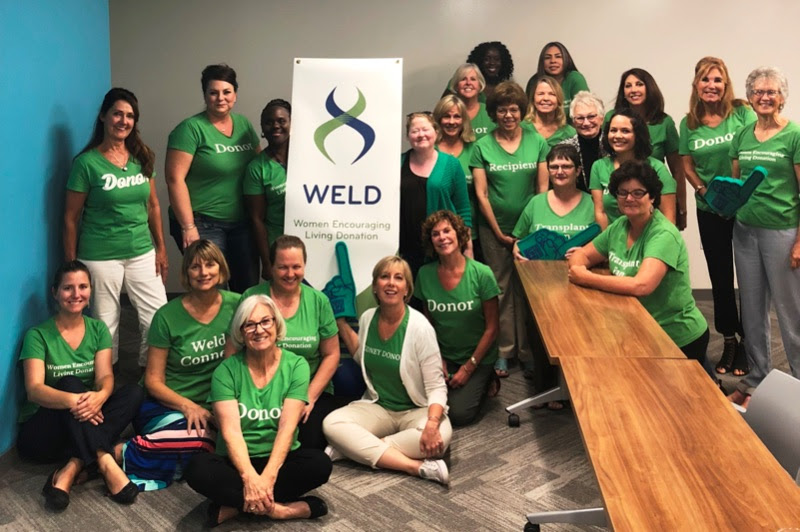
I heard about the San Diego organization more than a year ago and was excited to learn that they were exploring branching out. They’ve teamed up with Donate Life, which promotes organ donation (after death). Deceased donation alone can’t meet the need for organs—nearly 100,000 Americans are on waiting lists for a kidney, for example, and only about 20,000 transplants are performed each year. So, WELD—and other groups promoting living donation—hope to bridge that gap. I’m so happy to be a part of their efforts.

National Kidney Month and National Women’s Month

Yes, March is National Kidney Month and National Women’s Month. What do kidneys and women have in common, you ask? Both groups are underappreciated! We can hope that someday we will get to a point where we don’t need to introduce people to integral aspects of our culture and our history (like Black History Month). For now, though, we obviously do. And this month we highlight the critically important role women play in our society. Similarly, we highlight the critically important role the kidneys play in our body.

Do you know what your kidney function is? You may think you know what women contribute to daily life, but do you know what kidneys do? For starters, they remove dangerous toxins from the blood, regulate the amount of fluids in our body, maintain the salt content of those fluids, balance minerals, produce urine, promote bone health, and so much more.

I’ve had a healthy respect for kidneys ever since my son was in dialysis. For nearly 2 years, dialysis machines, doctors, nurses, and technicians did a masterful job of trying to approximate what healthy kidneys manage to do every day.

Yet even with doing their damndest to get this juggling act all right, dialysis could produce only about 20% of normal kidney function. One-fifth.

Like women, kidneys pull off much of their heroic daily work quietly, often without calling attention to themselves. That’s why when kidneys are starting to fail, we usually don’t notice. About 30 million Americans have chronic kidney disease—meaning they’re gradually losing kidney function—and most of them don’t know it. It’s called “the silent killer” because people usually don’t feel sick (and often look fine) until it’s dangerously far along. I know of people who just had a routine screening at a health fair, or went to the ER for a broken arm, or just didn’t feel right—only to learn, to their shock, that their kidneys were failing significantly and they needed to start dialysis ASAP.

My son knew he had kidney disease ever since it was diagnosed following a strep infection when he was in college. He was otherwise healthy and was told to monitor the condition with routine blood tests, which he did, never showing or feeling any symptoms. It was only at a routine checkup soon after his college graduation that the tests showed a precipitous decline in his kidney function. Within a month he was having surgery to put in an access point for dialysis, in 3 months he was undergoing dialysis 3 days a week, and close to 2 years later, he was welcoming my left kidney into its new home. It’s lived there happily since 2006, by the way. (My right kidney is managing fine without it.)

So, this month, please make an appointment to have your kidney function checked with a simple blood test. (And be sure to thank a woman every day!)

5 Truths about Becoming a Living Kidney Donor

There are still many myths about what’s involved in donating a kidney, and here are a few. I first included these in an article in 2017 and have already needed to update a couple of them because many aspects of the process have gotten easier. How many of the questions can you answer correctly?

Photo by Pixabay on Pexels.com

True or False: The surgeon removes a rib to get to the donor’s kidney.

False: Thanks to minimally invasive laparoscopic surgery (the standard of care), I had two tiny slits and a three-inch bikini incision.

True or False: Donors must be young.

False: More than a third of living kidney donors are over 50. It’s the health of the kidney–plus the donor’s overall health–that counts. I was 58 when I donated mine.

True or False: Donors stay in the hospital for a few weeks.

False: A typical stay is now 1 or 2 days.

True or False: Donors need to miss work for 3 to 6 months.

False: I could have gone back to my sedentary job as an editor in 2 or 3 weeks. A laborer might need a couple of months.

True or False: There’s no turning back.

False: You can change your mind at any point.  My transplant nurse coordinator, social worker, psychologist, nephrologist, and transplant surgeon all assured me that I could.  My son would be told only that I had been eliminated.

I just discovered an embarrassing glitch (aka technological error) in this brief post, so I’ve corrected it and reposted. It’s drawn (and updated) from an earlier, longer post I wrote for WELD’s blog. The original 2017 article appeared on the National Kidney Foundation website.